

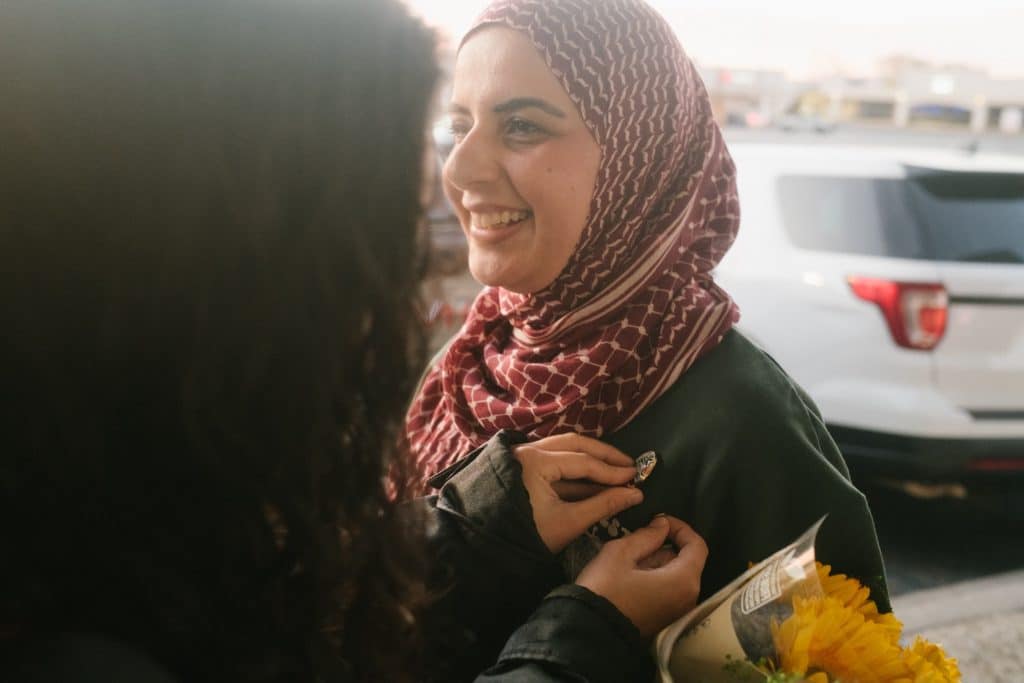
One month ago, Mondoweiss reported on what would be Leqaa Kordia’s final hearing to determine bail eligibility while confined in Prairieland Detention Center in North Texas. Now, she has returned to her home in Paterson, N.J., with renewed strength.
Kordia’s release was widely celebrated. Notable supporters like Zohran Mamdani lauded her release, as did organizations including the Council on American-Islamic Relations (CAIR) and Jewish Voice for Peace (JVP). Perhaps the best known Columbia protester who had been arrested, Mahmoud Khalil, also met with Kordia, joining her at a press conference at Paterson City Hall alongside his wife and fellow activist Dr. Noor Abdalla.
Kordia had been detained for a year, with Immigration and Customs Enforcement (ICE) and the Department of Homeland Security (DHS) claiming a student visa expiration as the reason for her arrest. However, throughout litigation, DHS lawyers alleged that Kordia was potentially tied to terrorism through bank transfers – a point that was proven false when her lawyers presented substantial evidence identifying payments as remittances to family members who had no ties to terrorism. DHS also pointed to Kordia’s arrest at a protest outside Columbia University during the campus demonstrations of 2024, which DHS alleges were “pro-Hamas” and supportive of terrorism.
After the judge’s order to release Kordia was appealed by DHS twice, her third hearing set her bail at $100,000 and facilitated her subsequent release.
One month after leaving Prairieland, Kordia remains steadfast and determined to shed light on injustice – both in Palestine and in the United States. In an interview with Mondoweiss, Kordia speaks about life following her detention, the friends she made in confinement, and her identity as a Palestinian.
Mondoweiss: Leqaa, thank you so much for speaking with us. What have you been up to since you’ve been released?
Leqaa Kordia: It’s been catching up with family, spending time with friends, alongside telling the story. I would like to say telling the story, not advocacy – just simply telling my story and the story of the ladies who were detained with me.
Can you tell me more about the strength you gained from friends you made inside and how your release felt knowing how many have remained inside?
So basically, we were a lot of women in one place, trapped in one place. We ate together, we laughed together, we cried together. If somebody was sick, everybody was around trying to help with the little that we have. With all of this, I spent 24/7 with these women. So they became friends, they became kind of family also. They would inspire me.
When I saw a pregnant lady who was in pain and needed medical care, but still, if you talked to her, she was smiling, trying to tell you a joke or something. Or if you saw an elderly woman who could barely walk, but still she would come to you when you were sick and try to make soup or something hot for you in a facility microwave, just to make you feel better – although she herself could barely walk. They inspired me with their strength. They inspired me with their unity. They’re very strong women. They’re daughters, they’re mothers, they’re teachers, they’re doctors, they’re housekeepers. They are just people who love to dream and love to live.
Are there any particular stories that you go back to in your head, or any moments inside that have really stuck out in your memory now that you’re out?
I mean, so many stories. It was a whole year taken away from my life, so it was a lot of stories. But there is this one story of an elderly lady in her late 60s. She went to her regular check-in, and she got arrested. They didn’t tell her why. They didn’t give her charges or anything for months. Then she was ordered to court. She appealed that.
But the story is that she had two grandchildren who were very attached to her – extremely attached to her – and they’re very little. She would cry almost every night, and she would be praying out loud to God: “Oh God, I just want to be dying among my family. I just want to be with my family.” She would literally tell me, “If the judge ordered me to stay in my son’s house and never leave, I will agree.”
There is another story of a refugee. She grew up in America. She came as a refugee to America when she was seven years old. She’s a green card holder. Her mother is a US citizen. Her siblings are US citizens. Her husband is a US citizen. One day, she received a message from ICE to come to check in. She had never checked in before because she’s a green card holder. She went for a check-in. They arrested her without explanation, without any reason. Since then, she’s been in detention now for, I think, six months. She’s been transferred to different facilities without explanation. She’s been denied bond. We’re talking about a refugee, a green card holder, married to a US citizen. This is another story of how much injustice there is in this place.
There was this lady who gave birth to her son. A week later, they arrested her. They deported the baby with one of the family members, but they kept her in custody for about three months, then they deported her. You see how cruel it is. They could have deported them together, for example. Even this, they didn’t give her. There are so many stories.
Tell me more about your arrest and where your head was at in the aftermath of that.
First of all, I’ve never committed any crime. I was very shocked and disappointed to know that the reason for my arrest in 2025 was because I practiced my freedom of speech. It was because I called for the end of the genocide. I called for a ceasefire. I called for peace. That was very disappointing and very shocking.
I’ve never committed any crime. I was very shocked and disappointed to know that the reason for my arrest in 2025 was because I practiced my freedom of speech. It was because I called for the end of the genocide.
If you talked to me at the beginning, I would have told you, “No, I will be out in like two weeks or so,” because I didn’t do anything wrong. I went to a protest against a genocide. This shouldn’t be something wrong. Every human should be protesting against a genocide. So I still had hope in the system, government, laws, everything. I was like, “No, I’m gonna be out in a short time.” When I appealed my first bond, I was really disappointed.
It was hard. It’s really hard to know that the land you always heard about as the land of freedom, the land where everybody can be whoever they want with whomever they want – it was very disappointing for me to be held for simply practicing my freedom of speech.
This all technically started at that protest outside Columbia in April 2024, and it feels like such a full-circle moment. How do you feel you’ve changed from this experience?
I’ve become stronger. Don’t forget that I’m a Palestinian – it runs in my blood. I would often be thinking of my family and my people in Gaza and Palestine, and their resilience would inspire me. Their strength would lift up my spirit. I would be inspired by them, their resilience, and their stories.
I’m a Palestinian. I can’t separate my story from the Palestinian story.
I would often also think of the Palestinian prisoners in the Israeli military prisons. There are thousands of Palestinians being held, many of them without trial, many of them without charges, being tortured, abused, denied basic human rights, starved on a daily basis. This would give me the power to continue to tell the story, to tell my story, because I’m one of them. I’m a Palestinian. I can’t separate my story from the Palestinian story.
We often compare ICE with the IDF, given that ICE has literally been trained by them. Did you notice similarities between ICE and the IDF’s conduct?
Yes. The humiliation, stripping people of their dignity, not calling us by names but calling us by numbers. Or seeing children – like this girl, she was 16 years old. She told me how ICE agents stormed her school and dragged her in front of her classmates. I saw this happen to my classmates in the West Bank.
My experience in ICE jails brought back all these bad memories of the West Bank and the checkpoints, the surveillance, the humiliation, the controlling. It’s extremely similar.
Israel is one of the only countries that arrests children and puts them in military prisons, without charges, without trials. And ICE is doing the same. They arrest children, they jail them, they kill them. My experience in ICE jails brought back all these bad memories of the West Bank and the checkpoints, the surveillance, the humiliation, the controlling. It’s extremely similar.
As a Palestinian, what is the thing that you wish people in the States more widely understood?
As a Palestinian, I have the right to live with dignity, to live with freedom, to live with justice. Calling for the end of genocide shouldn’t be a question. It shouldn’t be, “Is that right or wrong?” Every human being should be calling for an end to genocide.
Our very existence is being questioned. For my entire life as a Palestinian, I live just to prove or just to try to exist. It’s almost like we’re begging the people of the world just to see us as human beings. I grew up as a Palestinian being used to my voice being silenced, seeing other Palestinian voices being silenced, hearing about people who advocate for Palestine or call for the Palestinian voice being silenced. So it’s not a new thing, unfortunately. It’s sad, and it hurts me to say that I’m used to this. I don’t want to be used to this. I don’t want to be just living and that’s it. I want to live with freedom and dignity and justice as a Palestinian.
And what do you think people need to understand about what’s still going on in Palestine?
Palestine has been under military occupation, under apartheid, for many years. It didn’t just start. What’s happening in Palestine is genocide against the Palestinian people, no matter what their religion is, no matter what their color is. It’s every Palestinian person. It’s ethnic cleansing. It’s systematic ethnic cleansing. The Israelis are systematically cleansing the Palestinian people. We’re not just talking about Gaza. We’re talking about what’s happening in Jerusalem, the lands of ’48 [areas within Israel’s 1948 borders].
What’s happening in Gaza is devastating. Bombs are still dropping, snipers are still shooting, tanks are still rolling, destroying buildings, cars, properties. And people still don’t have access to medical care, basic medical care – something like a painkiller, for example. They still don’t have easy access to it. Food and water is very, very minimal in Gaza.
Israel says they’re allowing food trucks into Gaza. But most of the time, when the Palestinians – when my family – go to take this food, they’re shot dead. They’re killed by the Israeli military, by a strike, by a sniper. My family, for example – all of them, whoever’s left in Gaza – they live in tents. In the winter, they’re soaked with water. In the summer, they can barely breathe. You can’t breathe in these tents made of plastic and UN-donated flour bags.
So the situation in Gaza is very devastating, and we could take hours to talk about it. But in general, what’s happening in Palestine is not only about Gaza, not only about the West Bank, not only about Jerusalem – it’s about the entirety of Palestine. And don’t forget also the Palestinians in the diaspora. There are more than 5 million Palestinians who are refugees and denied the right to return to Palestine. Often, when we talk about Palestinian rights, some people might say, “Oh, just stop killing them, and that’s it.” And we forget about the more than 5 million Palestinian refugees outside of Palestine who are denied their basic right to return to their homeland.
What’s your favorite thing about Palestine? What sticks out in your memory?
Everything is beautiful about Palestine. The land, the trees, the sea, the soil. Everything is beautiful about Palestine. Everything speaks in a poetic way. I’m about to cry. I can’t tell you what’s my favorite thing about Palestine. Palestine is a piece of heaven on earth.
Have you stayed in contact with your friends that are still inside? How are they doing?
Yes, I am still in touch with the ladies inside. The situation is still horrible. The conditions seem like they’re getting worse every time. We’re trying to talk more about the conditions so they can improve them and do something better, but it seems like nobody’s caring. It gets worse and worse and worse.
For example, I’ll tell you the story of an Iranian lady who came to the US as a UN refugee. She was paying her taxes. She was going to her regular check-ins, and one day she got arrested by ICE. She suffers from a rare sickness. She needs special medical care. She needs proper food – she needs to be careful about what she’s eating, what she’s drinking, all that. And in ICE jails, the food is not edible. The water has things swimming in it. They don’t give you fruits or vegetables or anything like that.
So what happened to this lady is that she’s not getting even the basic medical care. Now she’s literally half paralyzed – the left side of her body became paralyzed, completely paralyzed. I asked, “What medication are they giving you?” She said, “Nothing.” “What food are they giving you? Are they giving you fruits, at least, or vegetables?” She said, “No.” So this is one of the stories of the ladies that I’m still in contact with.
I would love to hear more about your conversation with Rashida Tlaib while inside. Tell me about that.
Congresswoman Tlaib was very eager to see with her own eyes what’s going on. I had the honor to meet her in person. She’s an incredible person. She has this dedication to helping people and trying to do anything to improve things, to make the situation better.
What she’s said [about ICE detention] is completely true. What we know is that all of these ICE jails are privately owned businesses for different companies, and they’re working with the government. They’re profiting from the government, and the government is profiting from them. So yes, her statement is completely correct.
What was the thing about being inside that disheartened you the most, and on the other hand, what was the moment inside that gave you the most hope?
It’s interesting, because they’re both kind of connected, kind of the same. What really disheartened me the most was being denied my basic religious rights and human rights, and also thinking of my family in Palestine. All I could do when I was outside was go to protests calling for the end of the genocide, and when I was inside the jail, I couldn’t even do this. Being denied my religious rights would really, really break my heart and make me sad all the time.
But what lifts my spirit, either in the jail or now, is actually my connection with Allah. This gives me more strength and keeps me going, having this tranquility and this peace inside me – just the mindset that Allah took care of me. I’m not alone. This was very, very important for me.
Sam Judy
Sam Judy is an investigative reporter based in Dallas, Texas. He typically writes stories focused on criminal justice, civil rights, and the ongoing rise of fascism in the United States.
And the ghouls in the WH and Congress have the gall to lecture the world about the evils of other governments! The horrors being imposed on principled human rights advocates such as this courageous woman—and the thousands being abused in these facilities—would not have been possible except for the complicity of the Democratic Party establishment.
One should never forget the refusal to allow a Palestinian scholar a mere five minutes to speak at the “Democratic” Party convention, at which a weak and ineffectual Gaza genocide denier Kamala Harris was anointed. It’s almost like they wanted to lose the election to saddle the alleged child rapist with the catastrophes of Ukraine and Gaza.