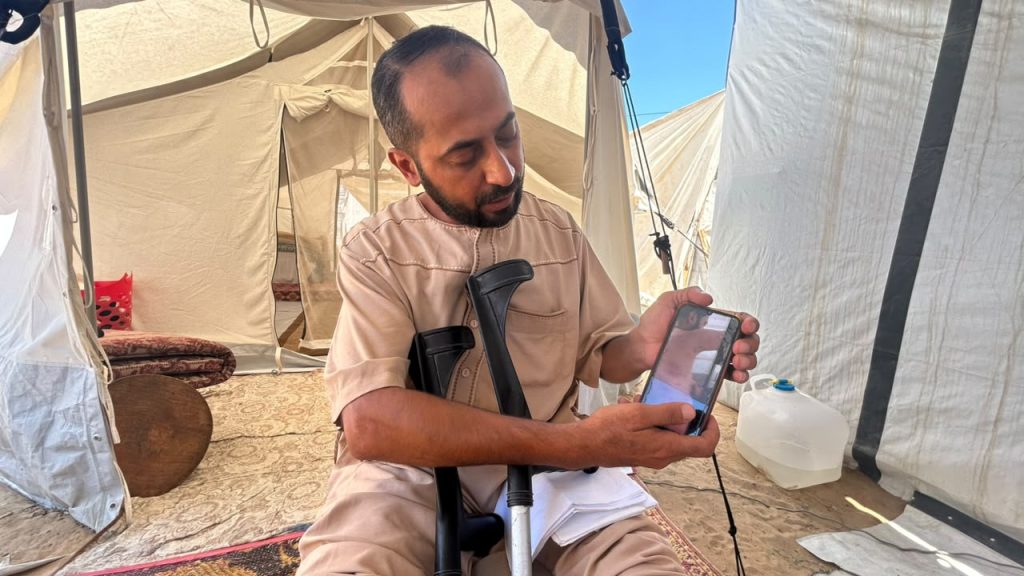
Mahmoud al-Aqqad’s hands shake as he tries to show his medical reports and the referral for treatment outside Gaza that he’s held for a year and a half, still unable to travel. It’s his only chance at recovery, or at least relief from pain that never leaves him, as he tries to escape the disability that keeps him from working or providing for his family.
The 41-year-old, recently diagnosed with an advanced case of seronegative rheumatoid arthritis that has deformed and eroded his bones, sits on a plastic chair outside his tent, leaning on the two crutches that have become his main way of moving, and his only way to get a little air outside a tent that turns into a near-oven in Gaza’s summer heat.
He is one of hundreds of thousands of Palestinians who were displaced to southern Gaza’s Mawasi area in Khan Younis, which the Israeli army designated as a so-called “safe zone” for civilians, even though it has launched multiple strikes on its tent encampments many times over during the past two years. The most recent strike occurred last month, killing a mother and her child and several others.
Al-Aqqad urges his oldest daughter, Amani, 10, to play with her younger siblings, Leen, 8, and Salah, 3, outside the tent so he can follow the news in peace, hoping to find some shred of information that could offer hope of treatment and a return to at least part of the life he had before he got sick.
As al-Aqqad scrolls through social media on his phone for the latest on Hamas’s dissolution of its government and preparations for a new phase, he hopes the move might be a prelude to Israel allowing patients to leave for treatment abroad under new understandings with Gaza’s incoming administration.
On July 6, Hamas announced that it had dissolved the “Government Follow-up Committee” that formed its administration in Gaza over the past two years, and that it was ready to hand over all government institutions to the National Committee for the Administration of Gaza (NCAG), which emerged from U.S. President Donald Trump’s “Board of Peace.”
But al-Aqqad says that nothing has fundamentally changed in Gaza since the Hamas announcement. For him, the basic measure after the government dissolution is whether he and thousands like him get a chance at treatment abroad, which he considers one of the crises from which Gazans suffer the most.
Others who spoke to Mondoweiss echoed similar sentiments, asserting that a political announcement in Gaza City means little on the ground in al-Mawasi. Nearly a week after Hamas said it would dissolve the committee that had governed Gaza and hand authority to a the new NCAG, residents, a human rights researcher, and a clan leader all described the same unresolved vacuum: no functioning courts, no police, and no clear timeline for when, or whether, any new administration will actually take control on the ground. Whether that changes anything for the two million Palestinians still living in tents, they agreed, depends less on who holds power in Gaza than on what Israel allows that power to do.
The situation is made worse by the fact that the current government’s ability to maintain public order and curb looting and lawlessness is being directly obstructed by the Israeli army as part of its ongoing hunt for all Hamas-affiliated civil government personnel, al-Aqqad says.
“With the targeting of police stations and security agencies, and the assassination of many of their personnel to prevent any attempt to bring order to the streets, the Israeli occupation forces deliberately created an environment of chaos,” he explained. “Especially around securing humanitarian aid convoys or settling daily disputes arising from scarce resources and overcrowding in displacement camps.”
“We want to return to life in any form,” he added. “Talking about which authority governs Gaza isn’t the real measure. The real measure is whether that will be reflected in our lives or whether they stay as they are.”
For al-Aqqad, he no longer cares who governs or what politics they hold. All he cares about is what they can actually deliver — and whether Israel will let them. “I might die after this disease has ravaged my body,” he said, explaining that just months ago, he was diagnosed with another illness linked to his original cancer diagnosis.
His current circumstances are a far cry away from how his life was like before the war, when he worked as a home electrician. Then the Israeli army destroyed his home like so many others’, he says, and today he looks at his children and wife and grieves over what’s become of their circumstances — his children forced to carry water jugs across long distances because he’s no longer able to.
“I might die, and leave behind the family I love, and who love me, because I don’t have access to treatment,” al-Aqqad said, weeping. “What do I gain from any change in Gaza’s governance if it isn’t my survival?”
“We’re waiting for the hoped-for change to happen, for the National Committee to come in and bring life back for people,” he added. “If that doesn’t happen, then nothing has happened — because here, the healthy and the sick are all among the dead.”

The living dead
The frustration gripping al-Aqqad reflects that of many Gazans, an extension of Palestinians’ past experiences since the war began, which have taught them not to be optimistic given what they see as Israel’s continued refusal to honor any commitments, especially the ceasefire agreement between Hamas and Israel that took effect on October 11, 2025.
That same feeling grips Muhammad al-Assouli, 38, who believes change won’t come easily, and that judging the outcome of Hamas’s announcement last week depends on the condition of two million Palestinians in Gaza — whether their nonexistent life continues as is, or whether they feel any improvement, however small.
Yet al-Assouli also speaks with a sense of cautious optimism. Sweating as he carries jerrycans of drinking water he rushed to fill from a truck at his displacement camp, north of al-Mawasi, he says that the inhuman life most Gazans have lived through for over two-and-a-half years might finally ease.
He believes that simply trying might produce positive results in Gazans’ lives, and that Gaza shouldn’t surrender to reality, but do everything that strips the occupation of its pretexts. Foremost among them is Hamas relinquishing governance, like it did last week.
Al-Assouli graduated in social work in 2005 and worked in a household goods shop. He now says he grieves over his children’s situation: his eldest son, Akram, 9, rushes with his three younger siblings as the blazing sun burns their heads and bodies, trying to fill more jugs so the family doesn’t face the same water crisis it experienced days earlier. “This is our routine: chasing water, food, and other necessities we don’t have,” al-Assouli said, adding that any movement toward ending the catastrophe they are living through feels like “a glimmer of hope in a dark tunnel.”
People are drowning, he says, and clinging to whatever they can. Right now, that means dissolving the current government and making way for the NCAG.
Joking with some of his neighbors about their dire situation, he calls on the world to put an end to the Nakba that has befallen Gaza and to treat the dissolution of Hamas’s government as the start of change. “It is the right of the tormented to return to living as human beings” he said. “We are dead while still alive…we want life.”

A ‘structural crisis’ in governance
Researcher and human rights defender Dr. Hussein Hamad describes the humanitarian situation in the Gaza Strip as having “moved past the stage of catastrophe to become a historical precedent in the systematic destruction of the means of life.” According to recent reports from the Integrated Phase Food Security Phase Classification (IPC), the highest famine-monitoring body in the world, hundreds of thousands still face “catastrophic levels” of food insecurity amid continued strict restrictions on the entry of relief and medical aid.
But the result of the catastrophic humanitarian situation are only compounded by the existing fragmentation of Gaza’s administrative landscape, Hamad says, describing a “compound structural crisis in governance and law enforcement institutions.” Yet for Hamad, the crisis wasn’t born from the genocide, clarifying that “it is an extension of years of Palestinian division that produced a distorted reality with two governments: one nominal, in the West Bank, and another de facto, in the Gaza Strip.”
The human rights defender explains that Gaza currently lives in an unprecedented state of administrative and political vacuum, where authority is theoretically contested by three parties: Hamas’s government in Gaza, the Palestinian Authority’s (PA) government in the West Bank, and the NCAG that emerged from the Board of Peace.
He points to Israel’s direct targeting of government and administrative personnel as the core obstacle: even after Hamas tasked a caretaker committee with preparing the handover, daily bombing risk has made civil administration, in his words, “a nearly impossible task, fraught with the risk of death.” As a result, he says, Hamas remains the only real, cohesive authority still functioning on the ground, whatever its formal resignation from direct governance.
The collapse extends to the justice system itself. With government headquarters and infrastructure targeted, executive and judicial authority has been “almost completely absent,” he says, courts have stopped functioning at every level, and the basic mechanisms of summons, arrest, and enforcement have broken down.
Police stations and security personnel have suffered the same fate, he adds, describing repeated targeting and assassinations aimed at preventing any force from imposing order on the streets. He argues this has left a vacuum of chaos that falls hardest on civilians, particularly in securing aid convoys and resolving the daily disputes that erupt over scarce resources in overcrowded displacement camps.
The human rights defender says the absence of the public prosecution and executive police force has forced society to resort to customary alternatives, such as protection or reconciliation committees, village elders, or senior family figures to settle disputes and maintain a minimum level of civil peace.
But despite the importance of this societal role in preventing total collapse, Hamad believes it cannot serve as a substitute for the rule of law, and does not guarantee justice according to human rights standards. In fact, some cases may instead be subject to the balance of family and tribal power, he stresses.
Clans ‘are not a party to governance’
Sheikh Tareq al-Astal, head of the National Gathering of Clans and Families, agrees with this assessment, affirming that “Palestinian clans are not a party to governance or the exercise of power, but rather play complementary social and national roles that serve the community and preserve its cohesion.”
For al-Astal, the main role of such tribal bodies is to “strengthen civil peace, community reconciliation, and contribute to easing citizens’ suffering within the limits of their capabilities.”
They cannot, in other words, be a substitute for official institutions or the political system. “”Rather, they serve as a supporting social current for community stability,” he clarified. “As a general principle, public affairs should be managed through legitimate, nationally agreed-upon institutions.”
Anything more than that would be to “use the clan structure outside its natural role,” he says, which he regards as unlikely to achieve lasting success, given the politicization of Palestinian society and its understanding of “the distinct roles of both official institutions and social bodies.”
Based on his observations of developments on the ground, al-Astal believes that civil and service institutions still perform part of their duties within available capacities, despite the exceptional circumstances facing Gaza, and despite the significant impact of the war and destruction on institutions’ efficiency and ability to function.
While al-Astal considers it too early to issue a final assessment of the nature of the change — since judging that depends on what the coming phase will bring in terms of practical steps and implementation mechanisms — he affirms that the coming phase requires a government that enjoys the widest possible national consensus and possesses the competence and ability to manage humanitarian services and reconstruction.
For al-Aqqad and al-Assouli, none of this changes what they’re waiting for. Al-Aqqad still checks his phone each morning for any sign that the borders might open for patients like him. Al-Assouli still sends his children out each day to fill water gallons before the sun gets too high. Whatever else shifts in Gaza’s chain of authority, both men measure it the same way: not by who holds power, but by whether their families can finally stop living like this.
This story was published in collaboration with Egab.
Mohamed Solaimane
Mohamed Solaimane is a Gaza-based journalist with bylines in regional and international outlets, focusing on humanitarian, political, and environmental issues.