

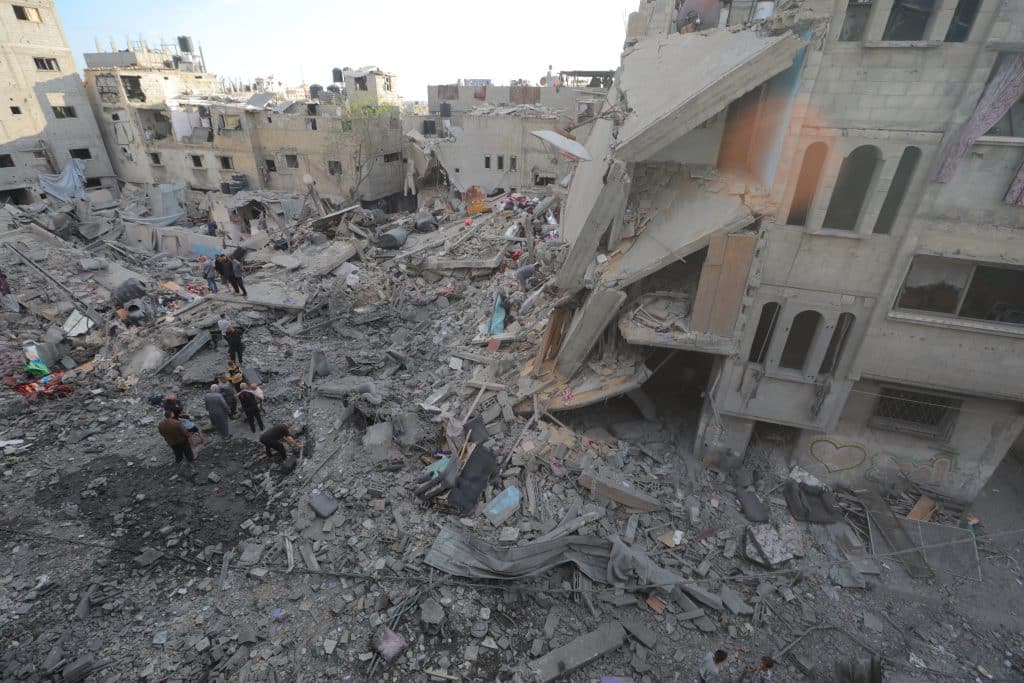
News that, in the midst of the genocide in Palestine, the German parliament was this week advancing legislation that would criminalize speech that denies that Israel has a “right to exist,” with penalties of up to five years in prison, came as a surprise to virtually no one.
This is, after all, the same Germany that perpetrated genocide first in Namibia and then in Europe, and is now actively and enthusiastically participating in the ongoing genocide in Palestine while brutally repressing all who dare speak out against it inside Germany.
Indeed, alongside Israel and the U.S., the German state today has the dubious distinction of being among those most captured by Zionist interests and most corrupted by Zionist ideology.
The German state even has an official policy (Staatsräson) dedicating the German state to the continued existence of the Israeli regime, and a formal declaration of Israel’s “right to exist” is required to acquire German citizenship. (No such declaration of Germany’s right to exist is required).
But the statement that the Israeli regime has no right to exist is not only a legally protected opinion. It is also demonstrably true, as a matter of both fact and law.
Of course, the statement that Israel “has a right to exist” has always been nonsense, unrooted as it is in either law or fact.
But this Zionist claim rings familiar to the ear of people in the West because it has been so often repeated as a pillar of Zionist propaganda, echoed by Western politicians benefiting from Israel lobby bribes, and by Israel-aligned media corporations dutifully buttressing the impunity of the regime.
Ask yourself if you have ever heard a similar refrain asserting Italy’s right to exist, or Canada’s — or Germany’s, for that matter? And yet the claim is constantly made that the Israeli regime (and only the Israeli regime) somehow has such a right.
The most obvious conclusion is that the regime and its proxies in the West are so deeply insecure about the legitimacy of the state, given the lawless and bloody history of its founding and expansion, that they have deemed it necessary to impose an enforced (and fictional) orthodoxy, rooted in an idea of Israeli exceptionalism and state-sponsored impunity.
But there is no such right in international law. None.
Inconvenient facts
Indeed, when I first entered the corridors of the United Nations in the 1980s, many states then existed that no longer existed when I left in 2023. Did the USSR, Czechoslovakia, Yugoslavia, East Germany, Tanganyika, Zanzibar, and the United Arab Republic have a “right to exist?” No. And neither does Israel.
States come and go, but none of them has a “right to exist.” As a factual matter, this is undeniable.
And yet, some still actively parrot the baseless Zionist fabrication that the Israeli regime somehow possesses it, others accept it without question, some (like Germany) even seek to compel others to declare it, and still others prohibit any attempts to challenge the lie.
There is no “right to exist” for states under international law. Thus, Israel cannot claim such a right.
Of course, states do have some rights. For example, states normally have a right to sovereign equality, to territorial integrity, and to self-defense under Article 51 of the UN Charter. But even these rights normally afforded to states are subject to conditions and qualifications, many of which would exclude Israel’s claim to them.
For example, the International Court of Justice has repeatedly found that Israel has no right to claim self-defense in its attacks on occupied Palestinian territories. (In essence, you cannot break into someone’s house and then claim a right to self-defense when they resist you).
Secondly, except for those agreed in treaties with Egypt (1979) and Jordan (1994), Israel does not even have defined borders. Much of the territory claimed and held by the Israeli regime is territory over which it has no legal claim whatsoever, and other territory claimed as part of the state is itself subject to challenge.
The regime can make no legal claims of territorial integrity over lands it unlawfully seized in 1967 and after, including East Jerusalem, Gaza, the West Bank, and the Golan Heights.
Its 1949 “Green Line” with Lebanon, Syria, the West Bank, and Gaza, is not an international border, but rather an armistice line merely meant to separate forces. The regime cannot claim it as a lawful border.
Moreover, given that the prohibition of the acquisition of territory by force is a jus cogens norm (the highest, peremptory rules) of international law and a binding obligation under the UN Charter, it cannot claim any of that land as part of its lawful territory.
Even the land claimed by Zionist forces in 1947 under the UN partition proposal is subject to legal challenge. Given that fact, the UN General Assembly had no authority under its Charter, or more broadly in international law, to overrule the will of the indigenous people or to create a settler-colonial state, and the Zionist forces had no right under international law to deny the self-determination of the Palestinian people or to acquire territory by force.
In fact, the International Law Commission has held that states must not recognize claims based on violations of jus cogens and erga omnes norms (binding on all states), such as those perpetrated by Zionist forces during the Nakba of 1947-48, and by the Israeli regime ever since. In addition, territorial acquisitions resulting from the threat or use of force impose obligations of non-recognition on all states.
The ICJ has recalled this principle with regard to the Israeli regime’s presence in occupied Palestinian territory as recently as 2024, when it found that the occupation of East Jerusalem, the West Bank, and the Gaza Strip is entirely unlawful, that it must end quickly and completely, and that all states are obliged not to recognize Israel’s presence in those territories and to work to end it.
Thus, as Israel has no defined territory, its legal claims to territorial integrity are significantly limited. And without recognized borders (and here we are not talking about a minor border dispute, but rather a lack of definition for most of the state’s territory), it even lacks a key criterion for recognition as a state.
To this day, almost thirty UN member states across Africa, Asia, and Latin America (including some of its closest geographic neighbors) do not recognize the state of Israel, and others have cut off diplomatic relations with the regime during the current ongoing genocide.
No sovereignty without equality
Finally, without lawful sovereignty, there can be no claim to sovereign equality.
Sovereignty, in international law, belongs not to states, but rather to people. The Israeli regime declares itself a “Jewish state,” and claims to represent its people.
But it does not represent the interests of non-Jewish persons (Muslim and Christian Palestinians) who are either present, or have a right to be present and part of the legitimate polity of that territory.
The ethnonationalist state of Israel can perhaps claim to represent 7.2 million (Jewish) constituents. It cannot credibly claim to represent the almost 16 million Palestinians who have a right to form part of the polity of that land.
Indeed, even if the regime forcibly settled every Jew on the planet on the land, it would still only represent a minority of the population, vis-à-vis the majority of Palestinians.
Excluded variously from equal representation (1948 Palestinians), any representation (Gaza, West Bank, and East Jerusalem Palestinians), or even the ability to exercise their legal right to return and participate (diaspora Palestinians), are the overwhelming majority of persons who have a right to form part of the polity.
Nor can Israel claim legitimate governmental authority. This is because international law establishes that “the will of the people shall be the basis of the authority of government,” which must be “expressed in periodic and genuine elections which shall be by universal and equal suffrage.”
Even a cursory examination of international law reveals that, to the contrary, the Israeli regime should not exist.
Excluding millions of the indigenous people of the land on the basis of ethnonationalist criteria is a textbook breach of that requirement. As such, the Israeli regime cannot claim legitimate governmental authority.
The ICJ has recently affirmed that the regime has no such authority in Gaza, the West Bank, or East Jerusalem. But the unequal terms imposed on Palestinians inside the Green Line, and the total exclusion of those in the diaspora, make the point equally applicable to the remainder of the Palestinian community as well.
And without that authority, the regime cannot claim legitimate sovereignty.
Similarly, the regime’s lawless conduct weighs against claims of sovereignty.
This is because modern conceptions of sovereignty include an element of responsibility (especially vis-à-vis respect for non-aggression, human rights, and international law) that a genocidal, apartheid regime with a continuous history of aggression, assassinations, crimes against humanity, and a chronic scofflaw status in the face of international legal rulings and UN resolutions cannot claim to have met.
From illusory rights to actual duties
Thus, as a matter of law and fact, the Israeli regime has no “right to exist.”
But the analysis should not stop there.
Even a cursory examination of international law reveals that, to the contrary, the Israeli regime should not exist.
The international community of states has obligations to cease recognition of the regime, to isolate it, and to work for its dismantlement and for the liberation of the Palestinian people from the regime.
Clearly, no one would today argue that Nazi Germany, or Apartheid South Africa, or Vichy France, or Khmer Rouge Kampuchea had a “right to exist.” Nor would we entertain claims for eternal colonial regimes in Algeria, India, Namibia, or Kenya. For the same reasons, no legal (or moral) argument could justify a right to exist for Zionist Israel.
To the contrary, international law requires that, where breaches of peremptory norms of international law are integral to the creation, expansion, and sustaining of a state (as was the case in apartheid Namibia and Rhodesia), such entities should not be recognized or accepted as legitimate states and should in no way be assisted.
Israel’s record is clear. It was founded on the breach of two peremptory (jus cogens) norms: the right to self-determination of the people of the land, and the rule on the non-acquisition of territory by force, as well as on the two highest crimes in international law: genocide and aggression.
Since then, it has refused the return of refugees and their compensation, and has continuously expanded its unlawful evictions, land theft, and colonization.
The United Nations and every major international human rights organization have concluded that the Israeli regime is guilty of apartheid and racial segregation, unlawful occupation, war crimes, crimes against humanity, and genocide.
The regime is now on trial for genocide at the ICJ, charges that the Court has found plausible enough to issue a series of preliminary orders (all of which the regime has ignored).
And the same Court has found the regime guilty of unlawful occupation, the forced denial of self-determination, the unlawful acquisition of territory by force, war crimes, apartheid, and racial segregation.
And the International Criminal Court has indicted the regime’s leaders for crimes against humanity.
For the full eighty years of its existence, the Israeli regime has held the distinction of being in breach of the highest number of UN resolutions and ICJ decisions of any country on the planet.
Today, the regime is unlawfully occupying Palestine, Lebanon, and Syria, attacking Lebanon, Syria, Iran, Yemen, and beyond, and perpetrating genocide in Palestine.
It has carried out assassinations across the region and has admitted to (indeed, bragged about) transnational terrorist attacks with booby-trapped pagers in Lebanon
Judged against the imperatives of international law, Israel is, in the strictest sense of the term, a rogue regime, illegitimate in its founding, and devoid of all legitimacy in its conduct ever since.
To declare that such a regime has a “right to exist” is an affront to generations of its victims, to international law, and to human decency itself. And the threat that it poses extends far beyond Palestine.
The Israeli regime is driven by a deeply racist and fundamentally violent ideology. It is armed with advanced technologies of surveillance and death, holds powerful conventional weaponry, and possesses stockpiles of nuclear, chemical, and biological weapons.
It has declared policies mandating the mass murder of civilians (the Dahiya Doctrine), the killing of its own citizens (the Hannibal Directive), and the potential nuclear destruction of the world (the Samson Option).
Its spies are active in countries around the globe, and its proxies are actively engaged in corrupting governments and institutions across the West.
Does such a regime have a “right to exist?” No.
In fact, dismantling such a regime and its replacement with a free Palestine with equal rights for all is not only a legal requirement, but also an existential imperative for all of humanity.
Craig Mokhiber
Craig Mokhiber is an international human rights lawyer and former senior United Nations Official. He left the UN in October of 2023, penning a widely read letter that warned of genocide in Gaza, criticized the international response and called for a new approach to Palestine and Israel based on equality, human rights and international law.


The author is correct. Former US State Department officials, including Robert Lansing and Majorie Whiteman, founded the American Society of International Law. They and current officials and practitioners codify the Restatements of Foreign Relations Law, including the Law of Nations (see Constitution Article I, Section 8, Clause 10 and The Paquete Habana case, 175 U.S. 677, 1900. The Restatement is employed by State governments and frequently cited by the Federal Courts and SCOTUS. It prohibits our government from recognizing any State which has acquired the qualifications through the use of threats or armed force or in violation of the UN Charter. I’ve pointed out repeatedly that the official record of US foreign policy decisions documents the fact that UNSCOP was designed to create a racist, theocratic state that violated the UN Charter, the US Constitution, and the civil rights of US citizens. I wish Mondoweiss would write an article about that someday. It’s the reason the Secretary of States was given unconstitutional sui generis power in 1950 to deport anyone, like Mahmoud Khalil and others without due process.
No country has a right to exist. People, on the other hand, do,
The most abhorrent aspect of this conflict, especially in the last 20 years, isn’t necessarily Israel’s bad behaviour—which is utterly disgusting and the antithesis of the humanistic values of Judaism it purports to represent—but the complicity and nauseating hypocrisy of western governments. They know what’s going on but are too cowardly, immoral or corrupt to do anything meaningful to stop the barbarity.
Nothing demonstrates the West’s mendacity more than the wholly performative recognition of Palestine. Britain, UK, Canada, France, et al, recognized Palestine but continue to look the other way as the territory that would form this new country is being literally of its indigenous people. They continue to host Israelis who are directly or indirectly committing genocide, provide weapons and provide diplomatic cover to the Apartheid regime. They allow the sale of stolen WB land to Jews in synagogues in London, Toronto and US cities. Sickening.
One can’t help but conclude this indifference to the suffering of millions of Palestinians isn’t primarily driven by self-interest (e.g. Israel lobby donations), but racism. Politicians seem to tacitly agree with the much lionized President/ghoul of Israel who declared that there are no innocents in Gaza, and with their former defence minister, ICC-wanted war criminal Gallant who called Palestinians “human animals”.
Agree!
One can also phrase it differently:
Israel has no right to exist as “the state of the Jewish people”. It should be the state of all the people who belong to the territory, with equal rights for all.
Or put differently: Israel has no right to exist as a racist state. No state has
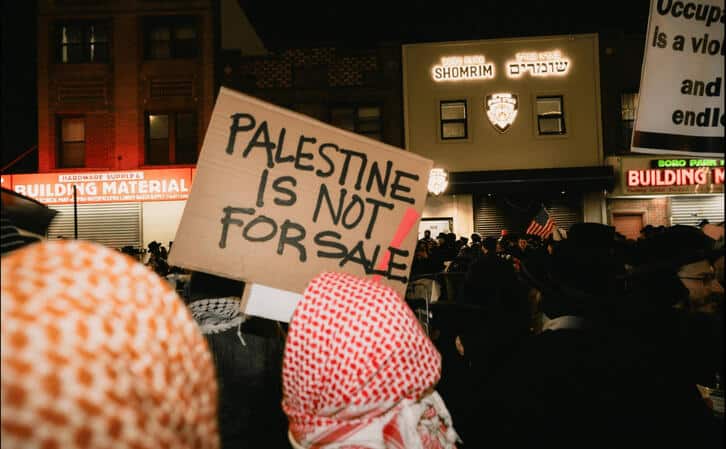
“… the German parliament was this week advancing legislation that would criminalize speech that denies that Israel has a “right to exist,” …”
Haredim and Zionism – Wikipedia
“There are a number of Haredi groups which not only oppose Zionism, but also do not recognize the State of Israel….The largest anti-Zionist Hasidic group is Satmar, which has around 100,000 adherents worldwide (as of 2006). The group’s position was crystallized by their leader, Rabbi Joel Teitelbaum, who authored comprehensive and polemic tracts detailing his opposition to Zionism. He encouraged his followers who live in Israel to form self-sufficient communities, rejecting social state benefits, and not to vote in Israeli elections. “
Will the German legal system prosecute members of these Haredi groups?
It is the first time when I hear this stated bluntly and unequivocally; maybe Prof. Finkelstein may have said it before.
“The most obvious conclusion is that the regime and its proxies in the West are so deeply insecure about the legitimacy of the state, given the lawless and bloody history of its founding and expansion, that they have deemed it necessary to impose an enforced (and fictional) orthodoxy, rooted in an idea of Israeli exceptionalism and state-sponsored impunity”, as the author said.
The so called “state of Israel” has no legitimacy whatsoever; this entity was created by terror and has lived by terror for 78 years. It is illegitimate according to human justice and especially and primarily, according to the divine justice. The Neturei Karta rabbis stated that after the destruction of the second temple, it was God’s injunction that Jews never returned to the historic land of Israel. In the 20th century, this command was trespassed. The Jews in Isreal sowed hatred and resentment, blood and destruction in Palestine, around it and into the whole world.