

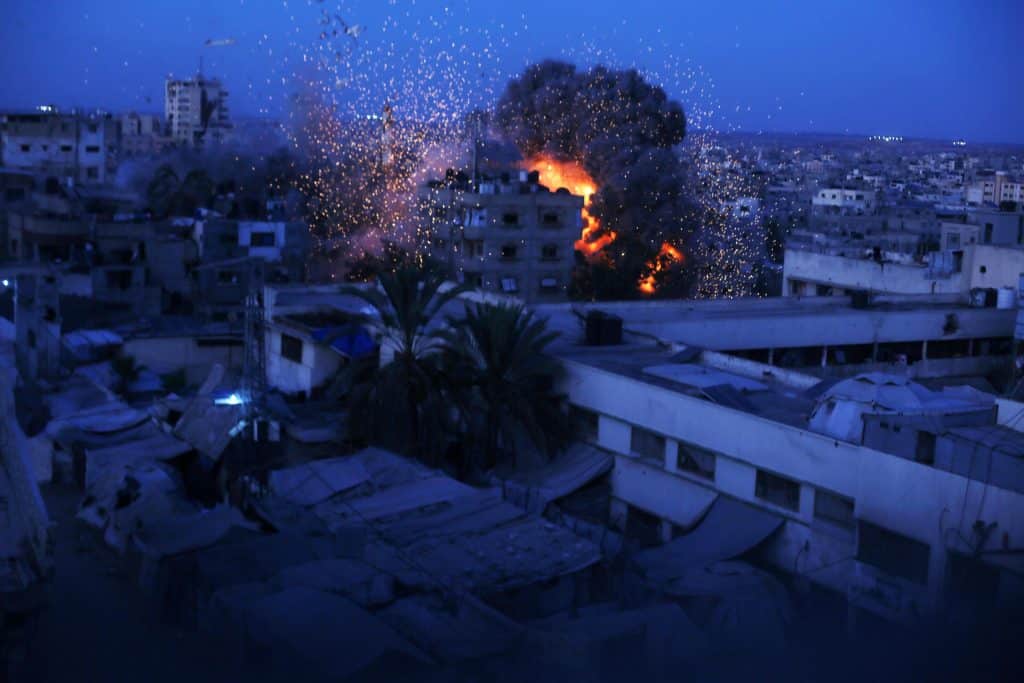
Not long after U.S. President Donald Trump announced on July 31 that a “historic” agreement for the “complete disarmament of Hamas” and Israel’s progressive withdrawal from Gaza had been reached, Israel launched an intensified series of airstrikes across the Strip, killing 19 people in Gaza in a single day on August 3. The attack confirmed for people in Gaza what they already knew: Israel would not abide by any agreement that doesn’t see Israel’s total control over the Strip.
The new framework put forward by Trump’s so-called “Board of Peace” on Thursday claimed that disarmament would take place in stages and would be met with subsequent Israeli withdrawals, while Hamas officials outlined that the movement would only hand over its offensive weapons if Israel ceased its campaign of assassinations and airstrikes, itself a flagrant violation of the so-called “ceasefire” signed in October 2025.
Yet over the weekend, Israel launched a series of strikes targeting displacement camps and a pharmaceutical warehouse at al-Aqsa Martyrs’ Hospital, where a fire destroyed roughly half of the facility’s medical supplies. The renewed bombardment also drove the death toll to its highest level in a single month for that year, reaching 152 people, according to the Palestinian Ministry of Health in Gaza. Among the slain are 21 children, 14 women, and four elderly people, figures the Ministry said underscore the impact of the escalation on civilians and densely populated residential areas.
These Israeli violations follow the same pattern which residents in Gaza have grown accustomed to: Hamas offers a concession, and Israel further escalates hostilities to keep the military pressure and perpetuate the genocidal war. The renewed attacks have deepened skepticism among many in Gaza who say the violence overshadows hopes raised by Trump’s announcement.
“The reality on the ground gives no indication that Israel is moving toward a genuine resolution,” Eyad Awadallah, 55, a resident of Gaza City living in a tent in Tal al-Hawa with his 6 family members, told Mondoweiss. “Nor does it suggest that Israel intends to honor what Trump announced about reaching an agreement and ending the war.”
“We have become accustomed to the usual stages in any agreement with Israel,” he added. “The Palestinian side fulfills its commitments, carries out its obligations, and makes painful concessions; Israel evades its responsibilities and continues its relentless war against Palestinians.”
Awadallah also said the latest escalation sends a broader political message. “I believe this is a clear message from Israel to Palestinians in Gaza and to the world,” he explained. “It is saying that it does not feel bound by any decisions, that the final word belongs to Israel. Even when the decision comes from Israel’s closest ally, President Donald Trump, Israel wants to demonstrate that it, not the American president, has the final say.”
Following the escalating bombardment, Hamas accused Israel of deliberately intensifying its military campaign in an effort to undermine the understandings reached with mediators, including the United States, regarding the continuation of the ceasefire agreement.
In its statement on August 2, Hamas said that the “criminal and frenzied bombardment” of Gaza, which resulted in the wiping out of entire families, was a “deliberate escalation” on Israel’s part, and aims to “disrupt the understandings reached with mediators, including the US administration, to complete the implementation of the ceasefire agreement.”
‘We don’t trust Israel, and we don’t trust America’
Shortly after the announcement of the agreement with the Peace Board, Hamas said that any progress depends first on Israel ending its military offensive and complying with the commitments of the ceasefire’s first phase, which included the entry of aid. The movement stressed that discussions over “heavy weapons” were tied to a broader political framework that includes a complete Israeli withdrawal from Gaza, the launch of reconstruction and early recovery efforts, the deployment of the National Committee for the Administration of Gaza (NCAG), the arrival of an international protection force, and guarantees for Palestinian self-determination and statehood.
According to the agreement’s published principles, civil administration and internal security would be transferred to the NCAG, which would operate under the principle of “one authority, one law, and one weapon.” But officials also said that the agreement does not require the movement to surrender its heavy arsenal to Israel or any non-Palestinian entity, but instead to place such weapons in secure storage under the authority of the NCAG. Personal firearms would remain subject to Palestinian law, with the committee serving as the sole authority for licensing and registration, according to the agreement’s text.
But for many Gazans, the details of the agreement didn’t matter. The more important question was whether Israel would abide by it, and the answer came within days.
“I don’t believe Israel has ever respected an agreement,” said Raed Darwish, 44, a displaced resident of Gaza City who lives in a tent with 11 family members. “Every time that it gets what it wants through military pressure, it abandons its commitments.”
Darwish pointed to the implementation of the first phase of the October 2025 ceasefire, arguing that Israel halted its bombardment only until Israeli captives and the bodies of deceased Israelis were returned.
“Once that was accomplished,” he said, “the bombing resumed with even greater intensity. Palestinians were once again subjected to daily airstrikes and killings.”
In his view, the latest proposal differs little from previous agreements, because Hamas had already accepted many of these conditions months earlier.
“Hamas agreed to relinquish governing authority and transfer responsibility to the NCAG,” he explained. “But Israel prevented the Committee from entering Gaza. The obstacle has never been the Palestinians.”
Like many displaced Palestinians, Darwish said his priority is not politics, but going back home. More than 1.9 million Palestinians remain displaced across Gaza, many unable to return because large areas near Israel’s expanded “Yellow Line,” which divides Gaza, remain inaccessible.
For Darwish, decades of failed negotiations have left Palestinians with little faith in promises made by either Israel or the United States.
“We don’t trust Israel, and we don’t trust America,” he said. “That judgment comes from experience. Since the Oslo Accords, Palestinians have repeatedly made concessions in exchange for promises of peace. Israel continued expanding its occupation while Palestinians continued dying. This war is only the latest example.”
Not all Palestinians, however, share Darwish’s view. Some believe Hamas prolonged the war by refusing Israeli conditions during its early stages. While acknowledging that accepting those terms would have been deeply humiliating, they argue that the continuing loss of civilian lives ultimately outweighed the political cost.
“Hamas should have accepted this condition from the beginning,” said Alaa Abu Asi, 39, a displaced father of 4, who lives in a tent west of Gaza City. “Instead, it kept rejecting it. The result was more destruction, more deaths, and more suffering. If it had been agreed earlier, perhaps we would not have reached this level of catastrophe.”
Abu Asi questioned the practical value of Hamas’s weapons throughout the war, noting that Israel continued assassinating senior Hamas leaders and carrying out military operations despite the movement retaining its arsenal.
Hamas says it will abide, but will Israel?
For many Palestinians, the issue of weapons remains deeply symbolic. Even those exhausted by nearly three years of war often regard disarmament as a form of national humiliation and a sign of defeat, despite Hamas’s insistence that the agreement calls only for freezing and storing heavy weapons rather than formally surrendering them.
For Sumaya al-Muqaddama, 25, a displaced mother living in Deir al-Balah, the debate over weapons is far removed from the realities of daily survival. “What matters to families in Gaza is simply returning home, even if those homes have been destroyed,” she said. “We want this suffering to end: the endless search for food and clean water, the unbearable heat inside the tents, and living among rats and disease.”
She said Palestinians enter negotiations with little leverage while Israel continues to exert military pressure. “Israel negotiates while continuing to kill civilians,” she said. “It uses bombardment, forced displacement, and the killing of women and children as a form of pressure. But Palestinians have no comparable means of applying that kind of pressure.”
Al-Muqaddama also accused Western governments of enabling Israel’s military campaign while portraying Palestinian resistance as terrorism. “The countries that speak about human rights continue supplying Israel with weapons, money, and political protection, while Palestinians defending their land are labeled terrorists.”
She recalled that previous ceasefire agreements had also promised humanitarian relief, but said Israel failed to fulfill those commitments.
“It did not even implement the humanitarian provisions it had agreed to,” she said. “Instead, aid deliveries were delayed and blocked. Every Palestinian knows this history. That is why people here remain skeptical.”
“We believe Hamas will abide by this agreement because it has little choice,” she added. “The real question is who will guarantee that Israel does the same.”
The continuing rise in civilian casualties and expanded airstrikes since the agreement was announced, she noted, bears this assertion out. She said responsibility now falls on the international community, particularly on President Donald Trump, who publicly celebrated the agreement, to ensure its implementation.
“If this agreement is to mean anything,” she added, “someone must guarantee that Israel honors its commitments. Otherwise, it will become just another agreement that ends the same way as the others: with more destruction, more displacement, and more lives lost.”
Tareq S. Hajjaj
Tareq S. Hajjaj is the Gaza Correspondent for Mondoweiss and a member of the Palestinian Writers Union. Follow him on Twitter/X at @Tareqshajjaj.


Israel stole Rashid Khalidi’s land. The U.S. is building an embassy on it | +972 Magazine — YouTube
It doesn’t matter where you put the borders, confiscation of private property remains prohibited and pillage is a war crime with no statutory limitations.
“I don’t believe Israel has ever respected an agreement,”
“The reality on the ground gives no indication that Israel is moving toward a genuine resolution,”…. “Nor does it suggest that Israel intends to honor what Trump announced about reaching an agreement and ending the war.”
_______________________________________________________
Assuming the foregoing is accurate, how best can that inform Mondoweiss and self-determination efforts going forward?