

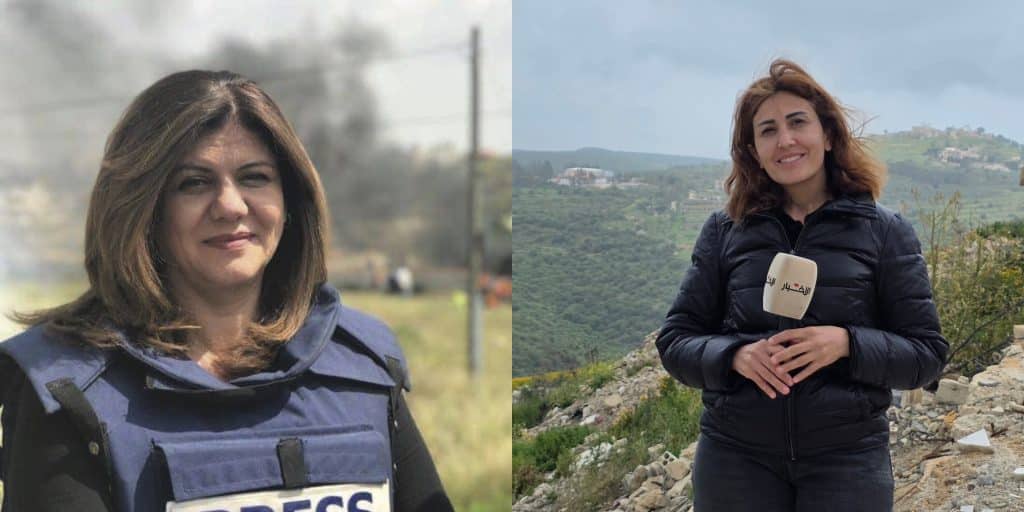
I am still under the tree. Beside me are Shireen and hundreds of journalists from Gaza and Lebanon, holding each other’s hands, trying to survive the monster of occupation.
On the day Amal Khalil was killed in southern Lebanon — following appeals she made to the Lebanese army and the Red Cross to evacuate her and her colleague, Zeinab Faraj, after being trapped in a building while reporting on Israel’s attacks on Bint Jbeil — I saw myself back under that tree with Shireen, the bullets surrounding us.
Four years ago today, a bullet fired by an Israeli soldier struck Shireen Abu Akleh in the head and killed her. On that day, the Israeli occupation’s war against journalists became visible to the whole world.
But since then, life for journalists in this region has only become harder with each passing day. The occupation’s crimes have not stopped. The killers were never held accountable. And international law did not prevent the occupation from killing again.
People ask me how I am doing after these four years. I tell them that more than 275 journalists have been killed in Gaza and Lebanon since Shireen’s assassination. If the world had held Israel accountable for that first crime, would we have reached this number?
That lack of accountability is what makes Israel’s current conduct possible, which has grown so brazen that it proudly and openly announces when it kills journalists, doctors, and paramedics. It did it with Anas Al-Sharif, Hasan Eslayeh, and Ismail al-Ghoul in Gaza, and with Ali Shuaib, Fatima Ftouni, and her brother Muhammad in southern Lebanon. In each of those cases, and in many others, the Israeli army issued official statements confirming they had been targeted, after previously threatening to kill them, sometimes openly on social media.
The entire world, its institutions, its human rights bodies, its international forums, bears responsibility for the bloodshed in Gaza, the West Bank, and Lebanon. Including the blood of journalists sitting in Israeli prisons right now: more than 44 held under administrative detention, living in isolation, hunger, illness, and thirst, with no clear date of release. Their only crime is being journalists.
Days ago, journalist Ali al-Samoudi was released after a full year of administrative detention. Ali had accompanied Shireen on the day she was killed and was wounded on the same morning by a bullet to the shoulder. He came out emaciated, with sunken eyes, and stories that would make anyone weep. He said they told him during interrogation, “You bothered us, Ali.”
His colleague Mujahid Al-Saadi, who was also with us that day, remains in Israeli detention. There is no news of his health or any date for his release.
Then there is Raneen Sawafta, a Reuters photographer and my friend, who miraculously survived after settlers attacked her while she was covering the olive harvest in the mountains of Nablus. They threw stones at her and beat her with clubs. She is still receiving treatment in hospitals.
And my colleague Mujahid Bani Mufleh, one of the finest Arabic editors in Palestine, was detained for eight months. Four days after his release, he suffered a stroke. He is still in the hospital in critical condition. A friend said, “I cannot imagine what Mujahid must have lived through in prison to come out this way.” Mujahid himself told me that two prisoners had died in his room. I felt, after hearing that, as though he had watched death enter the room, smelled it, and waited for it to reach him.
Every day, journalists in Gaza, the West Bank, and southern Lebanon leave their homes not knowing whether they will return. Each day is an attempt to survive: a missile from an Israeli aircraft, a bullet from an Israeli soldier, a settler armed with a club, attacking everything Palestinian.
And four years after Shireen, I am still under that tree.

This is why Joe Biden must be added to the list of war criminals. The Shireen Abu Akleh cover-up shows the cowardice of the Biden Administration.
A bit off this exact topic, but I think this is important enough to deserve mention: today the New York Times ran an opinion piece
The Silence That Meets the Rape of Palestinians… in wrenching interviews, Palestinians have recounted to me a pattern of widespread Israeli sexual violence against men, women and even children — by soldiers, settlers, interrogators in the Shin Bet internal security agency and, above all, prison guards….There is no evidence that Israeli leaders order rapes. But in recent years they have built a security apparatus where sexual violence has become, as a United Nations report put it last year, one of Israel’s “standard operating procedures” and “a major element in the ill treatment of Palestinians.” A report out last month, from the Euro-Med Human Rights Monitor, a Geneva-based advocacy group often critical of Israel, concludes that Israel employs “systematic sexual violence” that is “widely practiced as part of an organized state policy.”… our American tax dollars subsidize the Israeli security establishment, so this is sexual violence in which the United States is complicit….“Israeli forces systematically employ rape and sexual torture to humiliate Palestinian female detainees,” the Euro-Med report said. It cited a 42-year-old woman who said she had been shackled naked to a metal table as Israeli soldiers forcibly had sex with her over two days while other soldiers filmed the attacks. Afterward, she said, she was shown photos of her being raped and told they would be published if she did not cooperate with Israeli intelligence….Another Israeli lawyer, Ben Marmarelli, told me that based on the experiences of the Palestinian detainees he has represented, rape of Palestinian prisoners with objects “is going on across the board.”…B’Tselem, an Israeli human rights organization, documented “a grave pattern of sexual violence” toward Palestinians. It cited the account of a Gaza prisoner, Tamer Qarmut, who said he had been raped with a stick. Torture, B’Tselem said, “has become an accepted norm.”
Opinion | The Silence That Meets the Rape of Palestinians – The New York Times
C-Span’s Washington Journal, MS Now, Fox, CNN etc etc. Not one of these outlets do stories about Palestinian or other journalist that Israel has killed on purpose to shut them up. Silence is complicity.
https://cpj.org/special-reports/record-129-press-members-killed-in-2025-israel-responsible-for-2-of-3-of-deaths/
https://www.aljazeera.com/news/2026/2/25/israel-has-killed-more-journalists-than-any-government-on-record-cpj
This afternoon on Judge Napolitano’s “Judging Freedom” both former IAEA weapons inspector and Prof Jeffrey Sachs state what many are saying that the Trump administration has depleted U.S. missile stockpiles to dangerously small levels. Both once again confirm what most of us know the U.S. and Israel started this war with Iran. That Iran is in most ways winning.
They both address defense companies making billions, retired Generals etc being bought out etc etc. U.S. middle to lower income citizens being raked over the coals with rising prices, Wall Street types winning.
Prof Sachs: Does not hold back at all.
“Israel’s economy is basically now a war economy”…….”Israel is the new Sparta…a ruthless state, it’s business is killing, it’s business is spying, it’s business is assassination ” “Israel is a military terrorism state.” Man oh man Sachs cuts loose.
https://www.youtube.com/watch?v=OWosQyuae0g
Former IAEA weapons inspector Scott Ritter with Judge Napolitano at “Judging Freedom” Latest on Iran etc.
So worth it
https://www.youtube.com/watch?v=ZXvUpuhAIBk