

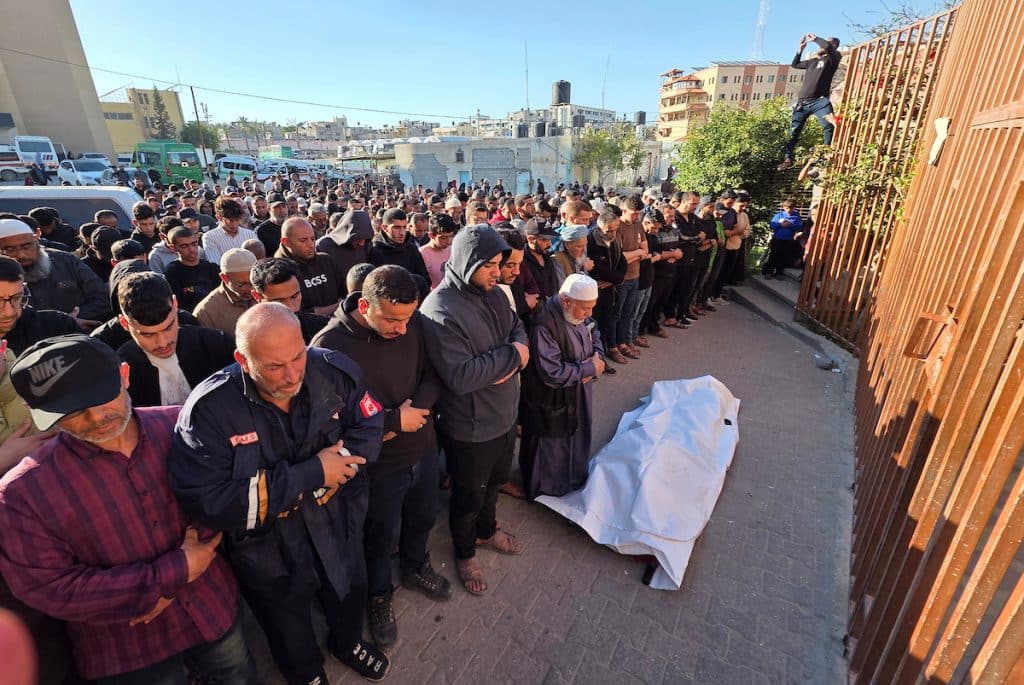
Six months after the ceasefire that was supposed to end the war on Gaza, the Strip is frozen in a post-apocalyptic limbo. The genocidal war has not resumed full-force, but neither is reconstruction underway, and Israel continues to restrict the entry of aid into Gaza as food shortages return. This may no longer be a temporary condition, but the new status quo.
The reasons are rooted not only in Israeli intransigence over the terms of the ceasefire deal or the issue of Hamas’s disarmament, but in the failures of the U.S.-Israeli positioning in the region in light of their stalled war on Iran and Lebanon. While those fronts remain unresolved, Israel and the U.S. have no path to closing the Gaza file, let alone moving it forward on terms that would benefit Palestinians. In other words, Gaza is paying the price for the faltering U.S.-Israeli strategic vision for the region.
Gaza is paying the price for the faltering U.S.-Israeli strategic vision for the region.
If there is one conclusion that can be drawn six months after the Gaza ceasefire entered into effect with U.S. President Trump’s “20-point plan,” it is that the end of the war in Gaza is farther off today than when it was in October, with the topic of reconstruction hardly even being discussed.
Gaza has never figured into Israel’s plans as a place whose people would be allowed to rebuild their lives. The reason is that Gaza remains a linchpin for its broader strategy for the region — one that is currently hitting a solid wall in Lebanon and Iran, and is consequently now being felt in Gaza.
Here’s how they’re all related.
Israel’s disunity of fronts
When the first Gaza ceasefire was reached in January 2025, Netanyahu stated that Israel accepted it in order to allow its army to regroup and focus on the Lebanese front and on Iran. Then Israel broke the ceasefire in March of that year and launched its first war on Iran in June.
When the second Gaza ceasefire was reached in October 2025, Netanyahu repeated the same “focusing on Iran” rationale for accepting it. In both Iran wars, the Israeli Prime Minister continuously claimed that he and his government were “changing the face of the Middle East.” This “change” included regime change in Iran and the destruction of Hezbollah’s fighting capabilities in Lebanon and the decapitation of its top military and political leadership.
Today, it is more than obvious that things in both Iran and Lebanon did not go the way Israel had planned. And amid all this, Gaza has been pushed to the bottom of the list of priorities, frozen in a state of a broken “ceasefire” in which Israel continues to launch daily low-intensity attacks on Palestinians that claim lives on a daily basis, but without any of the international outrage that had accompanied Israel’s conduct during the previous two-and-a-half years.
This is a far cry from where Gaza should be if the broad terms of the ceasefire were even lightly implemented. According to the ceasefire deal and Trump’s plan, Gaza should have been undergoing reconstruction by now under the aegis of a “national committee” of Palestinian technocrats, supposedly to be supervised by the Trump-led “Board of Peace,” both of which were announced in January alongside U.S. envoy Steve Witkoff’s announcement of the beginning of the second phase of the ceasefire. Then in February, various countries pledged up to $7 billion to the Board of Peace for the rebuilding of Gaza. By all measures, Gaza should be in a totally different place by now.
Yet the situation on the ground is vastly different: 98% of Gazans remain displaced, more than 80% of housing units stand as piles of rubble, most civilian infrastructure remains decimated, and residents continue to suffer from a lack of medicine, food, and clean water, while infectious diseases are spreading among tent encampments. Moreover, the crossings into Gaza, which Israel was supposed to open as part of the deal, have largely remained closed since the U.S.-Israeli war on Iran started.
Meanwhile, the Israeli army has continued its airstrikes and artillery shellings across the Strip. Israeli forces regularly open fire on Palestinians near the “Yellow Line,” the invisible and supposedly temporary border that cuts Gaza roughly in half. The result is a death toll of 834 Palestinians and over 2,300 wounded since the ceasefire was reached, according to the Gaza Ministry of Health.
This abject reality has become the new status quo, almost as if the Gaza front is awaiting the big “change” to sweep the rest of the region before its reverberations are locally felt.
Waiting for the Middle East to change
Last Sunday, the Israeli security cabinet met to discuss the possible resumption of the war on Gaza. This means that the Israeli cabinet is openly considering breaking the ceasefire brokered by Trump — along with Egypt, Qatar, and Turkey — and ending the supposed “peace plan” that Trump had proclaimed at Egypt’s Sharm al-Sheikh summit, where he boasted of ending a “3,000-year conflict.” The news of the cabinet meeting was reported by the Israeli public broadcasting corporation, but it received little media coverage elsewhere.
According to Israeli military analyst Amos Harel, Netanyahu might be considering resuming the genocide in order to strengthen his position ahead of the Israeli elections in November. This was hinted at by Israeli foreign minister Gideon Saar, who in late April justified the interception of the humanitarian Global Sumud Flotilla bound to Gaza in international waters with the possibility of escalation in the Strip.
However, any resumption of the war in Gaza would most likely be time-limited and end back at some sort of ceasefire that Israel breaches on a daily basis — just at a lower scale of intensity, and with a continuously deteriorating humanitarian situation that receives only intermittent relief.
In other words, a return to the same status quo. And why? According to all military officials, it is because there is no clear goal to be achieved in Gaza.
This is especially true if the real goal of renewed hostilities is tied to internal Israeli political calculations, which in turn are influenced by Netanyahu’s need to demonstrate some sort of achievement after the stalled campaigns in Lebanon and Iran. Neither he, nor his government, nor the Israeli military at large has succeeded in achieving any of the stated goals they set out to achieve in Iran, including regime change, let alone the decimation of the nuclear program.
Back in October, when Hamas accepted Trump’s terms for the ceasefire, it consulted the other Palestinian factions, which collectively agreed to the deal. But Trump’s idea of a deal wasn’t favorable for Palestinians, and after two years of what the entire world has now recognized as a genocide, the ceasefire’s framework guaranteed no accountability, no reparations, no end to the Israeli blockade, and no unity with the West Bank. Even the reconstruction was mentioned without any guarantees. Instead, Trump’s vision for Gaza was to turn it into a playground for investors.
This isn’t even to mention any broader Palestinian national demands for self-determination. The technocratic committee for the administration of Gaza was bound to Trump’s Board of Peace — not to the PLO or the Palestinian Authority (PA) — and last February, Netanyahu’s office officially rejected the technocratic committee’s request to enter Gaza because it had used a similar logo to the PA’s. Yet Palestinians accepted the terms of the committee’s formation due to the enormity of the calamity Israel has inflicted on Palestinians — in effect, the “shock doctrine” through genocide.
Yet even such terrible terms for Palestinians, which were framed by U.S. negotiators, remained unsatisfactory for Israel’s maximalist ambitions. If there is one part of the ceasefire deal that Israel implemented without any resistance, it is the splitting of the Gaza Strip in two through the drawing of the Yellow Line. Although it was nominally supposed to mark the first phase of Israel’s military withdrawal from the Strip, Israel simply saw it as the next step in total colonization, as confirmed by the Israeli army’s Chief of Staff, Eyal Zamir, when he said that the Yellow Line would be Israel’s “new border.”
And as the wars in Lebanon and Iran developed, Gaza faded into the background, and Palestinians’ hopes of beginning to overcome the genocide faded as well. Since Israel and the U.S. haven’t been able to conclude the war in Iran and Lebanon with complete Israeli military superiority in the Middle East, the region has been forced into a status quo of “no war, no peace.”
Israel had hoped that the outcome of the war on Iran and Lebanon would result in uncontested Israeli dominance in the region. That hasn’t happened yet, and the signs of it happening aren’t forthcoming. Yet without that strategic positioning of regional dominance, Israel lacks the capacity to end any war on any front. Crucially, however, it also lacks the capacity to go on and complete the ethnic cleansing of Gaza, especially with international criticism mounting and the army engaged in other never-ending fronts. The result? A continuation of the current dystopian, post-apocalyptic reality in Gaza.

Re The Big Picture: I claim that in the past few months I’ve seen a slew of articles written by pro-Israeli people that follow the same pattern: there’s the boilerplate condemnation of Hamas terrorism and Palestinian wishy-washiness followed by the speculation that maybe Israel refuses to negotiate and always chooses war, and gee whiz, maybe it’s not really ethical to lock people up without a trial, and maybe Israel is heading ( never actually getting there but always heading! ) towards apartheid.
Example: Commanders for Israel’s Security put out a 2026 assessment of the situation ( emphasis mine ):
https://en.cis.org.il/wp-content/uploads/2026/01/BT2026-Summert.pdf
The current Israeli government pursues a strategy of “endless war,” leading to creeping West Bank annexation, open-ended Gaza occupation, and increasing regional and global isolation. Its main components include:
…Accelerating de facto annexation in the West Bank, parliamentary declarations of sovereignty there, illegal settlement expansion (including in the strategic E1 area), and tolerance – if not encouragement – of settler violence…
…Deliberate weakening of the Palestinian Authority to the verge of collapse.