Ahmad Barakat sat across from Hamas security leaders and civilian government police officers, conducting interviews, but the whole time, he was waiting for the moment it would end so he could leave. He was afraid they would all be killed together, as Israel continues to hunt down and target every member of the Gaza government’s security apparatus, including civilian law enforcement. Police officers can be targeted at any moment, even when they’re with their children, and Israel justifies it by calling them “Hamas operatives.” The fact that they are civilian employees of what remains the governing power in Gaza doesn’t matter to Israel. And it doesn’t matter when a journalist interviews them for a media report.
Ahmad told me plainly that conducting those interviews meant placing his life on the line. He thought he might be killed at any moment. He went anyway, got the interviews, and came back safely.
Ahmad is a colleague I worked with eight years ago in Gaza City. After I left Gaza, I brought him on to help us secure the interviews I can no longer get myself. In recent weeks, after months of persistent attempts, the two of us finally reached Hamas government leaders and police officers. We were trying to understand what was happening inside the movement, including details about the militias operating in Gaza, about the security forces confronting them, and about the ongoing targeting of police. It was a real breakthrough, and it allowed us to publish last week’s report on Hamas’s campaign to confront Israeli-armed militias that are continuing to sow chaos across the Strip.
Hamas leaders rarely speak to the media in the detail we were able to include in our report. But getting there required Ahmad risking his life, which he informed me of after the fact.
What Ahmad went through is not unique to him. It is the daily reality of every journalist still working in Gaza. All of my colleagues know that Israel does not want images to leave the Strip, and yet, despite everything Israel has done to kill the people carrying those images, they keep on coming out of the concentration camp.
Journalism in Gaza is the most dangerous civilian profession in the world, perhaps second only to first responders and police officers. Israel targets journalists for reasons that go beyond the targeting of doctors, nurses, and others who provide essential services to Gaza’s people. But those killings are about eliminating humanitarian capacity and creating the conditions designed to bring about the destruction of Palestinian society. The targeting of journalists, however, is about something else: erasing the truth before it can travel beyond the barbed wire. I felt that fear on every assignment when I was still there. Drones overhead, warplanes coming and going, random bombardment at all hours. At any moment, you think: it could be now.
Since then, I have lost more colleagues than I can count. A year ago, Israel targeted one of my colleagues who secured me several important testimonies from Gaza, the much-beloved Hasan Eslayeh. Israel falsely accused him of being a Hamas operative because he interviewed Hamas leaders in the past and was photographed in a photo-op with Yahya Sinwar.
While Hasan survived the initial attack, he knew they intended to kill him, and he told me as much over the phone when I called him following the strike. At the time, he told me, “They may target me inside the hospital, in this room of mine.” And that’s exactly what they did a month later. He was in Nasser Hospital’s burn unit, still recovering from the first assassination attempt, when an airstrike ended his life.
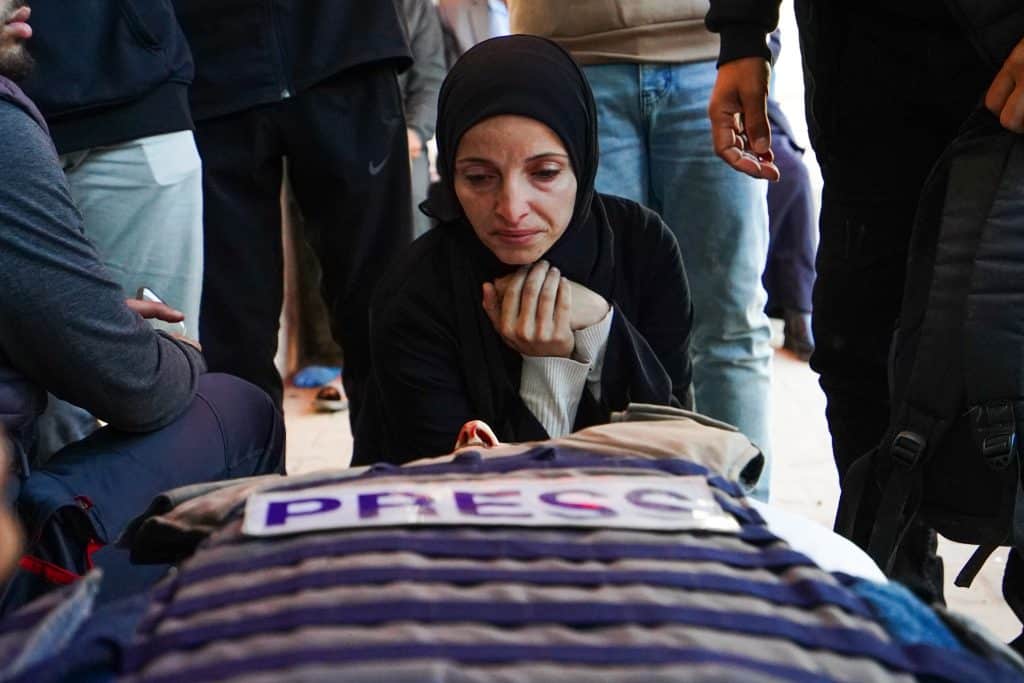
Throughout this genocide, journalists in Gaza have not stopped. Not one has retreated. They have stood firm against explicit Israeli threats, telling stories, publishing what they witness, exposing what is being done to Gaza and its people whenever they can. They have paid with their lives: more than 250 journalists have been killed directly in this war. Those who remain keep going without surrender.
They deserve the world’s recognition for what they have done, and for what they continue to do.