

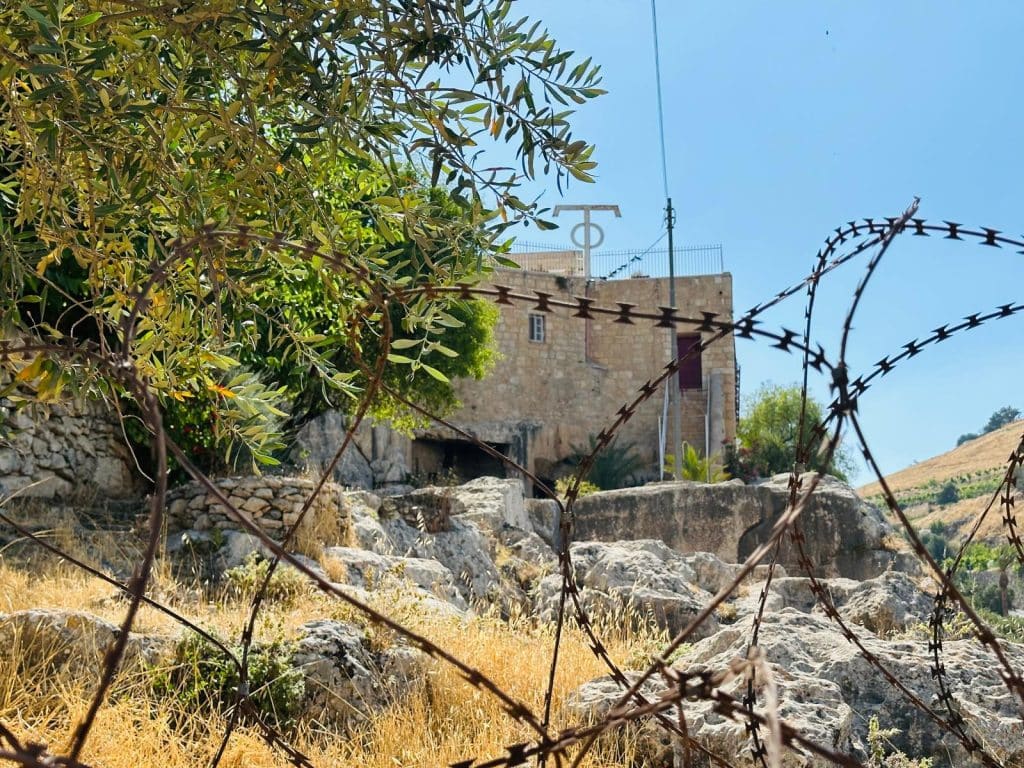
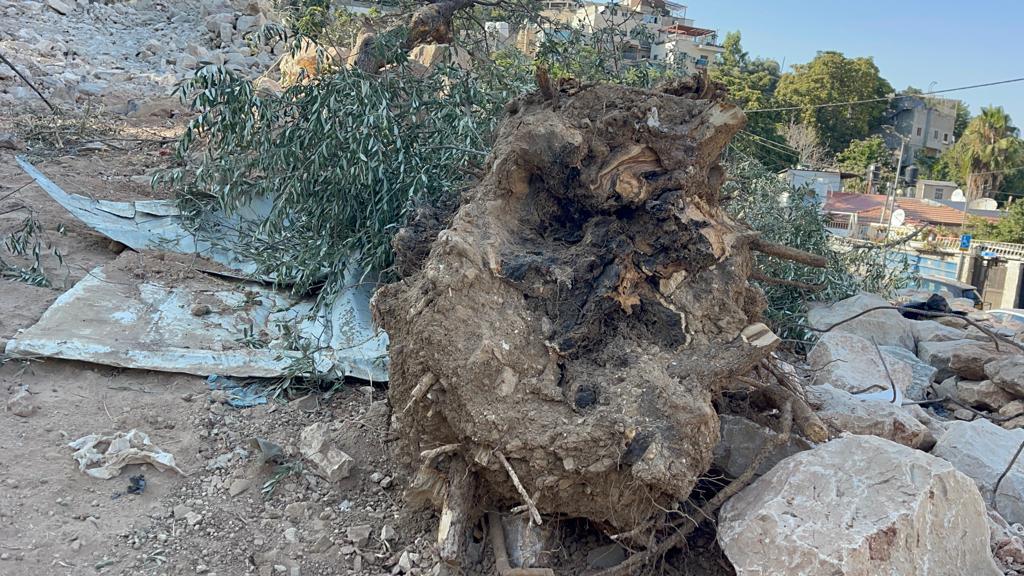
In the predawn hours of June 15, 2026, heavy Israeli military vehicles stormed the Greek Orthodox Patriarchate’s lands in Wadi Rababah, Jerusalem. The shouts of Israeli soldiers mingled with the cracking of ancient tree branches and the uprooting of crops, a flagrant violation of the church’s legal ownership rights.
The bulldozers were part of a systematic, years-long Israeli effort to erase Jerusalem’s Palestinian character by seizing properties from its residents through a particular set of legal and administrative measures. The raid was also the latest in a string of Israeli attacks targeting church properties around Jerusalem.
The latest raid was made possible by an administrative instrument known by Israel’s Jerusalem Municipality as “gardening orders” — a mechanism deployed to seize control of supposedly “neglected land” under the guise of “landscaping.”
The cumulative effect of these measures is meant to impose new facts on the ground by restricting owners’ access to their properties, residents say. In this sense, the church raid isn’t an isolated incident, but it is also tied up in Israel’s broader attempts to erase the presence of Palestinians in Jerusalem, both Christians and Muslims.
Attempts to erase Jerusalem’s Christian presence
Damage from the raid was not limited to physical destruction; the Patriarchate’s representative was forcibly expelled from the property, and his belongings were confiscated. The land belonging to the Patriarchate was then encircled with barbed wire and iron gates, not only severing it from the adjacent monastery, but from its own archeological and religious past stretching back thousands of years.
In a statement, the Patriarchate affirmed its ownership of the land, registered as Plot 6, Basin 29985, and declared the Israeli confiscation to be without legal basis — the order cited by the authorities had been issued in April 2019, but it expired in April 2024, rendering it legally void. The statement further characterized the uprooting of trees, the expulsion of the lawful custodian, and the enclosure of church land as setting a “dangerous precedent.”
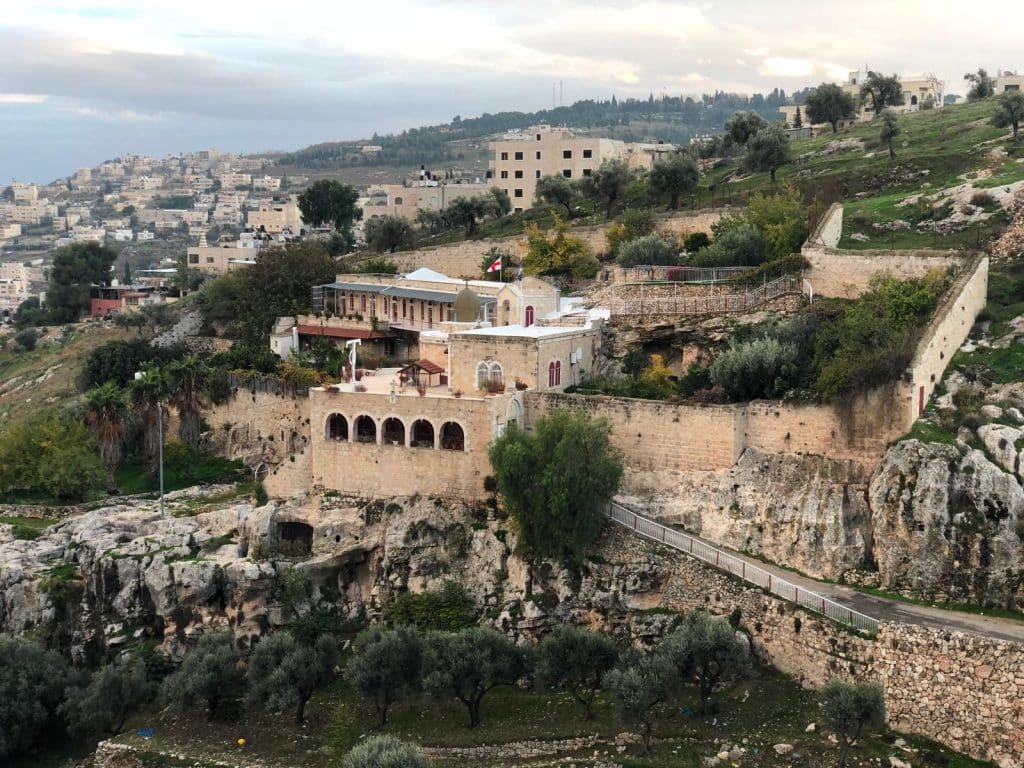
The attack on the Greek Orthodox Patriarchate was not the only recent attack on church property. In 2025 alone, the Rossing Center for Education and Dialogue documented 52 attacks on Christian sites, including vandalism, offensive graffiti, the desecration of statues, and the throwing of trash and stones by Israelis.
This has led Palestinian Christians to fear that Israel is also aiming to erase Jerusalem’s Christian character through a series of legal and extra-legal means.
On March 29, 2026, Israeli forces blocked the Latin Patriarch of Jerusalem, Cardinal Pierbattista Pizzaballa, from entering the Church of the Holy Sepulcher to celebrate Palm Sunday Mass, sparking controversy and accusations that Israel was clamping down on freedom of religion under the pretext of “public safety” amid the Iran war.
But such restrictions are not confined to major religious occasions. Hostile behavior toward Christians has become a recurring experience that many describe as a systematic narrowing of their presence in the city. Clergy and worshipers sometimes face verbal and physical attacks in the vicinity of the Old City, including spitting, slurs, and harassment by extremist settlers.
“I grew up in a Jerusalem completely different from the one we see today,” said M.B.J., a Christian resident of Silwan who preferred not to be named. “The past four or five years have brought a dramatic shift in the character of this city. This is not merely an aesthetic change to the urban landscape — it is a fundamental transformation of the city’s social and spiritual fabric. Christians in Jerusalem, who are an inextricable part of its history and identity, feel increasingly like ‘unwelcome guests’ in their own homeland.”
This feeling reflects a deep fear that their presence in their homeland as Christians is being systematically eroded, M.B.J. added.
“Gardening orders” as a pretext for colonial land grabs
A visitor to the area around the Greek Orthodox church today would struggle to imagine that this land was once part of an open Palestinian agricultural landscape. In the past, the church grounds were considered a natural extension of Silwan’s agricultural fields. Today, the space is encircled by the trappings of Israeli colonization: iron chains bearing the Star of David, signs and instructions in Hebrew, and restricted pathways that limit movement within the land.
These confiscated lands have also seen the construction of agricultural infrastructure, animal pens, and mobile rooms, radically altering the land’s aesthetic character and historic patterns of use.
“Every time I arrive here, I find that another thing has changed,” Shadi Samarin, a representative of the Wadi Rababah residents’ committee in Silwan, told Mondoweiss. “Trees uprooted, seedlings destroyed, the land bulldozed more than once. Even the animals we raise have been confiscated.”
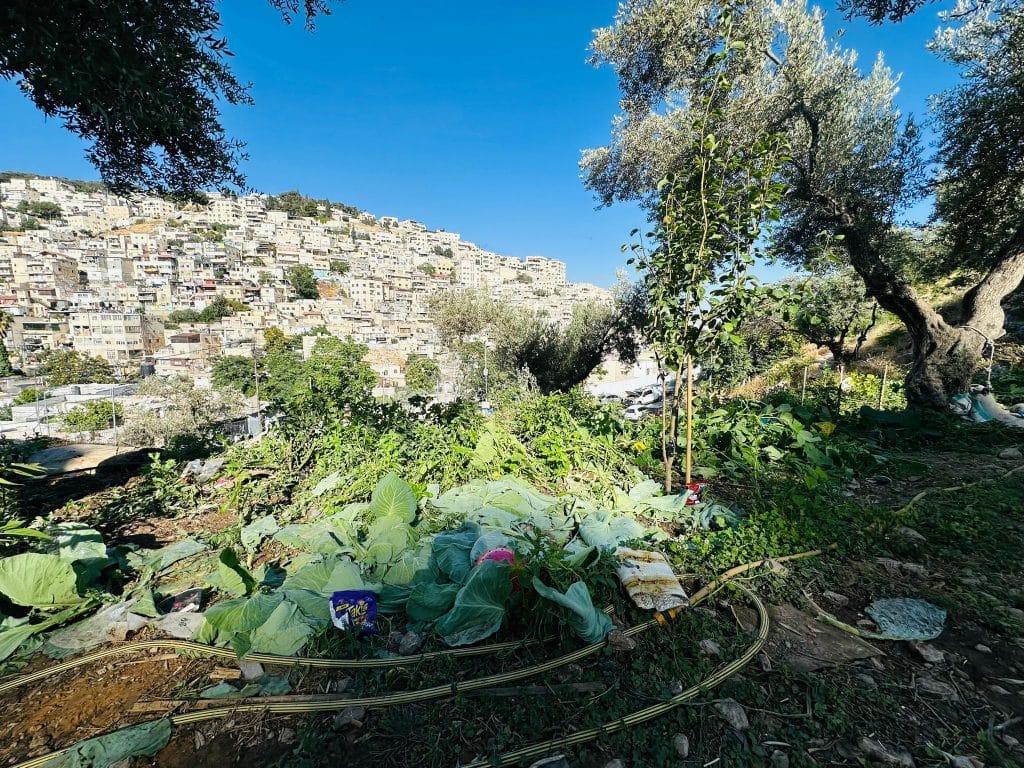
In addition to the crackdown on Palestinian Christians, the cordoning off of church land is also part of a broader Israeli colonization strategy meant to confiscate as much land from Palestinians in Jerusalem as possible. In the Silwan neighborhood of Wadi Rababah, Israel’s Jerusalem municipality has used “landscaping” or “gardening” orders to gradually seize Palestinian properties.
“The first pretext is gardening work: a soft infiltration of our land,” Samarin explained. “Then they escalate by adding terraces and installing electronic gates.”
These additions to Palestinian properties, Samarin clarified, are what the state calls “site improvement” operations, serving as an initial, seemingly innocuous measure in the eventual restriction and control of how residents use their land.
What began as a limited intervention for ostensible gardening work, Samarin said, is “just the first step in eventually transferring care for the land over to the Custodian of Absentee Property Department, which places that land under its permanent control.” Samarin explained that this department is able to claim control over the land because the state now regards it as “absentee property or ‘unused’ land.”
The danger, he says, is that this eventually leads to a transformation of the land’s legal status, especially once portions of it are classified as falling within a “national park” zone; this designation would “paralyze owners’ ability to use their land,” Samarin said.
A comprehensive study by Emek Shaveh, an Israeli archaeological organization, found that between 2018 and 2019 alone, the Jerusalem Municipality issued gardening orders covering 27 plots of land in Wadi Rababah, totaling approximately 60 dunams (6 hectares). But according to Israeli rights group Peace Now, these confiscation orders have dramatically escalated in recent years, with orders issued for a total of approximately 200 dunams (20 hectares) in the neighborhood. This pattern suggests a systematic strategy that goes beyond green development.
The Muslim who guards the church
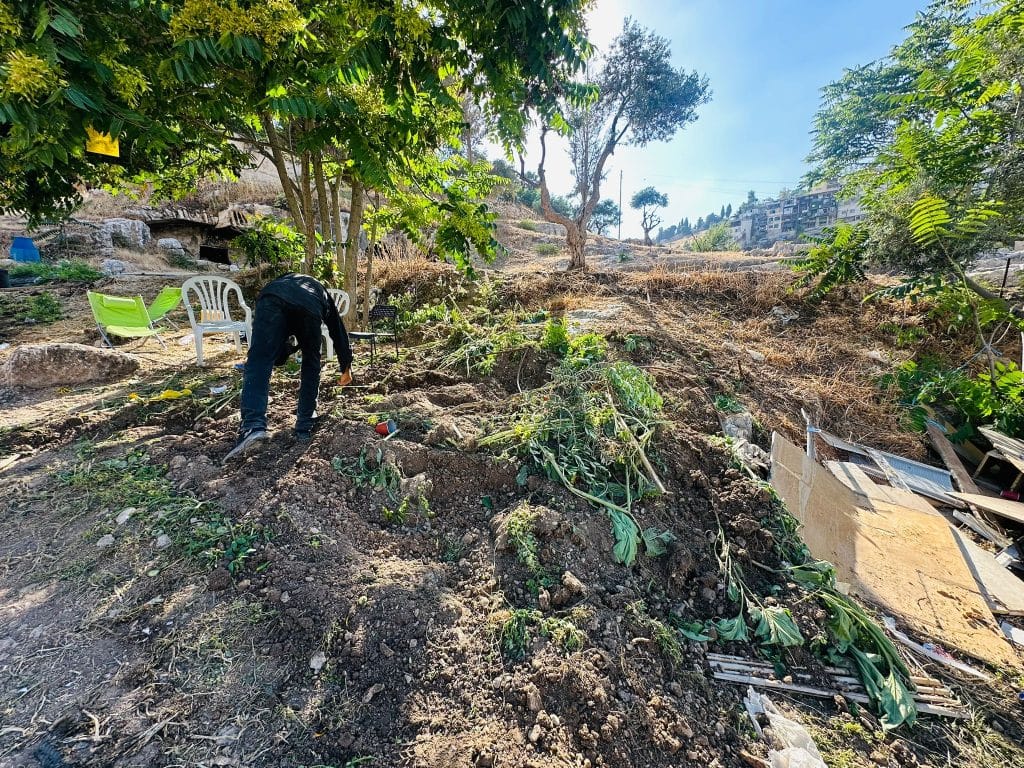
At dawn, Khaled al-Zir, the Muslim caretaker of the church, begins his day on the path leading to the Greek Orthodox Patriarchate’s land in Wadi Rababah. He knows the details of the location as well as his own home. He pauses at the trees, checks the agricultural rooms, surveys the land’s boundaries, and watches for any change that may have occurred in his few hours of absence.
Al-Zir carries his camera on his daily rounds, documenting cut branches, bulldozer tracks, or any attempt to alter the features of the land his family has been tied to for decades. The lens has become part of his routine, alongside the farming tools he uses to maintain the site. “This land has been cultivated by my family for many long years, and to this day I try to preserve it,” he said. “They tried to confiscate the agricultural rooms, the equipment, the fertilizers, even the vehicles used for work. But I still come back every day in spite of everything.”
In recent months, al-Zir’s visits have become a daily presence stretching from the early morning hours until evening. He sits near the church, monitors activity in the area, and attends to small matters such as trash bags left at the entrance. These details might seem trivial, but for him, keeping the site clean is part of protecting the land itself, as any sign of neglect could later be used to justify further confiscation measures.
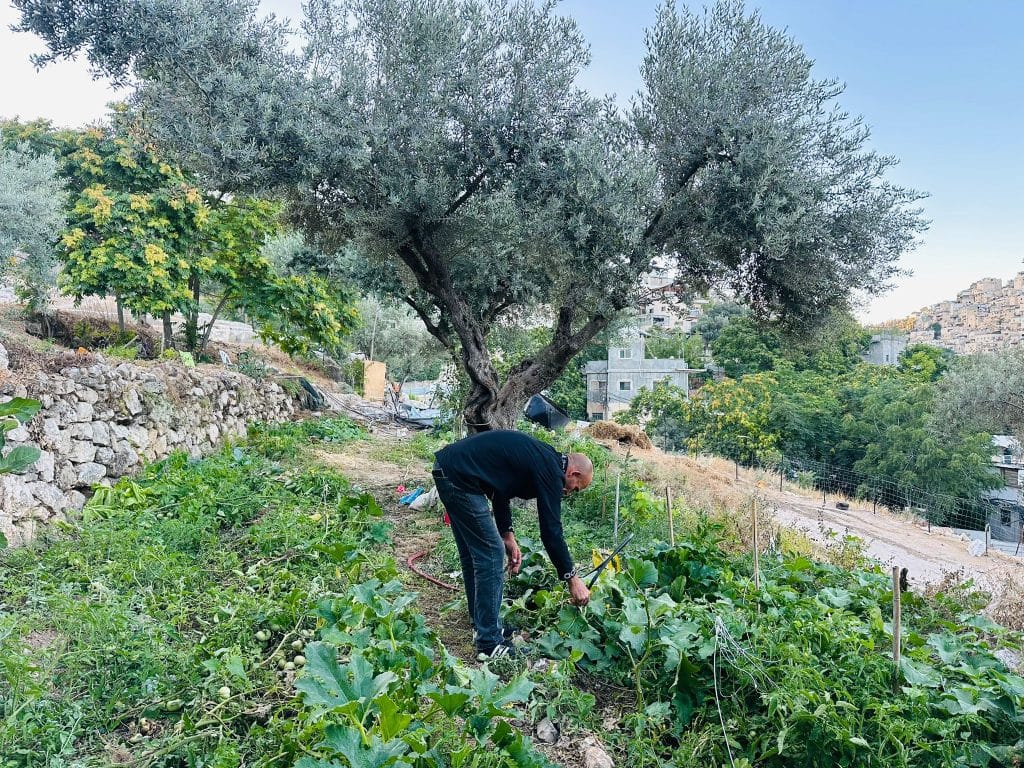
Al-Zir and his family have a long history with the land around the church, which he used to farm while also caring for the site. Today, that history is under threat, pushing Khaled to double down on his daily ritual: arriving on the land, working it, and rarely leaving it.
“Even a brief absence can change everything,” al-Zir explained. “The issue is no longer about who owns the land. It’s about proving our presence. If you leave, it’s no longer yours. It’s that simple.”
We left al-Zir near the church as he made his way to his farm on the Patriarchate’s grounds. We asked him to take some photographs of his farm so we could include them in this report, but the images he returned weren’t the ones he had planned to take.
Hours later, a message arrived from al-Zir with the following images attached: burned plants and the aftermath of a settler attack while he was away. Suddenly, his mission had shifted from documenting the site’s condition to recording a fresh assault on the property.
“I’ve brought you fresh pictures this time. It would be best to buy a new memory card, something big enough to hold all of this,” he wrote. “It seems our battles are intensifying.”
Majd Jawad
Majd Jawad is a Journalist and researcher from Jenin, Palestine, holding a Master’s degree in Democracy and Human Rights from Birzeit University and a Bachelor’s degree in Journalism.
Coincidentally I’m reading about Hans Kohn, a Zionist leader who wrote about the 1929 Hebron massacre. His writings are directly relevant to the slow ethnic cleansing described in this piece and are worth examining. From the Wikipedia article, emphasis mine:
His writings began to generate books, where he discussed current geopolitics and nationalism. In 1929, he wrote a resignation letter from Keren HaYesod titled “Judaism is Not Zionism”…Following the Hebron massacre three months prior, he wrote a following letter:
“I feel that I can no longer remain a leading official within the Zionist Organisation… We pretend to be innocent victims. Of course the Arabs attacked us in August [1929]. Since they have no armies, they could not obey the rules of war. They perpetrated all the barbaric acts that are characteristic of a colonial revolt. But we are obliged to look into the deeper cause of this revolt. We have been in Palestine for twelve years [since the start of the British occupation] without having even once made a serious attempt at seeking through negotiations the consent of the indigenous people. We have been relying exclusively upon Great Britain’s military might. We have set ourselves goals which by their very nature had to lead to conflict with Arabs… for twelve years we pretended that the Arabs did not exist and were glad when we were not reminded of their existence.”
Hans Kohn – Wikipedia
Judaism is not Zionism — written in 1929! Also see
Lessons from a disillusioned Zionist
No Birthright Lasts 2000 Years — The Claim Only Israel Gets Away With | YouTube