

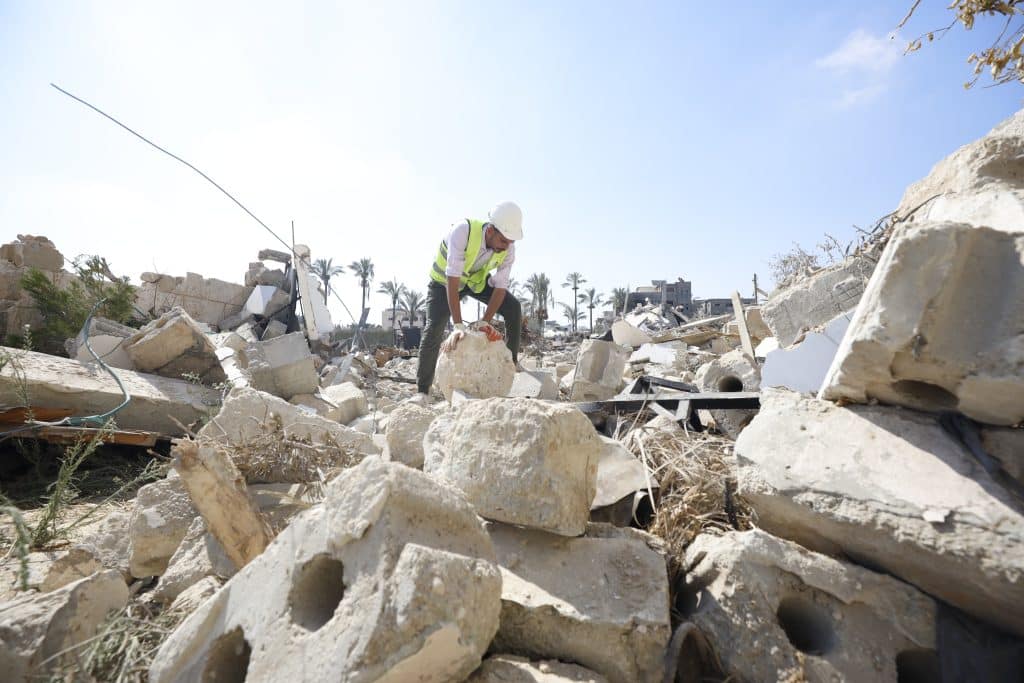
In the rubble of a bombed site in Khan Younis, a group of volunteers in yellow high-visibility vests work in near silence.
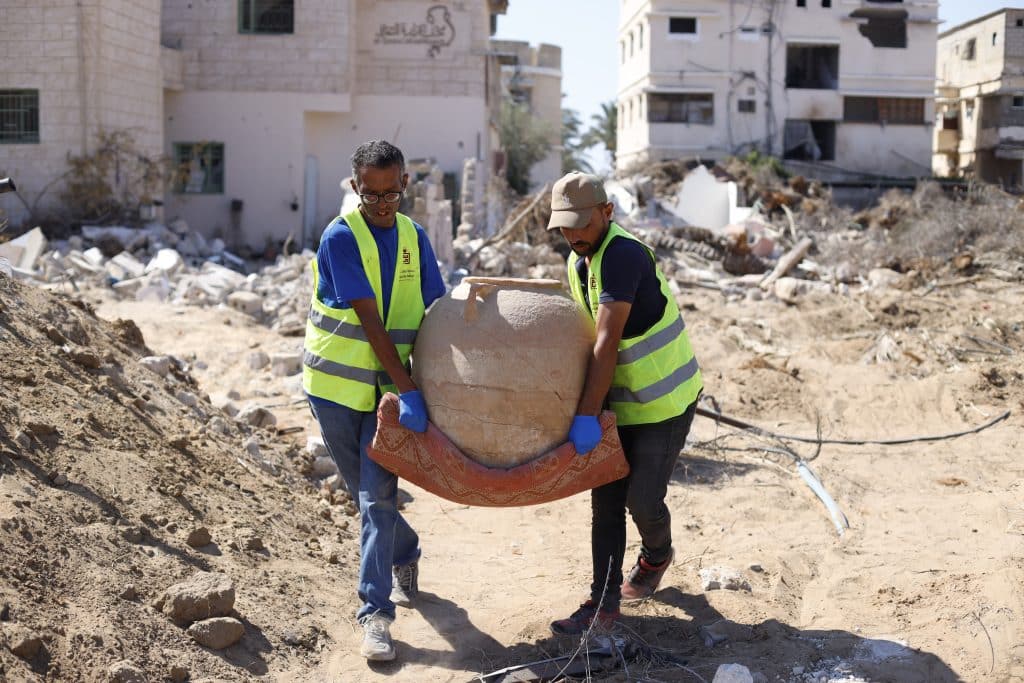
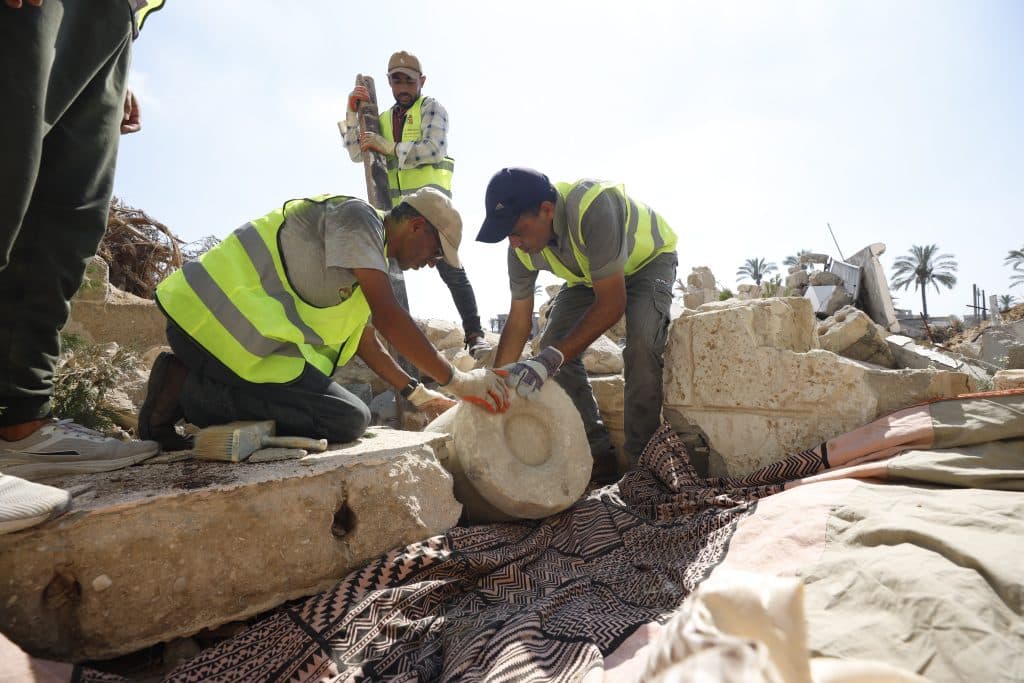
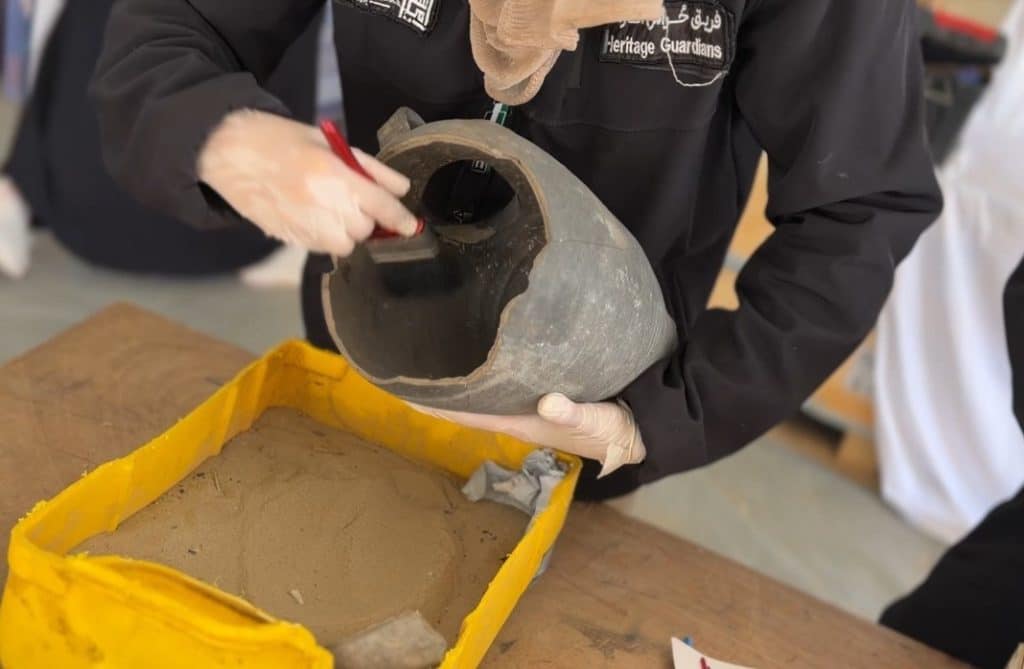
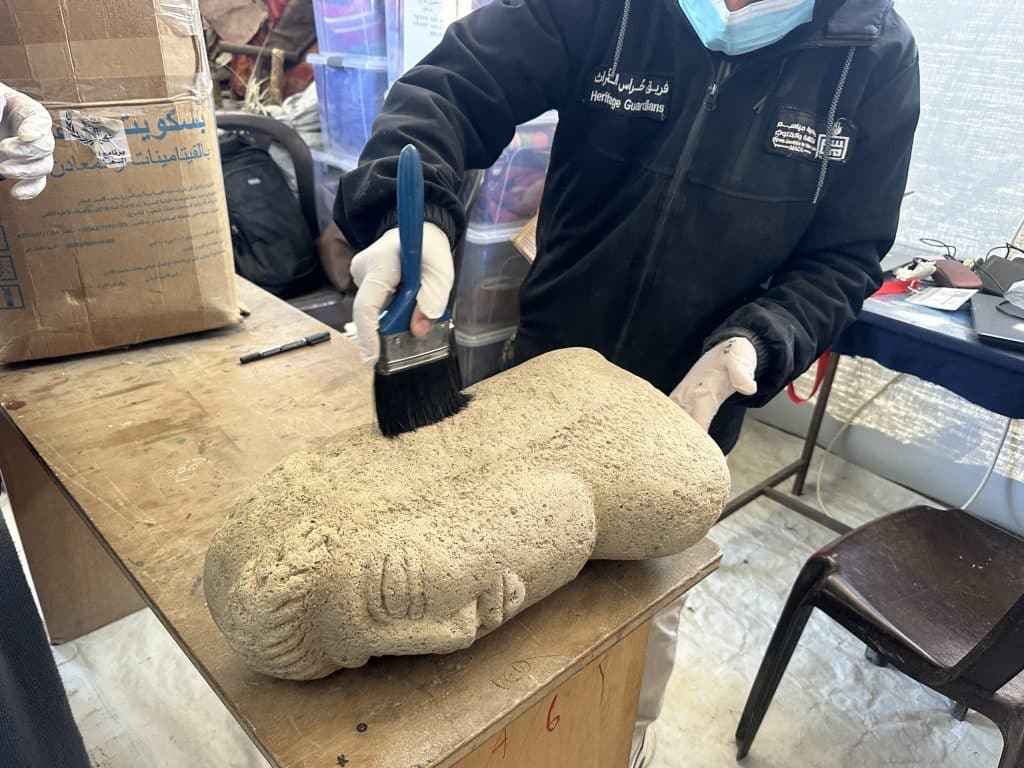
They have no tools but their hands, relentless determination, and the knowledge that what lies beneath the debris is irreplaceable. Carefully, they lift carved stone fragments and pottery vessels by hand, wrap ceramic pieces in whatever protective material they can find, and admire ancient statues, shattered on the ground, dating back thousands of years.
The volunteers are part of the Heritage Guardians Team, an initiative affiliated with the Mayasem Association for Culture and Arts. Although Israeli shelling never stopped rocking Gaza, they’ve been trying — carefully, methodically, and with bare hands — to save what remains of the Strip’s archaeological heritage before it disappears entirely under the rubble.
According to Hamouda al-Dahdar, director of the Department of Archaeological Sites and Excavations at Gaza’s Ministry of Tourism and Antiquities, Israeli forces systematically and deliberately targeted many of Gaza’s archaeological sites, most of which had remained closed throughout the war. “They were attacked without any apparent military justification,” he told Mondoweiss.
Before the war, the Gaza Strip was home to archaeological sites and artifacts from periods spanning more than 5,000 years of continuous human civilization. Nearly every part of the territory contained an archaeological site or historical remains, while five major museums preserved the vast majority of artifacts unearthed across Gaza.
But the ongoing genocide has left virtually nothing untouched. Beyond the destruction of homes, civilian infrastructure, and the killing of tens of thousands of civilians, the war has also devastated archaeological sites and artifacts painstakingly excavated and preserved over decades. Many have also been taken out of Gaza, in what the Strip’s Ministry of Tourism and Antiquities regards as theft.
Systematic destruction
According to Gaza’s Ministry of Tourism and Antiquities, more than 500 archaeological and historical sites have been damaged since the war began.
“Among the greatest losses to Israel’s ruthless and blanket bombing is the Qarara Archaeological Museum, which housed more than 3,500 artifacts, some dating back over five millennia,” Yousef al-Abadla, a Palestinian journalist and member of Mayasem, tells Mondoweiss. The museum was destroyed during the war, and not a single artifact could be recovered as it fell behind the Yellow Line, which Israel prohibits Gazans from crossing.
Al-Abadla told Mondoweiss that the war has inflicted catastrophic damage on virtually every archaeological site in the territory. “Among the hardest hit is Hammam al-Sammara, which is over 1,000 years old; the Great Omari Mosque, a 2000-year-old architectural and historical treasure; and Qasr al-Basha, a 900-year-old place that was turned into a museum in the Old City of Gaza,” he noted.
The Byzantine Church in Jabalia, which dates back to the time of Byzantine Emperor Theodosius II, who reigned between 408 and 450 AD, and Tal Rafah, the ruins of a Roman-era brick building dating to 63 BC, have both been bulldozed.
“Many of Gaza’s oldest archaeological sites, some dating back more than two or three millennia, are located inside the Israeli-controlled Yellow Line. These include the Byzantine Church and Tell Rafah,” al-Dahdar said. “Both of which have been completely bulldozed and reduced to rubble.”
As of March 2026, UNESCO has verified damage to 164 cultural heritage sites in Gaza since October 2023, including eight archaeological sites and two museums. The agency has called on all parties to adhere to the 1954 Hague Convention, which prohibits occupying powers from destroying cultural heritage — a convention Israel has signed.
Salvaging history with bare hands
All five of Gaza’s principal museums suffered damage during the genocide, with those that escaped destruction left severely damaged.
Al-Abadla says the al-Aqqad Museum in Khan Younis — a private collection belonging to Palestinian antiquities collector Walid al-Aqqad containing hundreds of artifacts — was also destroyed. Only a small portion of its contents was recovered.
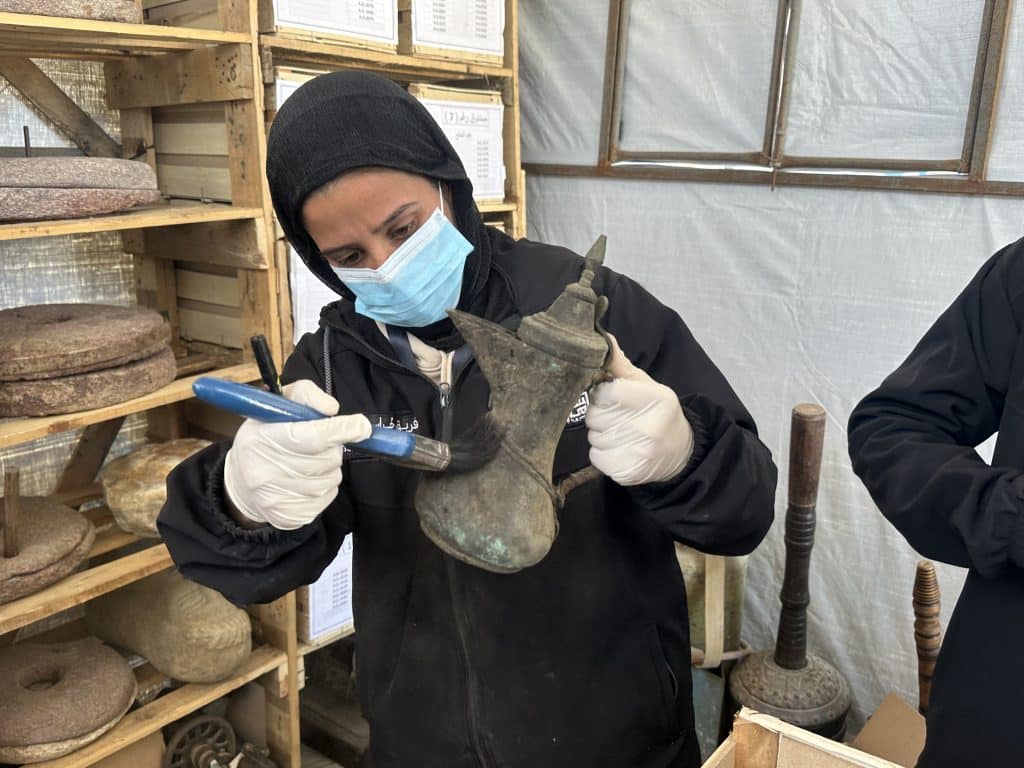
What the Heritage Guardians Team managed to salvage was transferred to the Mayasem Association’s headquarters in Khan Younis, but wartime preservation is its own threat. Al-Dahdar explained that the departure of archaeology specialists recruited abroad during the war, combined with a complete lack of specialized equipment, has made the work increasingly precarious. Given the age and fragility of many objects, improper recovery risks irreversible damage.
Al-Dahdar describes one particularly devastating sequence. During the first ceasefire, following Israeli withdrawals from certain areas, damaged artifacts were collected and moved to a storage site inside a residential building.
“Although many had already been damaged, the collection suffered another devastating blow when the building itself was later bombed,” he said. “Many of the artifacts that had been rescued were destroyed.”
Taken out of Gaza
The most contentious chapter in the story of Gaza’s wartime heritage involves not destruction, but removal.
Between April 3 and December 7, 2025, France hosted an exhibition organized by the Institut du Monde Arabe in Paris, titled “Saved Treasures from Gaza: 5,000 Years of History.” The exhibition presented itself as a rescue operation, with artifacts removed from Gaza during the genocide, displayed publicly to preserve and celebrate Palestinian cultural heritage at a moment of catastrophic loss. The institution’s website says the Palestinian Authority supported the exhibition.
Gaza’s Ministry of Tourism and Antiquities sees it differently.
The ministry says it had no involvement in the exhibition and insists that no international institution coordinated with it before the artifacts were removed. It maintains that they were taken out of the territory through illegal means.
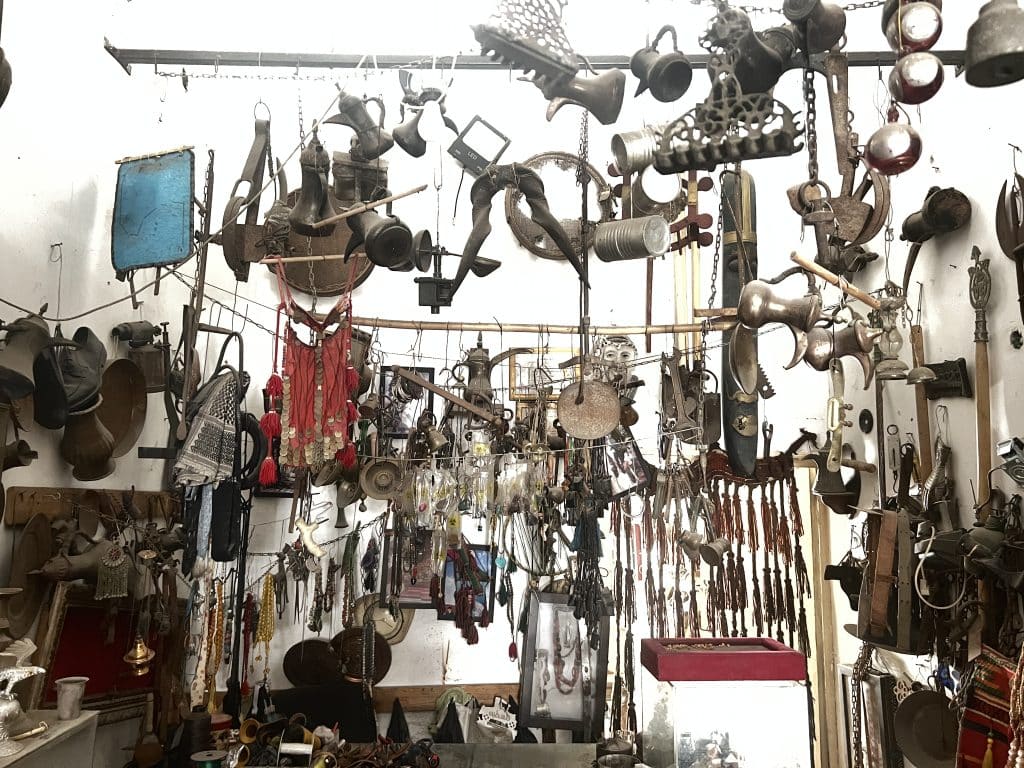
“This is theft, not protection,” al-Dahdar said. “If the objective had truly been to safeguard these artifacts, they would have been transferred to the custody of the Palestinian Authority in the West Bank — not to France.”
He suggests that any arrangements concerning the artifacts may instead have taken place with Israeli authorities, without the participation of Palestinian institutions in Gaza. Attempts by Mondoweiss to reach the Institut du Monde Arabe in Paris for comments, by email and telephone, went unanswered.
According to al-Dahdar, international human rights organizations have been in contact with Gaza’s authorities regarding the missing artifacts, and efforts are underway to secure their return.
Not everyone who encountered the exhibition shares the ministry’s framing. Qassam Muaddi, a Palestinian journalist who visited the Paris exhibition, found himself holding both responses at once.
“I believe that celebrating Gaza’s 5,000-year history in this way is important in times of genocide – as a response to the attempts to erase Gaza’s identity and history,” he said. “But it hurts a little to see that Palestinian life needs to be destroyed in order to give Palestine’s history some recognition. It is as if Palestine’s history isn’t recognized unless Palestine’s present is destroyed — and that recognition always has to take place outside of Palestine.”


My better half is a trained archaeologist, so over the years I have accrued a reasonable amount of knowledge of the subject.
Archaeology in Israel is thoroughly corrupted. Instead of the practice elsewhere of digging down to see what may be there, in Israel (and its occupied territories) it’s all too often digging down to see if there are traces of Jewish occupation there and to hell with what went before or since.
“ Israeli forces systematically and deliberately targeted many of Gaza’s archaeological sites, most of which had remained closed throughout the war. “They were attacked without any apparent military justification,” he told Mondoweiss.”
It’s Jewish Terrorism. This article just appeared in the New York Times –
These Generals Fought for Israel. Now They See ‘Jewish Terrorism’ as the Threat.**A growing number of former Israeli generals, intelligence officials and prime ministers are accusing settlers in the West Bank of committing ethnic cleansing with “Once a society behaves this way,” one said, “that society is doomed.”…..“This is ethnic cleansing, to put it simply,” Ephraim Sneh, a retired brigadier general and former minister of health, said of Israeli settlers’ attacks on Palestinians in the West Bank…..Asaf Agmon, a retired Air Force general, went even further, comparing it to what some Israelis’ forebears endured in the Holocaust — not in the scale of the violence, he explained, but in the effort to erase the Palestinian presence from much of the West Bank…..The retired generals condemning this violence are part of a small but rapidly expanding array of influential Israelis, including many from the upper echelons of the military and intelligence apparatus, who are publicly declaring the lawlessness in the West Bank a threat to Israel’s existence as a democracy.
These Generals Fought for Israel. Now They See ‘Jewish Terrorism’ as the Threat. – The New York Times
**
excuse me, Jewish terrorism in the Holy Land began in the late 19th century, but better late than never.
Some of the retired officials contend that the campaign against Palestinians in the West Bank is reminiscent of Nazism — an extraordinarily contentious assertion, especially in Israel, where many Jews found sanctuary after their families were eradicated in Europe.
Moshe Ya’alon, the former army chief of staff who served as defense minister under Mr. Netanyahu until 2016, recently likened the ideology of extremist Israeli settlers in the West Bank to that of World War II Germany….“What is Jewish supremacy?” Mr. Ya’alon, long considered a security hawk, recently said on Ynet, an Israeli news site. “Eighty years after the Holocaust, ‘Mein Kampf’ in reverse. The master race is us.”
These Generals Fought for Israel. Now They See ‘Jewish Terrorism’ as the Threat. – The New York Times
How Taliban-like.
Of course, if France was genuinely motivated by preserving history, they would not have supplied the weapons, diplomatic cover or looked the other ways as dual citizens joined the IDF in starving and slaughtering Gaza’s children, and destroying its heritage.
More and more evidence of Israel’s international crimes against Palestinians. Israel destroying Palestinian homes, lands, lives in mass.
Sad, powerful evidence of Israel’s long list of crimes committed against Palestinians. The list is of those human rights crimes continues to grow.
Will there ever be any justice? Keep pushing!
https://opil.ouplaw.com/display/10.1093/law:epil/9780199231690/law-9780199231690-e278?p=emailAcImj8P39FyS2&d=/10.1093/law:epil/9780199231690/law-9780199231690-e278
Historical Development of the International Legal Rules in Question6 Although there was a general agreement that cultural property should be spared from the direct or indirect effects of armed conflict, international law was slow in developing legally binding rules to that extent. The earliest regulation of interest in this context—although only of national character and applicability—is contained in the Instruction for the Government of Armies of the United States in the Field of 24 April 1863 (the ‘Lieber Code’). It provided that classic works of art and similar objects ‘must be secured against all avoidable injury’ (Art. 35 Lieber Code). It further provided that property belonging to churches, to establishments of education, or foundations for the promotion of knowledge, which included museums for the fine arts, or of a scientific character, was not to be considered public property and was thus exempt from appropriation by occupying forces (Art. 34 Lieber Code, in connection with Art. 31). The Brussels Declaration (1874) as well as the Oxford Manual (‘Manuel des lois de la guerre sur terre’, adopted in 1880 by the Institut de Droit international) followed the same approach, although they were less explicit. The Lieber Code, as well as the Brussels Declaration and the Oxford Manual, exercised remarkable influence on the work of the Hague Peace Conferences (1899 and 1907) which formulated the first legal rules on the protection of cultural property in armed conflict.