

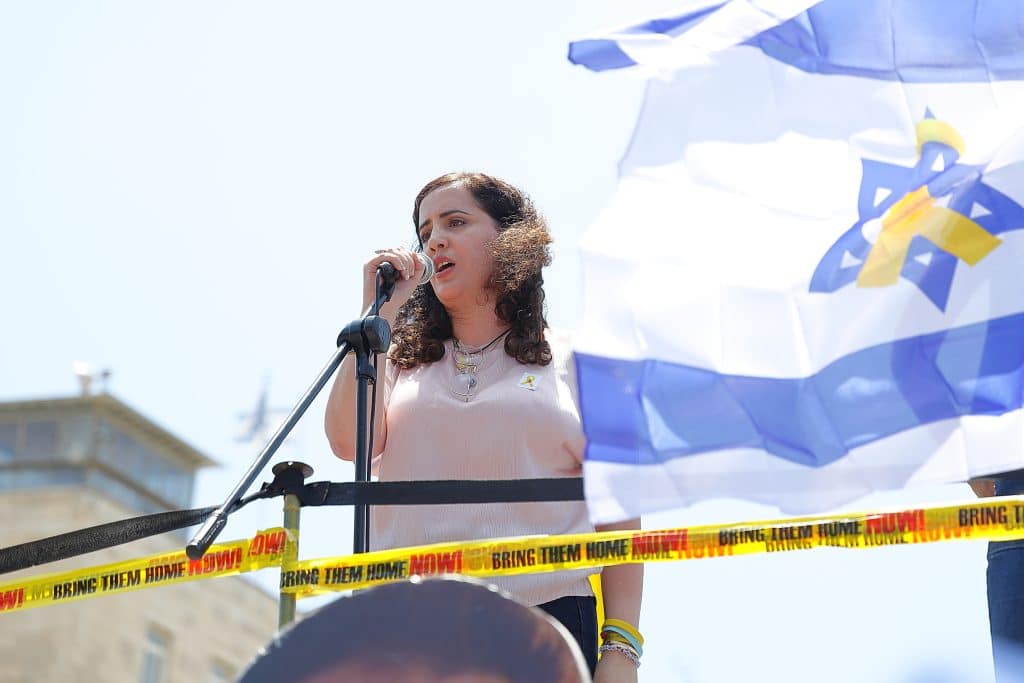
You might not have heard about her yet, but Naama Lazimi is number 2 in the Israeli Zionist “left” party, The Democrats, who are led by former general and deputy army chief of staff, Yair Golan.
But Lazimi is a step up from Golan, who notoriously advocated for the indiscriminate starvation of Palestinians in Gaza in the wake of October 7. Lazimi, by contrast, has ditched advocating for genocide and is instead calling for a return to good old apartheid.
Only advocating for apartheid, of course, puts you on the far left in Israel today, and in this, Lazimi is being celebrated as a fresh wind of change. Liberal daily Haaretz hailed her as “the superstar of the Israeli left, and she wants power” in a lengthy profile of the politician earlier this month, running at just over 7,500 words.
The left has generally been polling poorly ahead of the upcoming Israeli elections, set for October 27 later this year — but so is the current right-wing coalition. The biggest challenger to Likud right now is Gadi Eisenkot’s Yashar party, polling around 24 of 120 seats. Eisenkot, incidentally, is the architect of the Dahiya Doctrine, a policy of indiscriminate killing that has guided the current genocide in Gaza. Meanwhile, the Bennett-Lapid “Together” ticket, which looked set for 25 seats in April, has since slipped below 15.
So with no party able to secure a clear majority, the left is looking for a candidate who can appeal to a wider Israeli base — and Naama Lazimi knows how to do it.
A ‘political arrangement without a Palestinian state’
On Monday, Lazimi was on the Kan public broadcaster’s “This Morning” show, where she outlined her political vision vis-à-vis the Palestinians: “It is necessary to strive towards a political arrangement that will not create a Palestinian state” in the coming term.
Well, that, at least, can count for honesty.
As I wrote on this site nearly a decade ago, a Palestinian state has always been fiction for Zionists. Even Yitzhak Rabin, precisely a month before he was murdered in 1995, assured the Israeli parliament that the Oslo Accords (which many believed were aimed at a “two-state solution”) would result in “less than a state” as far as Palestine was concerned.
This was always a cardinal Zionist point. Zionism, being the settler-colonial enterprise it always was, was not meant to let Palestine exist, but to replace it with the Jewish supremacy of Israel.
And as far as being Zionist, Lazimi is a proud one. The Haaretz profile cites her meeting with Bedouin educators, in which she explained what Zionism meant to her:
“I want to tell you something as a Zionist. The Zionism they’ve [right-wing, religious Zionists] brought here is a distorted Zionism. Zionism, as I understand it, means equal rights for everyone who lives in the country. As far as I’m concerned, the mistreatment of Arab society, not only Bedouin society, is something that runs counter to Zionism.”
That statement is itself a major distortion of Zionism. Equal rights is anathema to the Israeli apartheid, from the river to the sea. The seasonal ethnic cleansing and even genocide of Palestinians has always been based on the understanding that Palestinians are a “demographic threat,” because Zionism needed their expulsion or disappearance as a founding principle towards the establishment of a Jewish political demographic majority.
And what of the occupation? In the Haaretz profile, the interviewer, Moran Sharir, asks, “Hasn’t your party abandoned the banner of fighting the occupation?”
“At various points, yes,” she answers.
“Over the past four years.”
“No. Over the past four years, we’ve been the only party talking about this issue,” share replied. “Now, look, there are different shades within the party on this, too, and that’s fine. There isn’t one set of talking points. There’s something about a democratic party that allows for a range of views.”
“Where are you on that spectrum?” Sharir follows up.
“I’m part of both the security-diplomatic discourse that sees separation as the path to security and the human-rights discourse that also demands universal, Jewish and human norms here,” Lazimi answers.
“Separation” in the sense that Lazimi describes is the subject of a wide-ranging consensus in Israel. Another word for it is apartheid.
Making excuses for genocide
Sharir challenges Lazimi on her position regarding the Gaza genocide, which he frames as a “humanitarian catastrophe” due to the starvation and “indiscriminate killing of children, women, and the elderly,” as well as the “genocidal rhetoric from people in the government, the media, the military.”
Lazimi was defensive. “We spoke out against it. Even if it wasn’t with the intensity you expected.”
“Forget intensity. How did I not hear it?” Sharir retorted.
“We spoke out a lot. I think Yair [Golan, head of the Democrats] is the most prominent figure who sparked a public discussion about it,” Lazimi fumbled.
Yes, the same Yair Golan who said a few days after October 7 that “it is forbidden to allow a humanitarian effort” into Gaza, and advocated that “we need to say to them: until the [captives] are released, from our side, you can die from starvation. It’s totally legitimate.”
He followed up this gem over a year later with another genocidal take: “we’d all like to wake up one spring morning and find that 7 million Palestinians who live between the sea and the river have simply disappeared.”
He made sure to qualify that this was not a realistic dream, meaning the Zionist left is admirably willing to abandon genocide because it isn’t feasible.
The ‘it’s complex’ bleeding heart liberal
But Lazimi waxes sorrowful over Gaza, too.
“Forget strategy for a moment. How did you feel, on a human level, about things that were done in Gaza? As a citizen, as a person, as a mother,” Sharir asks.
“Sometimes, when I read journalistic investigations, it pains me, whether they’re about Gaza or about us,” she says. “The question is what happened along the way, what we left behind, how much scorched earth. Of course, I have thoughts about that.”
But she rushes to qualify her sympathy. “At the end of the day, we’re a society that has had to contend with a multi-front reality in every sense,” she equivocates. “That multi-front reality doesn’t always leave you with the capacity to look as unflinchingly as possible at things that are happening, and I feel sorrow about that too…But I have to accept that we’re dealing with everything simultaneously.”
It was this “overload,” Lazimi maintains, that “didn’t allow Israeli society to look closely at what was happening.” Israel was, after all, “a disaster-stricken society.”
You must understand, one could almost hear her say. You must understand the need to commit genocide.
With such powerful skills at Zionist gaslighting, it’s no wonder she’s such a superstar on the left. She might one day become Prime Minister.

Jonathan “Only advocating for apartheid, of course, puts you on the far left in Israel today, and in this, Lazimi is being celebrated as a fresh wind of change.” Bingo!
““I want to tell you something as a Zionist. The Zionism they’ve [right-wing, religious Zionists] brought here is a distorted Zionism. Zionism, as I understand it, means equal rights for everyone who lives in the country. As far as I’m concerned, the mistreatment of Arab society, not only Bedouin society, is something that runs counter to Zionism.”
The Neo Hasbara!
She sounds like Hakeem Jeffries’ kind of “gal.”
The political spectrum in Israel differs significantly in its dividing lines from that of European countries. Historically and socially, being classified as ‘left’ (Smol) there often refers to core issues other than the human rights and occupation debate from an international perspective.
When Israel talks about “left”, it reminds me of Strasserism.
Laura Loomer such a hate filled racist.
https://www.reuters.com/legal/government/trump-ally-laura-loomer-faces-criticism-over-racist-comments-against-black-women-2026-08-31/
“WASHINGTON, Aug 31 (Reuters) – Multiple lawmakers and rights advocates on Monday condemned Laura Loomer, a far-right activist and ally of U.S. President Donald Trump, over racist comments attacking Democratic socialist Angie Nixon and other prominent Black U.S. politicians.
“Angie Nixon is a ghetto, black, communist,” Loomer said on X on Monday. Nixon recently scored an upset victory in Florida’s Democratic primary race for the U.S. Senate, one of a number of winning candidates that have stirred enthusiasm on the party’s left flank but been characterized by Republicans as extremists.”
Truth teller Max Blumenthal talking about Loomer’s racism,Ben Gvir’s hate filled racism today on “Judging Freedom”
https://www.youtube.com/watch?v=yde4RX0mXHQ
“ Equal rights is anathema to the Israeli apartheid, from the river to the sea.”
_____________________________________________________________
Mondoweiss advocating for what from the river to the sea….in every article.