

On June 30, an Israeli soldier posted a photo on his personal Instagram account of a Palestinian man who appeared to be in his twenties. He was naked except for his underwear, blindfolded with a dark cloth, his hands bound behind his back with a heavy-duty tie, and his body fastened to a metal bed with ropes. The soldier captioned the leaked image with a single word in Hebrew: “Good morning.”
To the world, and to those following the scene from a distance on social media, the image was just another harsh visual document added to the daily record of arrest, abuse, and stripped human dignity in wartime. But in the besieged Gaza Strip, that same image became a “poisoned glimmer of hope” that threw four families into turmoil, each family insisting that the bound man in the leaked photo was their husband, son, or brother, missing for months.
The bitter dispute over the photo highlights a daily, hidden battle to establish whether loved ones are alive and waiting to be found, or dead and buried under more than 61 million tons of rubble and concrete.
But for thousands of women in Gaza, namely the wives or widows of men who are still missing, a particularly cruel reality has emerged. Not only do they live with the pain of not knowing where their husbands are, or not being able to bury them, but they also face a legal and bureaucratic void that leaves them and their children trapped in limbo. In a traditionally patriarchal society that runs entirely on paperwork, women who find themselves with no male breadwinner and no official proof that their husbands are dead are stuck with no way to run their own lives or protect their children from poverty and instability.
One of those women is Ghadeer al-Ghoul, the wife of Amin al-Ghoul, who has been missing since November 2023. The al-Ghoul family was one of the four families who claimed that the blindfolded and bound man in the photo was their son after the image went viral in Gaza in June.
Since that photo was released, Ghadeer runs her trembling fingers over the zoomed-in screen hundreds of times a day, pointing to small dark marks on the man’s neck, a familiar curve in his shoulder, and a particular angle in his feet that she memorized over their long years of marriage.
“I know Amin’s features and the marks on his body — my eyes never mistake them, and my memory never forgets them, no matter how long the days stretch or how much crueler this war becomes,” Ghadeer told Mondoweiss.
“I hope with all my heart that he’s the one in that photo, even if he’s a prisoner being tortured and humiliated, because to me, detention means he’s still breathing, still alive on this earth. Unknown absence, on the other hand, is a slow death that eats away at our souls.”
A desperate search for her husband
Ghadeer al-Ghoul’s journey with loss began in November 2023, when her husband Amin suffered a nervous breakdown and severe psychological shock in the wake of a massacre that killed dozens of close relatives in a strike on their home. He was rushed to al-Aqsa Martyrs Hospital in Deir al-Balah for treatment. On one chaotic day, amid the crowds of dead and wounded filling the hospital’s corridors, those with him woke to find his bed completely empty. No news of him has surfaced since; nothing to explain what path he took, or who took him.
Since then, for almost three years, Ghadeer has stayed suspended in confusion, not knowing whether her husband was dead or being held in an Israeli prison somewhere. That’s when the leaked photo appeared.
Though she believed the man appeared to look like Amin, her confusion was made all the worse once Israeli media outlets circulated a claim that the detainee in the photo had been captured in the Beit Hanoun area in north Gaza while advancing toward a military position just weeks earlier — a timeline that flatly contradicts the time and place of Amin’s disappearance in 2023 from the Al-Aqsa hospital in the center of the Strip. The contradiction has left Ghadeer torn between a mind working through the evidence and a heart that refuses to accept it.
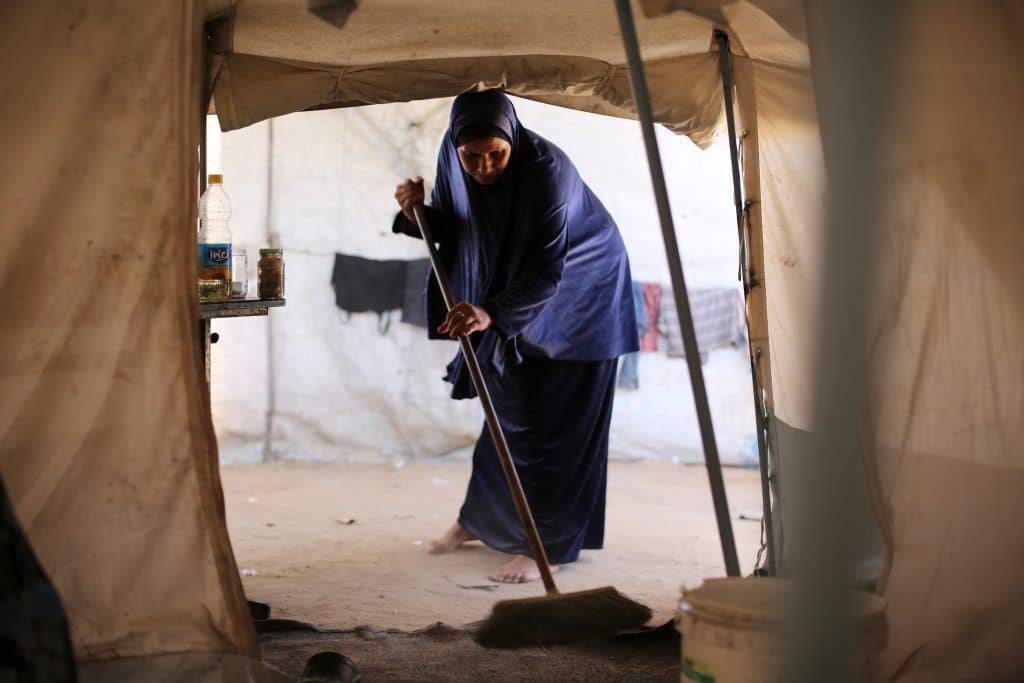
Ghadeer’s tragedy did not stop at emotional devastation. Like countless women in her situation, she has faced both psychological and financial obstacles. Since her husband Amin is administratively classified as “missing” without an official death certificate, she has become completely unable to access his bank account to withdraw the family’s money still in the account. She has also faced obstacles at many aid distribution points that require the presence of a “head of household” — in other words, a man, or a widow who can prove her husband is dead. Ghadeer has neither.
“The bank asks me for a legal power of attorney or a death certificate before I can withdraw from my husband’s account, and relief organizations treat me as if my husband is still around and able to go get food himself!” Ghadeer said bitterly. “I have neither the money nor the papers that would qualify me for a food parcel to feed my children.”
The deeper pain lies in her children’s psychological and social decline. Her young son suffers from involuntary bedwetting and nightmares in which he screams his father’s name.
“My children are not who they used to be. My little boy wakes up terrified at night, screaming, ‘Where’s Baba?’ Socially, they’ve become withdrawn inside the tent, refusing to mix with anyone or play, as if ashamed of their father’s absence,” Ghadeer said. “If I leave them for even a minute, they panic, thinking I’ll disappear as their father did. And the hardest part is I don’t even have money to buy them a piece of candy to calm them down.”
A stolen identity, a life beside the grave: the stories of Um Yousef and Amina al-Bahtini
Ghadeer’s story is that of every woman in Gaza whose husband has gone missing. Every detail of their daily lives — receiving aid, managing a bank account, even child custody and paperwork — is tied to their marital status as it appears in government records. But when there’s no way to verify their spouse’s fate, their legal rights are effectively frozen.
Without the physical presence of a body (or a medically confirmed recovery of a dead body in an official report), a married woman cannot obtain a legal death certificate. And without that one document, every banking and administrative process grinds to a halt: she cannot claim her own right to inheritance or her children’s, she cannot liquidate her husband’s assets to support the family, and cannot even draw a widow’s pension or the stipends set aside for the families of the dead — all of which require official proof that the household has, in fact, lost its breadwinner.
That suffering is stark in the story of Um Yousef al-Far, who lost her husband Raed in December 2023 after he stepped out of the mosque where the family had taken shelter in Rafah, looking for food and water for his sick daughter, when an Israeli airstrike hit the area. His name later appeared on field lists of the dead, but crews were never able to locate or recover his body, given the level of destruction and how dangerous the conditions were.
Um Yousef is now caught helpless between a daughter slowly dying of cancer and a leg condition that troubles her every step, dragging herself daily to collect a relief parcel that officials refuse to hand her. Her husband is the “primary beneficiary,” they say, and she has no right to it without a power of attorney or a death certificate.
“I now live in a crumbling tent pitched under the collapsed roof of my house in the Shati refugee camp,” Um Yousef told Mondoweiss. “I have a clot in my leg that limits how much I can move or work, and I’m raising my four children alone — one of them battling cancer, needing treatment, care, and food that simply doesn’t exist in the markets — with no document proving my right, or theirs, to aid or to the stipends set aside for the families of the dead.”
“The system treats my husband as if he were still alive, still carrying out his duties, while the reality strips my children and myself of even the most basic rights to a decent life. We live on whatever our neighbors can spare.”
Not far away, in Gaza City’s al-Yarmouk neighborhood, Amina al-Bahtini lives out the same nightmare of this gray zone, caught between death and paperwork. She’s set up a tent just a few meters from the rubble of her six-story home, which was previously flattened in an airstrike. Somewhere beneath those collapsed concrete floors, several meters down, lies the body of her husband Muhammad since December 24, 2024. After the Israeli strike buried him under the rubble, no equipment or heavy machinery was ever available to pull him out.
Amina’s fight was never just grief over the rubble. It turned into a daily battle with institutions demanding she prove the impossible. She moves between courts and torn-up roads, her children’s papers in hand, running into rules that require witnesses who can swear they saw the dead bodies under the rubble, as if dying in Gaza happens under conditions that can be documented.
She refuses to leave the area of her bombed-out home, finding a bitter kind of comfort in simply staying near her husband’s body. But that closeness comes with total administrative paralysis — she fights through daily tangled proceedings in the religious courts, trying to secure the one document that could pull her children out of poverty and limbo.
‘We’re not asking for miracles’
Faced with this human catastrophe, Gaza’s religious courts have run into a test with no precedent in modern judicial history. Under standard Islamic jurisprudence and the rules governing the missing and absent, declaring a missing person dead normally means waiting four years or more, until death becomes the reasonable presumption, before a court can issue a formal ruling, distribute the estate, and settle the wife’s status. But waiting four years through a genocide and total destruction means condemning thousands of families like Ghadeer’s, Um Yousef’s, and Amina’s to poverty and the loss of their basic rights.
To get around the impasse, courts began relying on circumstantial evidence and strong indicators to issue expedited presumptive-death rulings, drawing on official Civil Defense bombing reports and testimony from survivors, neighbors, and credible witnesses who can confirm a missing person was at the exact site of a strike when it happened.
This exceptional process has allowed some women to obtain a judicial ruling declaring their missing husband dead so they can manage their affairs, settle financial claims, or file for judicial separation to break the legal deadlock over inheritance and childcare. But the fix carries real risks: if a husband is “presumed dead” and suddenly returns (released from prison, say, or having survived some other way), he may find his estate already divided up and his wife remarried.
Amina al-Bahtini sits in her tent as the sun sets, looking at the collapsed frame of her home and the massive slabs of stone no rescue crew has ever managed to lift or clear. For her, the legal fight in the courts isn’t paperwork or a jurisprudential debate playing out in some judicial hallway. It’s a fight for dignified recognition, forced on her by the reality she faces every morning.
Amina sums up the pain of this wait as she wipes her small child’s face. “I sleep every night beside my husband’s grave, buried under this rubble,” she said. “For weeks, I smelled the loss rising up between the stones. And still the paperwork demands I bring two witnesses to formally swear they saw him die under that collapsed roof.”
“We’re not asking for miracles,” she added. “We’re not asking the world to lift tons of concrete off our husbands if it can’t even give us excavators. All we want is one simple official paper that pulls our living children out of hunger. So that we’re not forced, every single day, to choose between preserving the dignity of our missing dead and keeping our living children alive.”
Enas Abu Ghayad
Enas Abu Ghayad is an independent Palestinian journalist, writer, and human rights advocate based in the Gaza Strip. Her work focuses on documenting systemic human rights violations and amplifying the lived realities of her community to an international audience. Dedicated to grassroots storytelling, Enas centers much of her reporting on the experiences and resilience of Palestinian women under conflict. Her investigative features and commentary have been featured in prominent regional and international publications, including Al Jazeera English, The Progressive, Kritica, and Raseef22.
Wow, I never dreamed of the heights to which Zionism has taken us Jews. This is the kind of thing which shows the world how wrong the antisemitic stereotypes are.
And how frightened they should be of our power!
Of course, Zionists don’t think about that kind of trivial stuff, they have a higher and more noble aims to think about.
Ah, this is becoming hysterical. Netanyahoo is at the UN right about now, telling that Nettie and Trump will “vanquish the barbarians” all over the world.
Now there’s a task the American volunteer army would love to take on,(we could always re-start the draft) helped by Israel’s 100 million (that’s a conservative total, it might be much more than that) population of healthy 18-26 year olds eager to fight to the death to create “Greater Israel”