

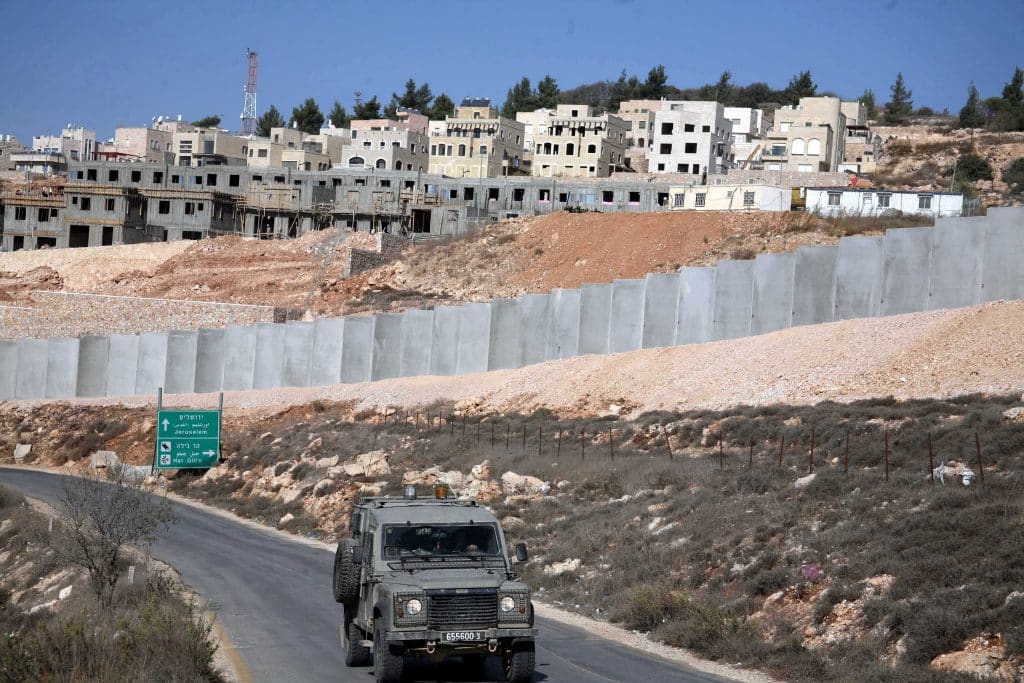
The UK has crossed a political Rubicon on Israel’s occupation of the West Bank. Yesterday, the Government recognised that Israel’s continued control over Palestinian territory is unlawful, bringing it into line with the International Court of Justice’s 2024 Advisory Opinion.
For decades, British governments have condemned Israel’s settlements as illegal while allowing the settlement project to expand with impunity. Palestinian communities have been displaced and Israeli control over the West Bank has become ever more entrenched. Yesterday’s announcement matters because it puts a concrete consequence behind that position: it will ban trade in goods and some services with illegal Israeli settlements.
The ban is welcome. But it should be the beginning, not the end, of this shift in policy. The UK now needs to address the wider policies and relationships it has pursued over the years that have allowed Israel’s unlawful occupation of the West Bank to become so deeply entrenched.
But this is not simply about where the dates and avocados on our supermarket shelves come from. It is about Palestinian land being violently seized, communities being fragmented, and Palestinians being denied the basic conditions to live safely, move freely and access healthcare. For Palestinians who have lived with this reality for decades, the question is whether and when this will begin to change the reality on the ground.
In July, a three-month-old Palestinian boy, Ahmad Maarouf Zaid, died after Israeli forces prevented his family from crossing a checkpoint for more than an hour as they tried to get him to hospital in critical condition. Weeks later, a Palestinian woman who was six months pregnant and suffering severe bleeding was held at a military checkpoint for more than 30 minutes while the ambulance carrying her was searched. Doctors saved her life, but her baby tragically died.
For Palestinians, these restrictions are part of everyday life. In the West Bank, there are now 925 movement obstacles, including checkpoints and road closures. A journey that should take minutes can take hours, or become impossible altogether. On average, Palestinians in the West Bank spend around 90 hours a month dealing with checkpoints, road closures and other restrictions on movement.
Between January and July this year, the World Health Organization recorded 98 attacks on healthcare in the West Bank, including 92 incidents involving the obstruction of healthcare. Eighty-three ambulances and other health transport were affected, as well as 11 health facilities. In July alone, there were 37 attacks on healthcare.
Yesterday’s announcement also had implications beyond the issue of settlement trade alone. The Government has now accepted what the International Court of Justice found in 2024: that Israel’s continued presence in the occupied Palestinian territory is unlawful. That should have consequences for how the UK responds to the system of control that has entrenched Israeli rule over Palestinian land and restricted Palestinians’ access to healthcare.
The Government also struck a new tone on Gaza, acknowledging that “there must be accountability” for what has happened there and hinting at further possible sanctions. Nearly a year into the so-called “ceasefire”, more than 1,300 Palestinians have been killed, while Israel’s “Yellow Line” has advanced to cover around 70% of Gaza, displacing our colleagues and communities we serve in the process. At the same time, vital aid and medical supplies remain critically obstructed while Gaza’s health system lies in ruins. Gaza cannot wait – the UK must follow its words with rapid action to puncture Israel’s impunity.
For Palestinians who have lived under this system for decades, the question is whether the UK’s ‘reset’ will make a difference to their lives. Can Palestinians move freely, reach healthcare and live safely in their own communities? For those living with the consequences of the occupation every day, recognition of their plight will only mean something if it is followed by an end to Israel’s violent occupation, its genocide in Gaza, and the escalating state-backed settler violence against communities across the West Bank.
Yesterday’s decision should mark a complete circuit break in the way the UK has dealt with Israel’s occupation for far too long. Israel’s control over Palestinian land has deepened while condemnation has too often stopped at words. The UK should now make sure this decision is followed by decisive and comprehensive action.
The UK has crossed a political Rubicon. It should not turn back.
“The UK has crossed a political Rubicon on Israel’s occupation of the West Bank.”
I would describe the UK’s actions and Ed Miliband’s speech in the House of Commons as a sign that the world is coming to its senses and refuses to be bullied anymore by charges of antisemitism. This Ha’aretz article covers it nicely:
“But what was most glaring about his speech was that he was stating the obvious. And he said it so clearly it sounded like a rallying cry for a new era of justice and accountability.
What was so obvious? That the two-state solution is the only path to Middle East stability. That Israel’s occupation of the West Bank is illegal. That the E1 settlement plan aims to bury a future Palestinian state. That Gaza is a site of “unconscionable” suffering. That violent settler attacks, backed by Israeli government ministers, are aimed at ethnic cleansing in the West Bank. That confronting the Netanyahu government is not the same as delegitimizing the State of Israel. That there is no contradiction between supporting the State of Israel and the State of Palestine. That British Jews are not the government of Israel. And that, when they choose, the international community can turn talk about red lines into real action.”
Israel, welcome to the sanctions era: UK heralds new reality that won’t end with Netanyahu
RE: “In the West Bank, there are now 925 movement obstacles, including checkpoints and road closures. A journey that should take minutes can take hours, or become impossible altogether. On average, Palestinians in the West Bank spend around 90 hours a month dealing with checkpoints, road closures and other restrictions on movement.”
SEE: “Permanent Temporariness” | by Alastair Crooke | London Review of Books | March 3, 2011
[EXCERPT] . . . A decade ago, I was a member of Senator George Mitchell’s staff on his first foray into the region, after he was asked to head a ‘fact-finding committee’ into the causes of the second intifada. Even then, Livni’s vision was evident in the Israeli strategy of excluding Palestinians from the body politic while making them subject to its methods of control. The Occupied Territories assumed an elastic, shifting geography in which the rule of law was suspended under cover of the law. It was [Ariel] Sharon who pioneered the philosophy of ‘maintained uncertainty’ that repeatedly extended and then limited the space in which Palestinians could operate by means of an unpredictable combination of changing and selectively enforced regulations, and the dissection of space by settlements, roads Palestinians were not allowed to use and continually shifting borders. All of this was intended to induce in the Palestinians a sense of permanent temporariness. Maintaining control of the Occupied Territories keeps open to Israel the option of displacing Palestinian citizens of Israel into the Territories by means of limited land swaps. It also ensures that Israel retains the ability to force future returning refugees to settle in their ‘homeland’, whereas a sovereign Palestinian state might decline to accept the refugees. It suits Israel to have a ‘state’ without borders so that it can keep negotiating about borders, and count on the resulting uncertainty to maintain acquiescence. . .
ENTIRE COMMENTARY ~ http://www.lrb.co.uk/v33/n05/alastair-crooke/permanent-temporariness