

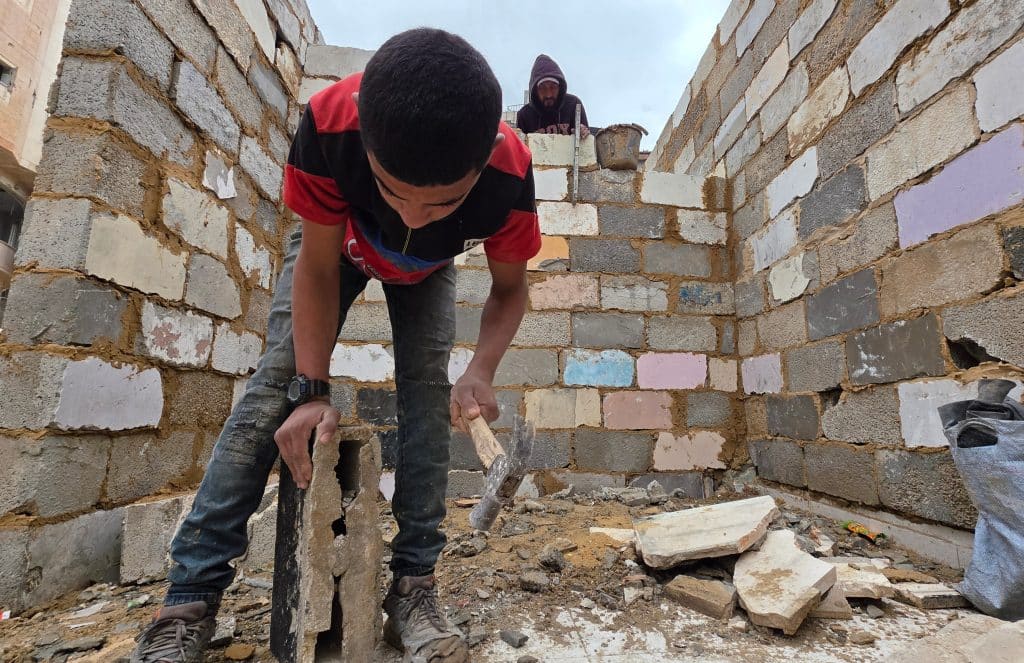
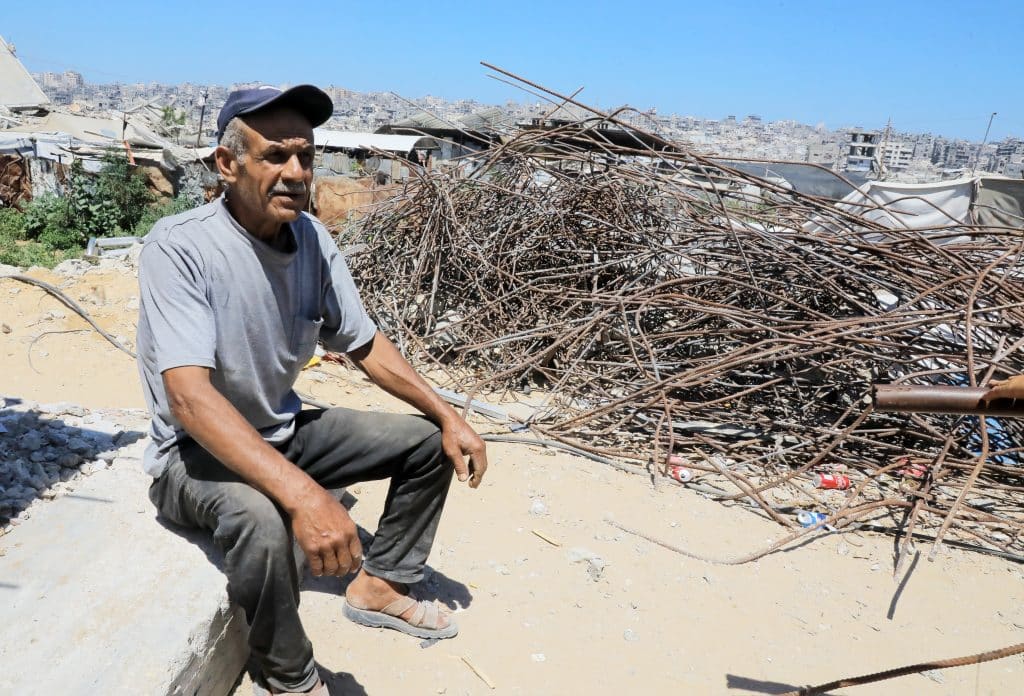
Next to his destroyed home in Khan Younis, Fayez Abu Shamala, 76, a Palestinian academic and former mayor of Khan Younis, is building again.
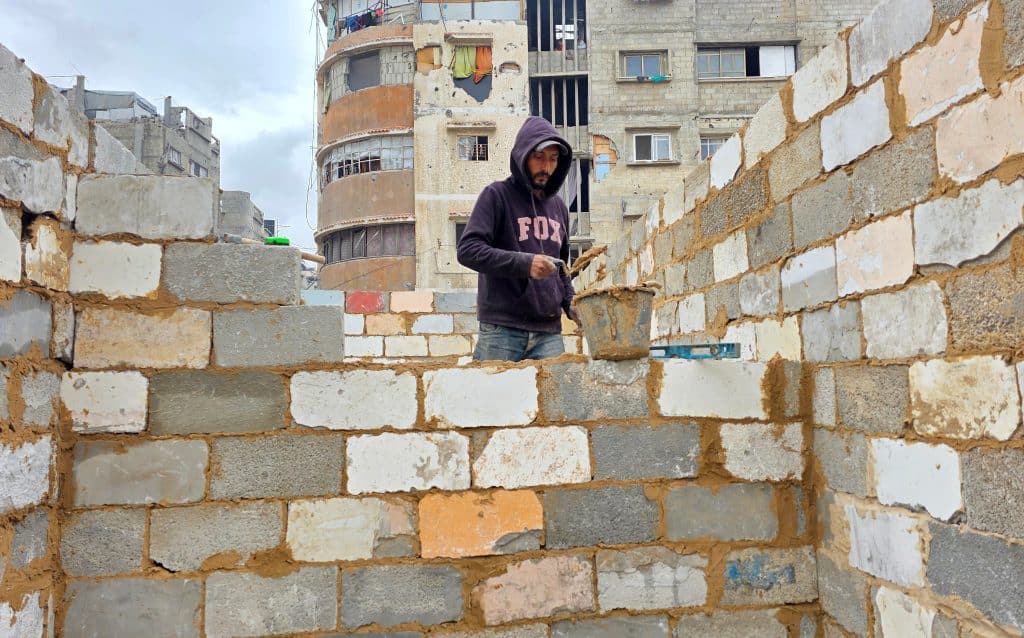
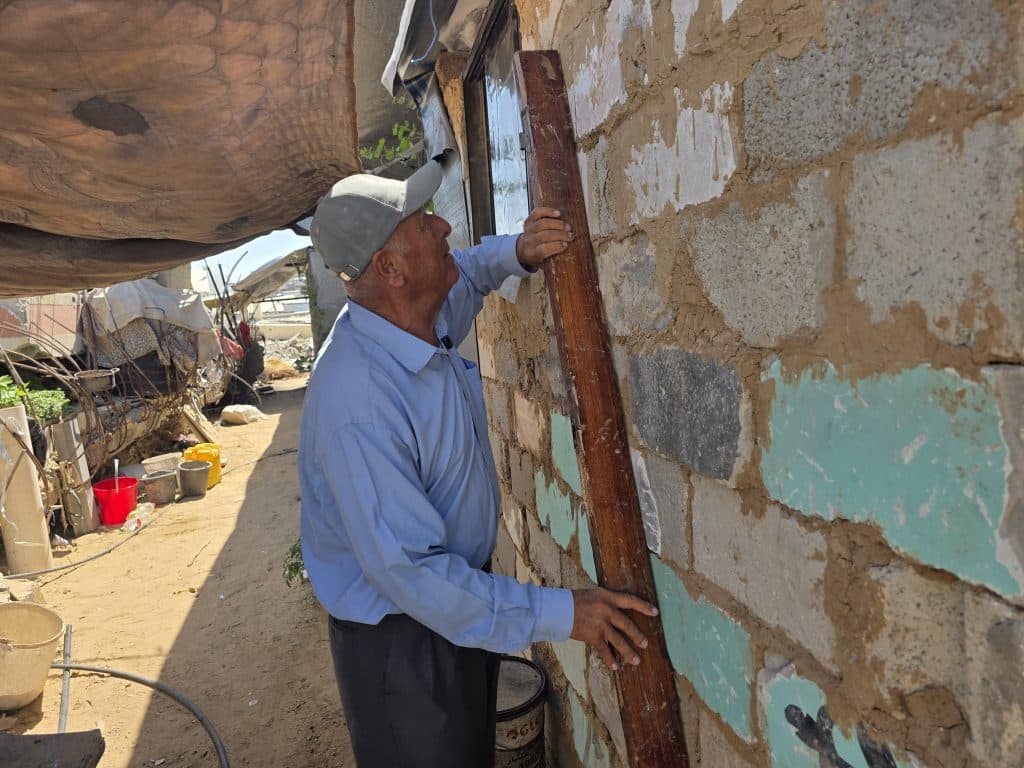
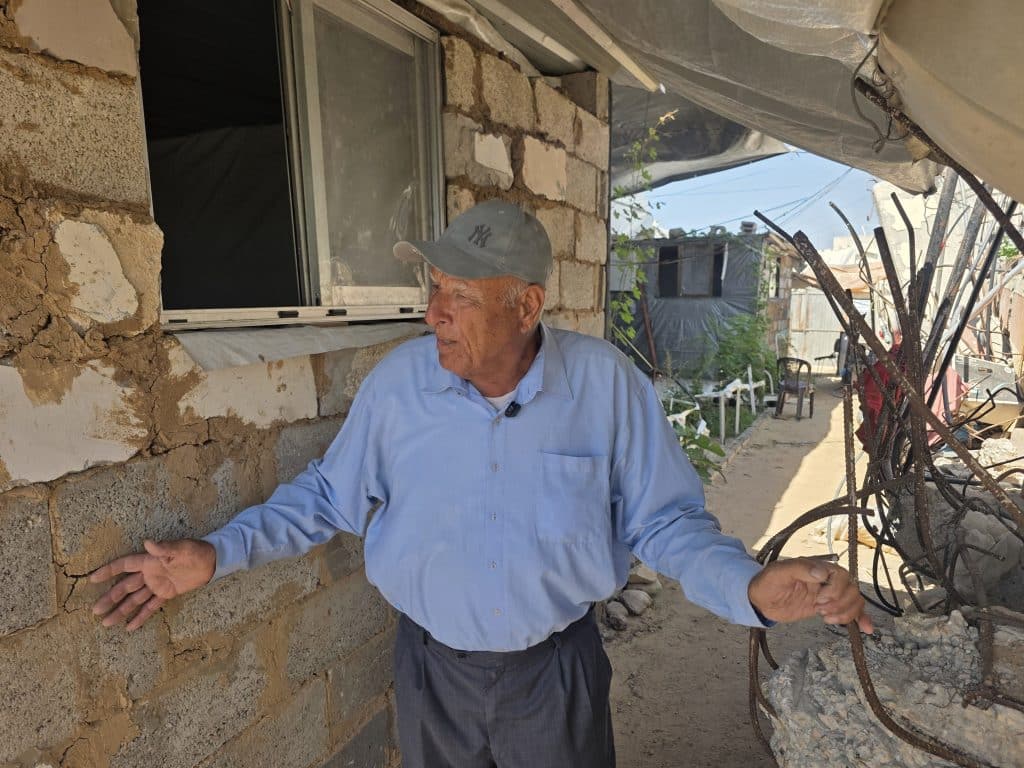
Abu Shamala salvaged usable stones from the debris of destroyed buildings, collected and repaired them, and, with the help of his family, built a small house. Instead of cement, unavailable anywhere in Gaza, he used clay to hold the stones together.
He then fixed pieces of nylon over the walls to protect them from rain. He also recovered some windows and doors from the wreckage, modified them, and installed them in what is now his home.
“I am here on my land,” Abu Shamala said. “To my right is the house I built, and to my left is the house the Israeli army destroyed. They are the destroyers, and we are the builders.”
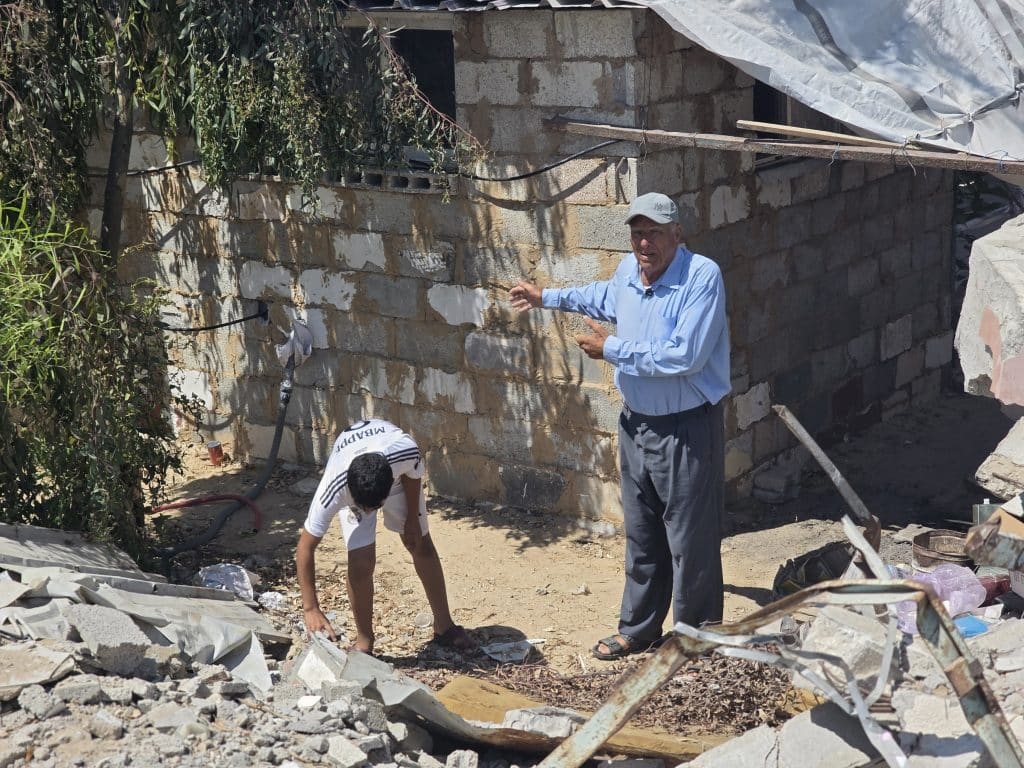
Abu Shamlah has slept in a mudhouse before, after he was displaced from his village in what is now the city of Ashkelon during the 1948 Nakba, when his family was forced from their land and lived for years in mud houses in the Gaza Strip. More than seven decades later, the cycle is being repeated across Gaza.
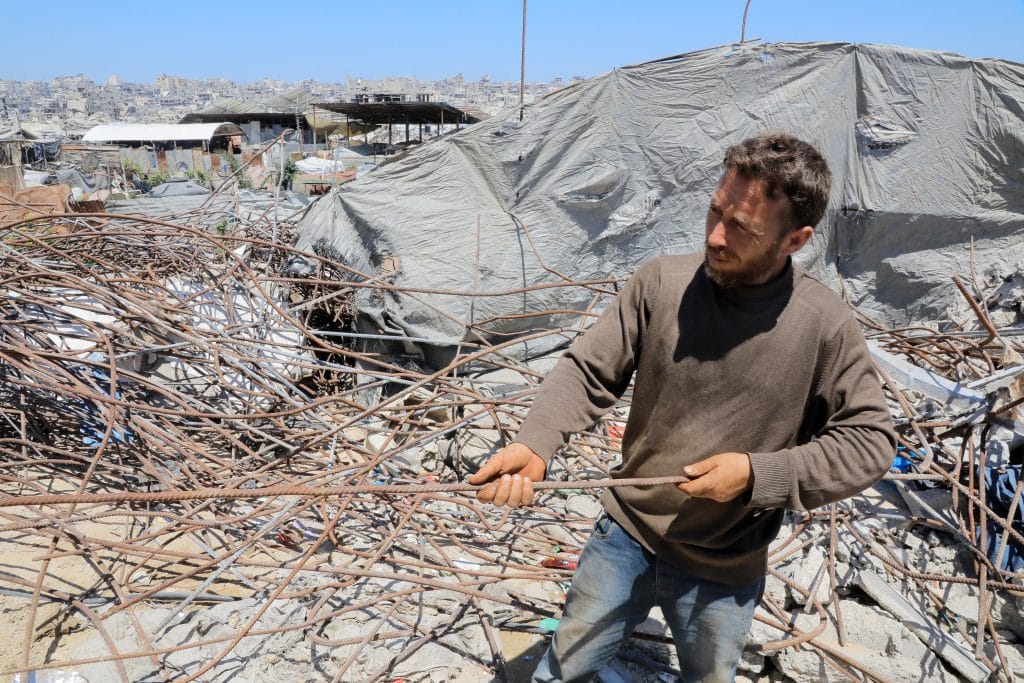
As Israel blocks the entry of cement, steel, and all conventional building materials, classifying them as “dual-use” items that could serve a military purpose, Abu Shamala and others across Gaza are constructing mud houses to brace for the cold and rainy season. By October 2025, UNOSAT satellite imagery found approximately 81 percent of all structures in the Gaza Strip had been damaged, with more than 123,000 destroyed outright. The UN estimates that the destruction generated 61 million tonnes of rubble. With large-scale reconstruction at a standstill, Palestinians are rebuilding with whatever they can salvage.
Alternatives to the alternatives
On August 15, the first two-story building in the Gaza Strip constructed entirely without banned building materials was unveiled. The building was constructed of steel rebar and aluminum on the inside and Jerusalem limestone on the outside. All the materials were extracted from the rubble.
The building, constructed by the Al-Rimal Company in Gaza City, will be used to run international organizations’ operations, including receiving and storing aid and overseeing its distribution across the Strip. Three engineers from the company planned and built the structure in collaboration with several professionals, technicians, and workers. It took them four months to complete.
“If it weren’t for the occupation, we would not have built this building,” said Younis Abu Mueilaq, one of the engineers who supervised the construction, meaning that the challenges imposed on Gaza ultimately forced the development of new and unprecedented approaches to rebuilding.
Al-Rimal Al-Taybeh is a partner of international organizations that operate warehouses across the Gaza Strip. As the war intensified and many of those warehouses were destroyed, the organizations began looking for alternatives once the situation became relatively calmer following the signing of the October 2025 ceasefire.
According to Abu Mueilaq, several alternative warehouses were established to replace those destroyed during the war, and as the company’s work with international organizations increased, an administrative building became necessary.
Israel continues to refuse to allow in the building materials needed for reconstruction, as well as the heavy machinery needed to remove the rubble, which has generated 61 million tonnes of debris — about as much as 15 Great Pyramids of Giza or 25 Eiffel Towers by volume, according to the UN. As a result, people in Gaza are turning to alternatives, some of which date back hundreds of years, such as mud houses, while others involve developing new methods that are expensive and beyond individuals’ means. Such projects are instead undertaken by companies and institutions, such as Al-Rimal Al-Taybeh, which constructed this building.
The building would ordinarily have been constructed with cement, Abu Mueilaq says, but since it remains unavailable due to Israel’s blockade, the team turned to construction metals recovered from destroyed buildings and modified them for reuse.
The external structure was mainly made of steel rebar fastened together with bolts. But when it came time to cover the structure with sheets of metal on the outside, as an alternative to cement, none was to be found.
“That was when we began looking for alternatives to the alternatives,” Abu Mueilaq said. “We started looking for whatever we could use. We found that there was a technique used in modern architecture in places such as Dubai, where the steel structure is covered with aluminum.”
Suitable aluminum was also unavailable in Gaza, either, so they eventually landed on another solution: Jerusalem limestone salvaged from destroyed buildings, cleaned and reused, to cover the structure. Each stone, five centimeters thick, was drilled at its four corners and fitted with a metal bracket to attach it to the steel structure.
“We placed one stone on top of another and secured them properly, and this beautiful structure emerged as a result of the hard work of the teams,” Abu Mueilaq said.
Once the exterior structure was resolved, the interior presented its own challenge.
Wood, cement, and suitable aluminum were all unavailable, but the team found aluminum used to manufacture kitchen cabinets — a material that had accumulated in warehouses because the other components needed to manufacture aluminum kitchens were unavailable. The aluminum was used to divide the building internally and create walls and partitions.
Abu Mueilaq says the project’s cost was extremely high, much like the cost of living in Gaza, he says, which increased many times over compared to before the genocide.
He also emphasizes that this experiment isn’t easily replicable. The materials used were recovered from within Gaza and cannot easily be salvaged or replaced.
“What we are using now cannot be used again later,” Abu Mueilaq explained.
The building, nevertheless, gave people something beyond shelter. “It gave people hope,” Abu Mueilaq said. “Hope that Gaza has the skilled workers, thinkers, and professionals capable of rebuilding their homeland if they are provided with the necessary resources.”

‘We are the builders’
Beyond the question of large-scale reconstruction, Palestinians have also resorted to ancient methods of building shelters that had been all but defunct for generations: using mud and clay to build houses.
Abu Shamala is one of them. The house he built from salvaged stones and clay is not large enough to accommodate his entire family, but it is a shelter. Still, it is a far cry away from what was once his family home of 500 square meters, made up of four stories that housed an extended family of over 20 people.
But Abu Shamala also worries about the approaching rainy season, since rain can dissolve the mud walls, and he cannot yet predict what will happen to the structure in such conditions.
“Obtaining clay is not straightforward either,” he explained. Khan Younis, where he lives, is divided into two areas: the eastern part, where clay can be located, and the western al-Mawasi area, which is sandy. The problem is that the clay-bearing eastern region is controlled by the Israeli military, beyond the so-called “Yellow Line” that demarcates the parts of Gaza divided between Israeli and Hamas control.
“Obtaining clay can sometimes come at the cost of lives,” Abu Shamala said. But despite the difficulties, he says building the house has given him a sense of movement toward stability, particularly after realizing that the Israeli occupation will not initiate or enable reconstruction and is instead increasing its restrictions on it.
“We are here, confronting the blockade and the aggression, trying to create life,” he said. “We are rebuilding our lives with our weak and limited resources, but we remain steadfast on our land.”
Abu Shamala says Israel accuses Palestinians of being destroyers, gesturing at the carnage surrounding him. “Here is a clear picture of who destroys and who builds. We build, and the enemy destroys.”
“This is the evidence of our love for our land,” he continued. “Of remaining steadfast on the land where we were born and raised, which gives back to us in equal measure to our affinity for it.”
He says he is part of a people that refuses to die and refuses to disappear.
“Despite the destruction, the bombing, the blockade, the deprivation of water and food, and the prevention of reconstruction, and despite all the crimes committed against us by the Israeli enemy, this is a people that builds its land with the barest of resources,” he said.
Tareq S. Hajjaj
Tareq S. Hajjaj is the Gaza Correspondent for Mondoweiss and a member of the Palestinian Writers Union. Follow him on Twitter/X at @Tareqshajjaj.


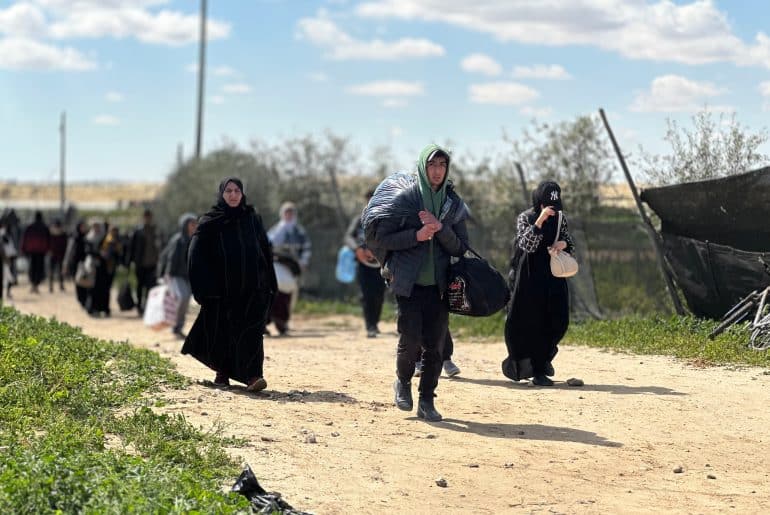
““Obtaining clay can sometimes come at the cost of lives,” Abu Shamala said. But despite the difficulties, he says building the house has given him a sense of movement toward stability, particularly after realizing that the Israeli occupation will not initiate or enable reconstruction and is instead increasing its restrictions on it.
“We are here, confronting the blockade and the aggression, trying to create life,” he said. “We are rebuilding our lives with our weak and limited resources, but we remain steadfast on our land.”
Since the mid 70’s when I heard Prof Edward Said speak about the history and plight of the Palestinians I have tried to stay aware, informed and done what I could about the horrific injustices the Palestinians have suffered at the hands of right wing, violent Zionist terrorist.
As I read the piece above I again wept wondering what else we can do. I contact Reps, I call and write into main stream media outlets begging, demanding they report about the decades long conflict. Not until the full on genocide (for decades a persistent but slow ethnic cleansing) that Israel has and continues to commit against the Palestinians has the U.S. msm kind of reported about the massive and serious genocide. Rachel Maddow other mainstreamers barely ever mentioned. Still there is a deafening silence about conditions in the refugee camps, millions living in tents, hunger, lack of clean water and other basics. I thought the occupying power was legally supposed to supply the basics. That would be Israel.
Have donated to Doctors W/O Borders, World Food Programme in honor of relatives and friends. Most of all in honor of those who are still suffering in Palestine.
Tariq can you suggest which organizations you think are most effective.
My last phone call into Washington Journal ( been calling in for over 20 years) asking them to cover this critical issue. They do not.
my comment/suggestions: at 12:58…..https://www.c-span.org/program/washington-journal/open-forum-part-2/684542