

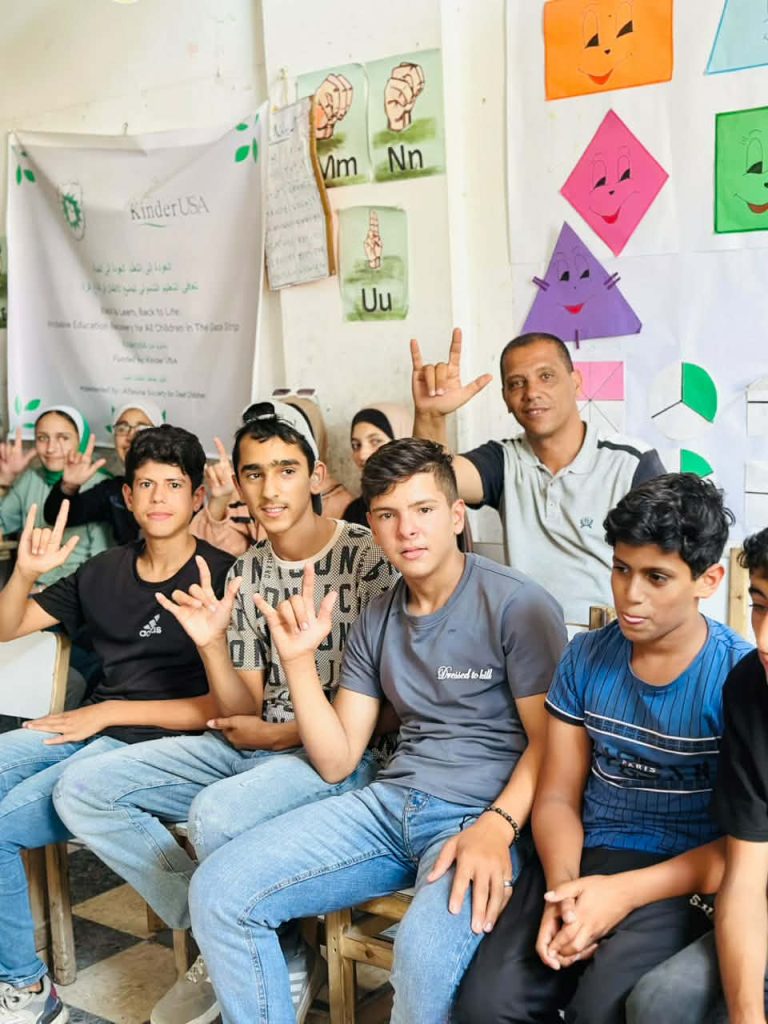
Zuhdi Murtaja, a deaf man working in a community kitchen serving children with hearing disabilities in Gaza City, posed a question in sign language.
“How can we protect ourselves if we can’t hear the bombings or the warnings? And where is the safe place?”
Fadl Kuraz, a sign-language interpreter and trainer who has spent more than three decades working with Gaza’s deaf community, paused before answering.
“There isn’t always a safe place,” he told him.
Instead, Kuraz gave him practical advice: watch the people around you. If they suddenly start running, run with them. Carry a card that says, “I am deaf. I need help.”
For Gaza’s deaf community, the war has added a layer of danger that is largely overlooked amidst the inhumane conditions with which the whole population grapples on a daily basis. Unable to hear incoming strikes, evacuation orders, or emergency sirens, they are fully dependent on others to interpret a rapidly changing reality — and in a war that has killed more than 73,000 people and displaced nearly the entire population of the Strip, that dependence has become a matter of survival.
A 2023 UNDRR survey of more than 6,000 people with disabilities across 132 countries found that 56 percent either were unaware of disaster-risk information available in accessible formats or could not access it. In Gaza, where the infrastructure for reaching people with disabilities has largely collapsed, this gap is acutely felt.
Kuraz has become one of the few people still trying to close it.
“The hardest thing deaf people face during the war is not only the bombing,” Kuraz says. “It is being unable to access information when they need it most.”
Kuraz — who holds a master’s degree in educational psychology and studied special education in Jordan with a focus on hearing impairment — dedicated the years before the genocide to helping the hearing impaired. This included sign-language education, supporting deaf students, helping teachers communicate with them, and running training sessions at the Atfaluna Society for Deaf Children, one of Gaza’s primary organizations serving people with hearing disabilities.
The war has entirely changed the demands of that work.
He now moves between educational points established by Atfaluna across displacement areas and neighborhoods, including al-Shati, al-Nasr, Sheikh Radwan, al-Jalaa, and Tal al-Hawa in Gaza City — all of them tent structures within shelter centers, lacking the basics. His work often starts with questions about the students rather than their lessons: How are they coping? Have new families arrived? Does anyone need batteries for a hearing aid? Has anyone developed hearing problems after another night of bombardment?
A different kind of access
At an educational point run by Atfaluna in the Jalaa area of Gaza City, a distant blast interrupts the activity. The vibrations cause some children to freeze. Others turn toward Kuraz.
He reassures them through sign language, and the teachers move them to simple games and activities. Within minutes, the children are laughing and competing for his attention.
Kuraz keeps his expression calm. This, he says, is among the most demanding parts of the work.
“I have to control my emotions and my facial expressions within seconds,” he says. “If I lose that control, the children will lose their sense of safety.”
The pressure does not end when he leaves. “The fear I suppress during the day catches up with me at night,” he says.
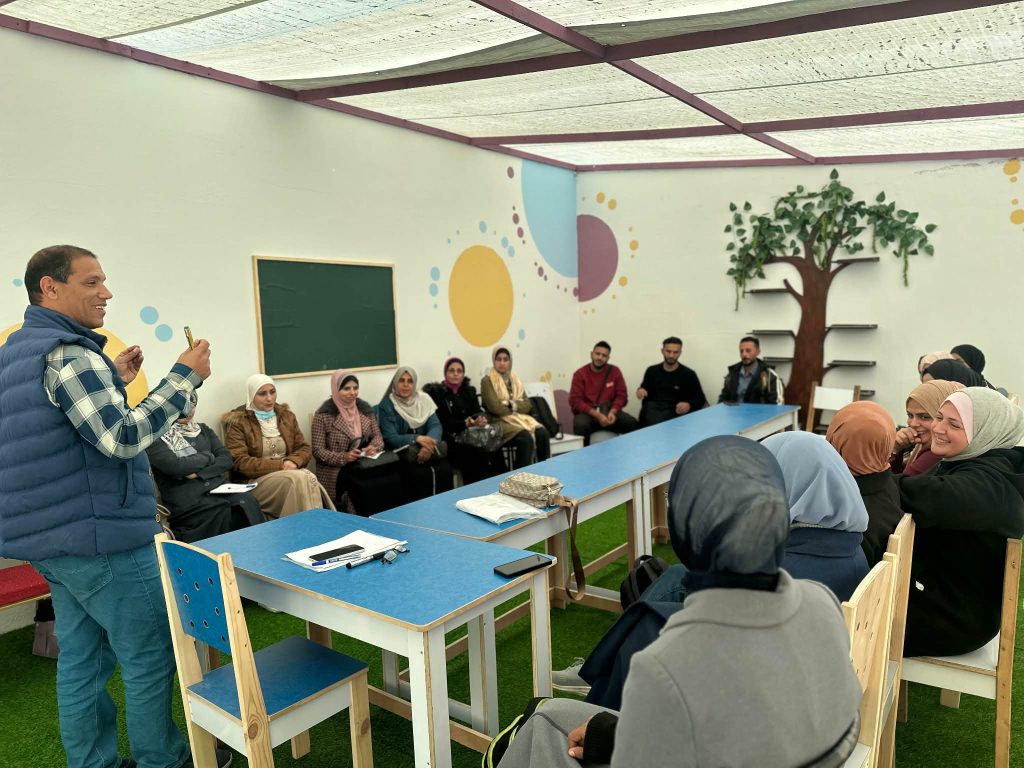
Many of the teachers working with deaf students are hearing educators whose sign-language skills continue to develop through practice. Kuraz works with them to strengthen their communication with students and better understand their needs.
“There are always new expressions, new situations, and signs that teachers don’t know,” he says. “I help strengthen their language because language is what connects these children to education.”
But education is only one part of the problem.
For deaf Palestinians, information that hearing people may receive automatically — through conversations, public announcements, television, or warning sirens — often has to be made accessible in another form.
During active Israeli attacks, that gap can have immediate consequences. When Kuraz meets students, they often want to know what has happened outside the classroom: Where was the bombing? Which neighborhoods were affected? Is there an evacuation? What is happening outside the shelter?
“They need someone to explain what is happening around them,” Kuraz says. “Political developments, humanitarian conditions, and changes in their communities — things that many hearing people receive naturally, but deaf people often cannot access.”
Murtaja himself has become part of that information network. A graduate of al-Rafa’i School for the Deaf in Gaza City, he completed university through a program specifically designed for deaf students. During the war, alongside his work at the Atfaluna kitchen, he administers a WhatsApp group and remains continuously present alongside Kuraz, monitoring political news and developments and helping pass information to the deaf community.
The problem extends beyond information sharing. Displacement has made it harder for deaf people to reach services, while many shelters, health facilities, and humanitarian responses are not designed around their communication needs.
“The challenge isn’t only reaching deaf people,” Kuraz says. “It’s that the services themselves are often not designed with them in mind.”
Access to hearing aids and their essential supplies has also been a persistent challenge. Atfaluna has previously reported that families of people with hearing disabilities struggled to obtain hearing-aid batteries and other necessary assistive equipment during periods of conflict. The challenge has continued amid Gaza’s wider shortages and disruption to essential services.
Measuring hearing loss
The scale of war-related hearing impairment in Gaza remains difficult to measure precisely — but the available data points to a crisis that is vast and largely invisible.
Before the war, approximately 20,000 people in Gaza were estimated to be living with hearing disabilities, according to data from rehabilitation centers and specialized associations cited by Al Jazeera. Field workers warn the number has risen sharply since October 2023, with estimates now reaching 30,000 to 40,000 people with hearing loss or impairment — many of them children.
The Global Protection Cluster’s July 2025 report estimated that over 35,000 people in Gaza have sustained significant hearing damage due to explosions. The same report noted that while comprehensive data on hearing and vision impairments resulting from hostilities is not consistently tracked, organizations working with people with sensory impairments report a substantial rise in the number of people with hearing and visual difficulties seeking services.
Atfaluna’s own assessments provide a further indication of the scale. Between December 2024 and August 2025, the organization screened 32,753 people and identified 2,500 children and adults with new hearing impairment as a direct consequence of the conflict.
That figure is not a total count, as it only reflects cases identified among those assessed. Gaza’s deaf community now includes people who were deaf before October 7, 2023, as well as people who developed hearing impairment during the attacks. Their communication needs are not always the same. Someone deaf from birth has usually developed sign language and a framework for navigating a world without sound. Someone who loses their hearing during a bombardment faces a sudden and disorienting loss, with no language to replace what sound once carried, and no established community to turn to.
On top of that, the organizations trying to help them face acute shortages themselves. Hearing devices, batteries, and cochlear implant parts remain severely restricted due to import limitations, according to Al Jazeera’s reporting. Many rehabilitation centers providing speech therapy and psychological and educational support have been damaged or destroyed.
For Kuraz, the work continues regardless. At the educational points, he helps teachers and students communicate despite displacement and repeated interruptions. And when the situation outside changes, the questions are often the same ones he heard from Murtaja at the start of the war:
What happened? Where should we go? What happens next?
Murtaja has not stopped asking them or helping others find the answers. In the WhatsApp group he runs, news circulates among deaf community members who would otherwise have no way of knowing what is happening around them. It is a small system, built from almost nothing, in the middle of a war.
“If they see fear on my face,” Kuraz said, “it will become theirs.”
Israel is “organised and prepared” to remove Palestininians from Gaza “by every way possible”, Defence Minister Israel Katz told reporters Wednesday, adding that there was no alternative “solution” to crisis. The Israeli government was simply waiting for the US to figure out where to take the displaced Gazans, he said. ….Forced displacement of civilians in occupied territory is considered a war crime under the Geneva Conventions.
Israel ‘organised and prepared’ to remove Gaza population if US gives green light, Katz says – France 24
Israel Katz says Palestinians will leave Gaza | Middle East Eye
Relevant to Gaza:
The Israeli army “kills first, then thinks and tries to find a reason” afterward to justify strikes on the Gaza Strip, said the executive director of Israeli veterans’ group Breaking the Silence, Anadolu reports….In an interview with France 24, Nadav Weiman said the army and Israeli authorities seek to “retrospectively” legitimize attacks by attempting to establish links between victims and Hamas or Palestinian Islamic Jihad after strikes have taken place.
“In cases like this Nasser hospital or the 15 paramedics that were killed by IDF (Israeli army) soldiers in Rafah, or air strikes that are killing three-digit numbers of civilians in Gaza … suddenly the IDF spokesperson in the state of Israel needs to explain to the international community what we did over there and who are the targets for the attack,” Weiman said….Weiman said that intelligence personnel compile the names of those killed and then search for evidence that can establish a connection, such as having a relative linked to Hamas or the Palestinian Islamic Jihad movement, being near a building identified as belonging to Hamas or having once been on a payroll.
Israeli army ‘kills first, then seeks justification’ for Gaza strikes, says veterans group chief – Middle East Monitor