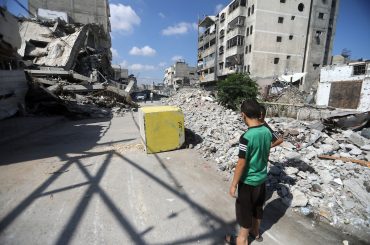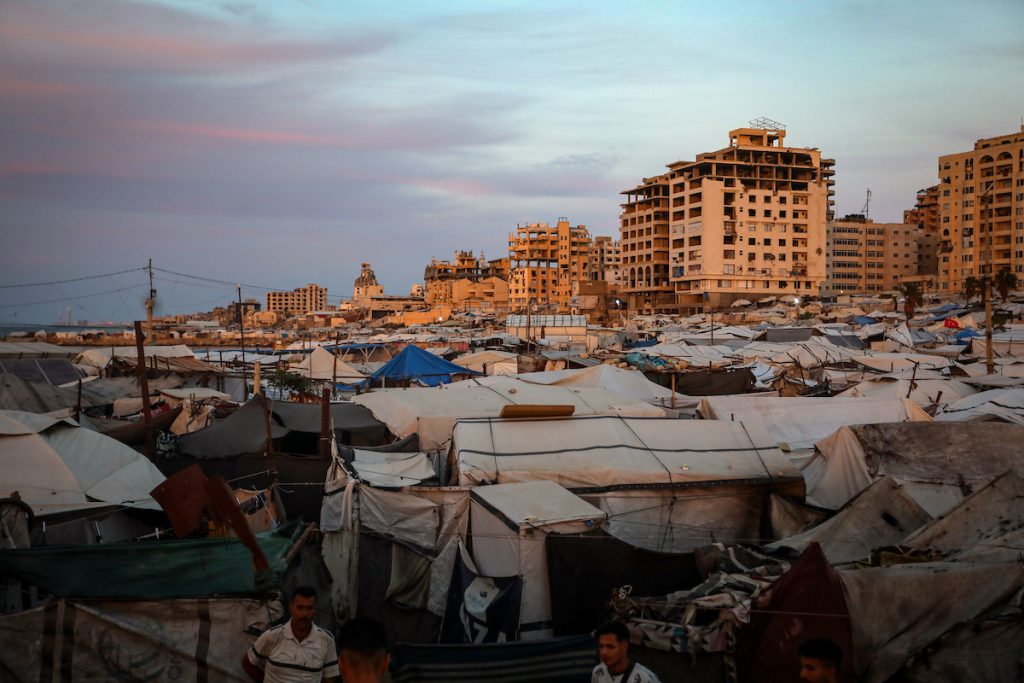
In the Al-Mawasi area west of Khan Younis, 40-year-old Samira Othman lives in a tent with her husband, Mohammed Othman, their five children, and her elderly father-in-law. The family was displaced from Beit Lahia in northern Gaza on November 18, 2023, after being forced to leave their home in search of safety. Their house was later bombed on May 1, 2024.
The family’s shelter lacks even the most basic sanitation facilities, which makes it difficult to find a suitable place to relieve themselves. Running out of options, they have built a makeshift toilet by digging a hole in the ground and placing two wooden planks over it.
“We have no proper sanitation facilities and are forced to use this method, despite the difficulties it causes and the lack of hygiene and privacy,” Samira told Mondoweiss.
The family’s situation is particularly difficult because Samira’s elderly father-in-law struggles to use the makeshift toilet. This prompted them to consider installing a prefabricated toilet cubicle that would better meet his needs.
“We tried to install a toilet cubicle so that my father-in-law could use it more easily, but it costs 2,000 shekels, an amount beyond our financial means. He is an elderly man who needs a suitable place where he can use the toilet with dignity,” Samira said.
The family fears the spread of disease due to the poor sanitary conditions, especially since their five children share the makeshift facility. Before the war, Mohammed had worked as a driver. Losing his source of income and the deterioration of economic conditions since the beginning of the genocide have made providing for his family an increasingly difficult daily struggle. Even installing a basic toilet has become an additional financial burden for a family already struggling to meet its essential needs.
A joint assessment conducted by the United Nations’ Global WASH (Water, Sanitation, and Hygiene) Cluster reveals the scale of the sanitation crisis in Gaza. According to the data collected in August 2025, around half of the households surveyed relied on shared, inadequate, or unsafe toilets, while 21 percent used buckets to dispose of human waste. Nearly 60 percent of households also reported sewage or human waste within ten meters of their shelters. These figures highlight the health and environmental risks facing displaced families amid the deterioration of sanitation infrastructure and overcrowding in displacement sites.
In an informal displacement camp consisting of around ten tents in the Nuseirat area of central Gaza, ten related families share a single toilet. After renting a plot of land and setting up their tents there, the families decided to pool their resources to build a shared sanitation facility. With the cost of installing a prefabricated toilet cubicle at approximately 2,000 shekels, each family contributed 200 shekels to build one toilet for everyone, including children and the elderly.
A member of one of the ten families, Abdel Hakim al-Razi, 40, said that people often have to wait in line for their turn to use the shared bathroom. “Sometimes someone wakes up in the middle of the night needing to use it, only to find others already waiting. They have no choice but to stand and wait until their turn comes,” he said.
“The same problem arises when we wake up for dawn prayers. We need to use the toilet and perform ablutions, but we have to wait because it is overcrowded. The toilet is at the far end of the plot, away from the tents, which makes things even more difficult, especially at night,” al-Razi said.
Even when families can afford to install a prefabricated toilet cubicle, water shortages and the absence of a sewage network can further complicate the situation, leaving the shared facility as the only available option. Long queues during the night and early morning have turned a basic daily necessity into a recurring hardship for families living together in a limited space with scarce resources.
From his experience working in the field, Sajed, an employee of Al-Zahra Municipality, has observed the sanitation challenges facing displaced families in informal camps across Gaza. According to Sajed, the spread of tents across rented plots and open spaces, far from sewage networks and adequate infrastructure, has made providing toilets and disposing of human waste a daily challenge, particularly as the number of displaced people increases while municipal resources remain limited.
“Displaced families are living in extremely difficult conditions,” he said. “Many are forced to build makeshift toilets or share a single facility among several families. The problem goes beyond providing a place to relieve themselves. They also need water, sewage networks and safe ways to dispose of waste.”
“When large numbers of families gather in a small area, a single toilet ends up serving dozens of people, including children and elderly residents. Such intensive use increases the need for regular cleaning, maintenance and emptying, all of which require equipment, materials, and resources that are not always available,” he said.
Sajed explained that the absence of sewage networks in many displacement sites increases environmental and health risks, as waste can seep into the soil or accumulate near tents, contaminating the surrounding environment and contributing to the spread of disease, particularly when water for personal hygiene and cleaning facilities is scarce.
“The problem is that building a toilet alone is not enough,” he said. “A complete system is needed, including water, drainage, waste removal, and cleaning. Families need facilities that protect their health and dignity, while municipalities need the resources to respond to these needs.”
The crisis reflects the growing gap between the needs of displaced people and the sanitation services available to them. Clean and safe toilets have become an essential necessity that many families struggle to secure.
Dr. Mohammed al-Haj is an emergency physician at Al-Aqsa Martyrs Hospital who treats patients suffering from the direct medical consequences of inadequate sanitation facilities. He warns that continued exposure to contaminated environments increases the risk of infection, particularly among children.
“When human waste contaminates the areas where families live, the risk of bacterial and parasitic infections increases. Infection can spread through contaminated hands, water, or food. We receive patients suffering from health problems associated with contamination, particularly gastrointestinal disorders and diarrhea,” Dr. al-Haj told Mondoweiss.
Dr. al-Haj explained that repeated episodes of diarrhea pose a particular danger to children because they can lead to dehydration and the loss of fluids and essential salts. In some cases, the condition can develop into complications requiring medical intervention, especially among infants.
“There are also skin diseases and infections that can result from poor hygiene and continuous exposure to contaminated environments. This is exacerbated by people living in overcrowded conditions with limited access to water, bathing facilities, and cleaning supplies,” he said.
Dr. al-Haj emphasized that addressing these health risks requires preventive measures, including improving public hygiene, monitoring water sources, ensuring the safe disposal of human waste, and providing early treatment for infections to prevent relatively minor illnesses from developing into more serious conditions.
Between makeshift holes in the ground and shared toilets in camps, humanitarian needs continue to grow amid ongoing displacement and deteriorating living conditions in Gaza, where displaced families are struggling to recover the most basic standards of health, privacy, and dignity.