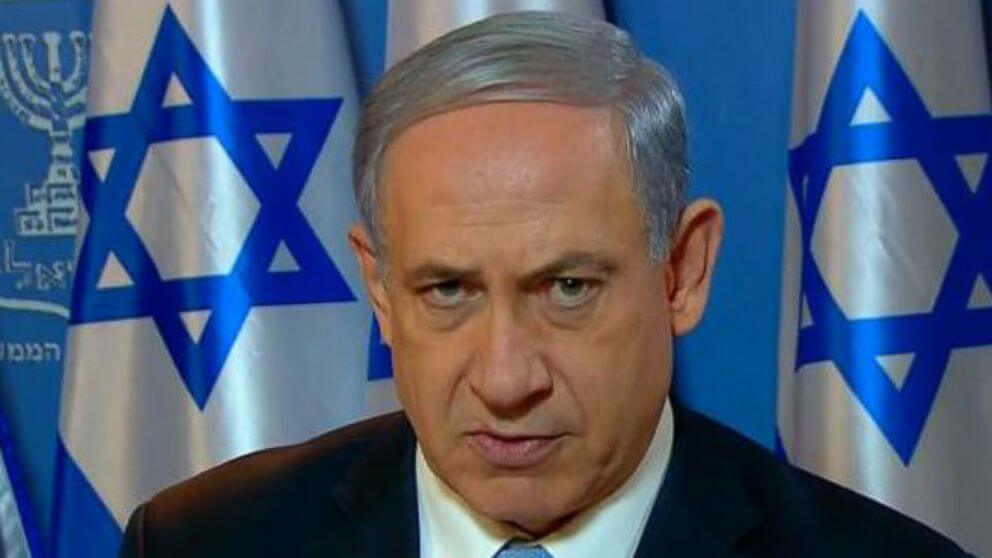
Benjamin Netanyahu is reported to be anxious about a Trump White House. Why? However hawkish Netanyahu appears to outsiders, he is relatively moderate compared to the rest of his government coalition partners and the Israeli prime minister could find himself outflanked by Naftali Bennett if the Trump administration approves settler demands to annex most or all of the West Bank. Netanyahu’s realization of his Greater Israel dream may prove pyrrhic.
European governments – fearful of upsetting Israel’s patron in Washington – have been trying to hold in check popular anger at a belligerent and unrepentant Israel.
It was presumably intended as an Israeli history lesson to the world. A video posted to social media by Israel’s foreign ministry shows an everyday Jewish couple, Jacob and Rachel, in a home named the “Land of Israel”. A series of knocks on the door brings 3,000 years of interruptions to their happiness. First it’s the Assyrians, followed by the Babylonians, Hellenists, Arabs, Romans, Crusaders, Mamluks, and Ottomans – all straight out of Monty Python central casting. The chauvinism in portraying Jacob and Rachel as the only normal folk, stoically enduring barbarians butchering each other in their living room, is ugly enough. But it is harder still to take seriously an account in which the Palestinians suddenly appear out of nowhere in 1948, as Britain departs.
The clearest message from Israel’s new $38 billion aid package is one delivered to the Palestinians: Washington sees no pressing strategic interest in ending the occupation. It stood up to Netanyahu over the Iran deal but will not risk a damaging clash with Israel and its loyalists in Congress over Palestinian statehood.
A new Israeli political group called Decision at 50 aims at ending the occupation of the West Bank, but its guiding assumption is that yet again the Israeli public should determine unilaterally the Palestinians’ fate. It has nothing to say about the occupation of Gaza or East Jerusalem, and offers no answer to the subjugation of Palestinians.
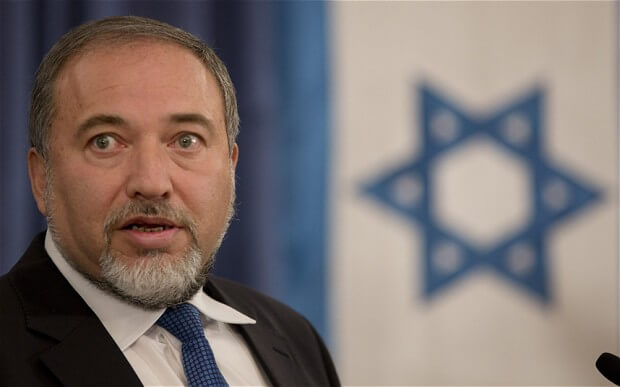
Launched this month, Avigdor Lieberman’s plan for the Palestinians – retooling Israel’s occupation – received less attention than it should. It includes, the defense ministry producing a map of the West Bank marking in green and red the areas where, respectively, “good” and “bad” Palestinians live. Collective punishment will be stepped up in towns and villages in red areas, while green areas will reap economic rewards.
It is possibly Israel’s darkest secret, in a country whose short history is replete with dark episodes. Last month Tzachi Hanegbi, minister for national security, became the first government official to admit that hundreds of babies had been stolen from their mothers in the years immediately following Israel’s creation in 1948. In truth, the number is more likely to be in the thousands.
In an effort to apologize for last year’s notorious election-day comment when he warned that “the Arabs are coming out to vote in droves,” Israeli prime minister Benjamin Netanyahu took to social media to last week to urge Palestinian citizens to become more active in public life. They needed to “work in droves, study in droves, thrive in droves,” he said. “I am proud of the role Arabs play in Israel’s success”. Swiftly and predictably, the reality of life for Israel’s 1.7 million Palestinians upstaged Netanyahu’s fine words. In a radio interview, Moti Dotan, the head of the Lower Galilee regional council, sent a message to his Palestinian neighbors: “I don’t want them at my [swimming] pools.” Sounding like a mayor in the southern United States during the Jim Crow-era, he added: “Their culture of cleanliness isn’t the same as ours. Why is that racist?”
The grubby underside of US electoral politics is on show once again as the Democratic and Republican candidates prepare to fight it out for the presidency. And it doesn’t get seamier than the battle to prove how loyal each candidate is to Israel. New depths are likely to be plumbed this week at the Republican convention in Cleveland, as Donald Trump is crowned the party’s nominee. His platform breaks with decades of United States policy to effectively deny the Palestinians any hope of statehood. The question now is whether the Democratic candidate, Hillary Clinton, who positions herself as Israel’s greatest ally, will try to outbid Trump in cravenly submitting to the Israeli right.