Thousands of Palestinians across the occupied West Bank and besieged Gaza Strip participated in massive demonstrations on Monday, the 70th anniversary of the Nakba. Azhar Abu Srour, a Palestinian refugee who was at a protest in Bethlehem, told Mondoweiss, “I am here as a refugee, to demand my right of return to my homeland, Beit Nattif, which we were expelled from 70 years ago. I am also here to protest against the massacre of our Palestinian brothers and sisters in Gaza, who have been protesting for weeks, for this same basic right of return.”
Hundreds of Palestinians took to the streets of Jerusalem in protest as American and Israeli officials celebrated the inauguration of the US Embassy in Jerusalem on Monday, the eve of the 70th anniversary of the Palestinian Nakba. “In America, they have the statue of liberty and pride themselves on freedom, but then they come to Palestine and support the racism of the Israeli occupation,” local activist Mohammed Abu al-Hummus told Mondoweiss. “This move shows us that they do not understand the true meaning of democracy.”
Doctors in Gaza have expressed concern that protesters in the “Great March of Return” have been targeted in the legs by Israeli live fire. Mondoweiss visits the Médecins Sans Frontières clinic in Gaza to hear who doctors and meet the injured Palestinians whose lives have been changed forever.
The Israeli border police officer who shot and killed Palestinian teenager Nadim Nuwara in 2014 was sentenced on Wednesday by an Israeli court to nine months in prison and a $13,940 (50,000 NIS) fine for negligent homicide. Nuwara’s father Saim said the sentence “does not even come close to justice.”
As the Great March of Return enters its fourth week, Nabeel Diab of the National Commission to Break the Siege of Gaza tells Mondoweiss: “The Palestinian people are eager to achieve their freedom, their independence, and their right to return to the villages where they were forced out of 70 years ago.” Diab is a member of a grassroots organization of activists who helped plan the march. He says that Israeli government claims that the protests are Hamas-led “are lies, and are defamatory statements that have no basis in reality.” Diab tells Mondoweiss: “This march is the embodiment of popular action involving children, women, and involving all the Palestinians that refuse to accept the occupation of our land.”
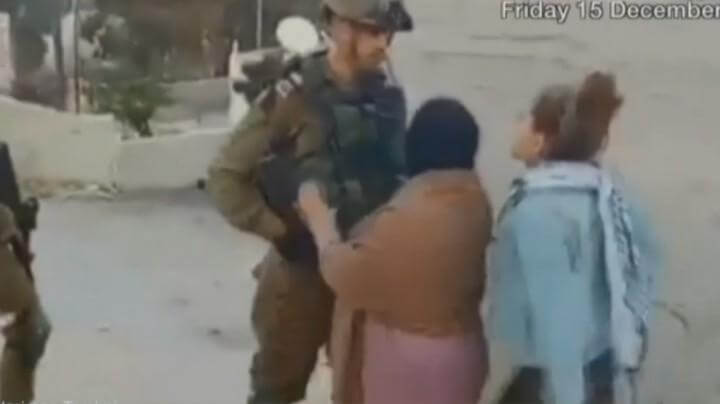
The family of Ahed Tamimi, the 17-year-old Palestinian activist who was imprisoned in December for slapping and kicking an Israeli soldier, released footage of the teenager’s interrogation during a press conference in Ramallah on Monday. The footage shows Tamimi resisting all efforts by the Israeli interrogators to coerce her into confessing to a number of charges and giving information about her family. “All of these tactics were used to try to break the symbol, the embodiment that Ahed has created through resisting the occupation,” Ahed’s father Bassem Tamimi said.
On March 30th, thousands of Palestinians from across the besieged Gaza Strip launched “The Great March of Return,” to demand their right to return to their pre-1948 homelands in historic Palestine. Since then, at least 29 Palestinian protesters have been killed, including a journalist and at least two minors. In this video, Palestinians who are putting their lives on the line to join the protests in Gaza explain why they are taking such a risk.
Earlier this month, Israeli police forces dressed in civilian clothes broke into the Palestinian al-Mujahidin cemetery and destroyed the tombstones of seven Palestinians killed by Israel.
Ahed Tamimi, the 17-year-old Palestinian who was imprisoned in December for slapping and kicking an Israeli soldier, has reportedly reached a plea bargain to serve eight months in prison including time served. She would be released in July along with her mother, who video’d the incident, according to preliminary reports.
Israel’s military appeals court ruled on Monday against an appeal by 17-year-old Palestinian activist Ahed Tamimi and her defense team to hold the teenager’s trial proceedings in open court, citing historical “benefit” of closed-door trials for minors. Fadi Quran, coordinator of the Free The Tamimis campaign, tells Mondoweiss, “The military can close the courtroom doors but it cannot close people’s’ eyes to the injustices that are happening.”