“You were washing the floors just like any other prisoner,” NPR reporter Daniel Estrin says to former Israeli PM Ehud Olmert in a long and respectful interview. But more than 4,000 Palestinian political prisoners are held on different terms by Israel, conditions cited by human rights reports charging apartheid– a charge that was unmentioned by the radio reporter.
The rightwing Israel lobby is enraged by the new report by the Special Rapporteur to the U.N. accusing Israel of “apartheid”– a “landmark moment of recognition of the lived reality of millions of Palestinians,” says Amnesty International. But J Street has had nothing to say about the report. It surely hopes it will go away, because these reports foster demands among progressives to actually do something about human rights violations beyond acknowledging their existence.
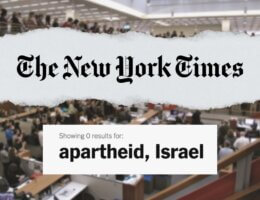
New York Times Jerusalem bureau chief Patrick Kingsley used a fresh apartheid report, by U.N. special rapporteur Michael Lynk, to finally slip Amnesty International’s apartheid finding into the paper. Kingsley wrote that Lynk, a distinguished Canadian law professor appointed by the U.N.’s Human Rights Council, had “accused Israel of committing the crime of apartheid in the occupied territories.” He quickly summarized Lynk’s finding, gave Israel’s foreign ministry and other critics a chance to respond — and then, right at the end, mentioned that Amnesty, among others, had produced a “similar” report.
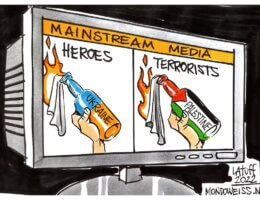
When Israel slaughtered hundreds of civilians in Gaza, mainstream journalists and politicians said the situation was too “complicated” to come out against such actions. Now they are cheerleaders for Ukrainian resistance, by any means, to military invasion and missile attacks. And Benny Gantz who bragged about bombing Gaza back to the Stone Age, is a hero to the Democratic Party. Yes there is an official propaganda line in the U.S., and journalists lost their mainstream careers for doing in Palestine what journalists routinely do in the Ukraine now.
Observers are puzzled — and disturbed — at why the ‘Atlantic’ just published a long article that tries to rehabilitate the crown prince of Saudi Arabia.
Asmaa Yassin wonders why Palestinian aspirations for freedom are not treated the same way as Ukrainian resistance to Russia by the international media. “It appears what really matters is the sides in the conflict: who is involved and with whom, rather than for what and why,” she writes. “The world’s attention is now vividly focused on the Russian invasion of Ukraine, and I am watching the news in Gaza speechless, boiling with rage.”
The European and American media now celebrating Ukrainian civilians building Molotov cocktails is the same that condemns Palestinians for even picking up a stone to resist military occupation.
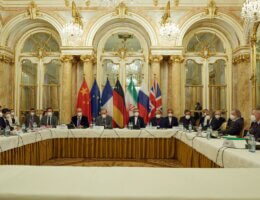
As global powers make progress toward a renewed Iran deal, the Israeli Prime Minister is objecting to it, the Foundation for Defense of Democracies, an Israel lobby organization, is calling a new agreement “a surrender pact,” and the New York Times, characteristically, has published a biased article that raises objections to the proposed deal without giving its supporters much space to defend it.
The New York Times sets the media agenda inside the United States. If the paper had published at least one single story, or run just one opinion piece, the Amnesty report on Israeli apartheid would not be fading from view.