

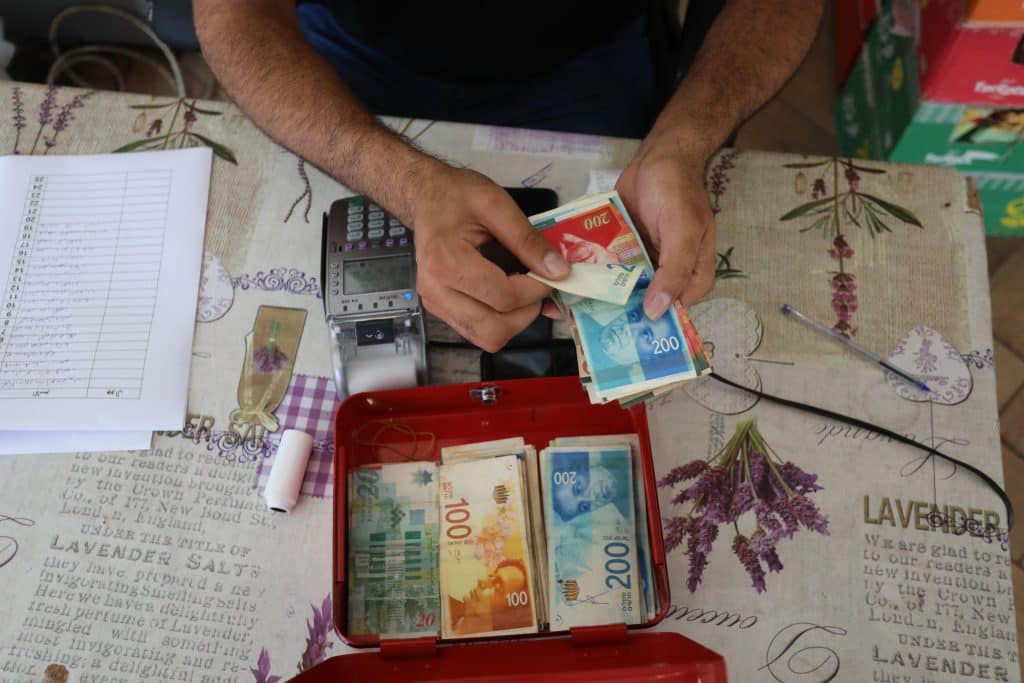
On September 4, at 7:00 a.m., Palestinian journalist Alaa Rimawi posted a simple call on his Facebook page: forgive the debts owed to you. By 8:00 a.m., responses forgiving half a million shekels had already come in. By Tuesday, the total had reached 75 million shekels — approximately $24 million.
The campaign, which Rimawi named “Forgive for the Sake of God,” spread rapidly across the West Bank, drawing thousands of responses from individuals, business owners, and companies. A clothing store owner in Silet al-Daher, north of Jenin, filmed himself burning a registry notebook containing 47,000 shekels in customer debts. A chicken business in Silwad, east of Ramallah, published a photo of a debt ledger totaling 250,000 shekels, with a note stating that all of it was forgiven. A lawyer shared that his client had dropped two court cases against debtors over bounced bank checks. A sidewalk vendor who sells corn forgave a cleaning worker who owed him 36 shekels.
“They might not be much,” Rimawi told Mondoweiss, “but 36 shekels is a big difference both for a sidewalk vendor and for a cleaning worker.”
The campaign’s scale reflects the depth of an economic crisis that has been building in the West Bank for years — one that Israel’s policies have systematically deepened, and that has left hundreds of thousands of Palestinians surviving on debt, reduced salaries, and depleted savings with no public safety net to fall back on.
The making of a crisis
The economic crisis in the West Bank had started before October 2023. Since 2019, Israel has withheld parts of Palestinian customs revenue – money it collects on behalf of the Palestinian Authority (PA) through its control of the borders. That withholding intensified after October 7, 2023, while Israel simultaneously revoked nearly all working permits for approximately 200,000 Palestinian workers who had previously been employed inside Israel. These two sectors — customs revenue and labor income from Israel — are the single largest sources of income for the Palestinian economy in the West Bank.
The consequences have compounded over three years. The PA, the largest employer in the Palestinian labor market, has been forced to pay half-salaries for more than three years. Workers who previously held Israeli permits to work across the Green Line have depleted most of their savings and rely on irregular, unstable jobs.
According to the Palestinian Central Bureau of Statistics, the cost of living rose by 53.67 percent across the Palestinian territories in 2024, while purchasing power fell by 34.93 percent in the same period, with a further 12 percent accumulation in 2026.
The result has been a widespread turn to debt. Many working Palestinians have been buying goods with borrowed money, promissory notes, or postdated checks, particularly from small wholesale distributors. For families doing their weekly grocery shopping, it comes down to a name and a number written in the store owner’s notebook.
While the economic hardship increases for Palestinians in the West Bank, Palestinians have resorted to cross-community solidarity to help each other face the effects of the economic strangulation. The success of the campaign is partly due to its tackling one of the most pressing economic problems for Palestinians.
The idea
The campaign began with a phone call. A schoolteacher contacted Rimawi to say she had a bank check for 2,000 shekels coming due, with insufficient funds in her account. In the West Bank, a bounced check can turn into a criminal offense — she was afraid of arrest.
Rimawi reached out to the check’s recipient, who agreed to pardon the debt. “I then thought, why not expand this call and launch a campaign?” he told Mondoweiss. “At the time, I thought it would solve a dozen cases like the teacher’s case, with a maximum of 100,000 shekels.”
With 166,000 followers on Facebook, he launched the call on the morning of September 4. Within an hour, a staggering half a million shekels (about $165,000) had been forgiven.
The geographic spread of the responses has been as striking as the total. In Qabalan, a town of 9,000 people southeast of Nablus, forgiven debts reached one million shekels ($330,000). In Qibya, west of Ramallah, with a population of 6,000, they reached 800,000 shekels ($264,000). In Sa’ir, northeast of Hebron, with 20,000 residents, the total hit two million shekels ($659,000).
One of the messages Rimawi published came from a man in Dahriyyah, Hebron, who identified himself as a former worker in Israel who lost his work permit and is himself wanted by Palestinian courts for unpaid bank checks. He wrote that he was forgiving six people who owed him 5,500 shekels ($1,800), for the sake of his dead brother’s soul.
A Palestinian from Jabaa, north of Jerusalem, announced the forgiveness of 7,500 shekels ($2,470) in promissory notes. Another, a lawyer, shared that his client asked him to drop two cases against debtors over bank checks in court.
“I also didn’t expect the participation to be so diverse,” Rimawi went on. “There are companies pardoning merchants for big amounts of money, but there is, for example, a sidewalk stall owner who sells corn, who pardoned a cleaning worker who owed him 36 shekels [$12].”
‘We have nobody to support us but each other’
The scale of the response, Rimawi says, exposes a gap between the legal framework of government debt in the West Bank and the reality of life under economic siege.
“This shows the disconnect between people’s circumstances in the West Bank and the requirements of the legal system: either you pay or you go to jail, as if we’re in a normal situation,” Rimawi explained. “We are living in the midst of a tragedy, and the economic situation is just one dimension of it.”
“In times of tragedy, we need to revive our human spirit, even at the expense of legal rights,” he went on. “Because, if we learned something in the past three years, it is that as Palestinians, we have nobody to support us but each other.”

Wow. The unusual aspect is not that private individuals have forgiven debts before. Individual cases of private debt forgiveness are certainly not new. What appears unusual is the scale: a large number of private creditors voluntarily cancelling debts owed by other members of the same community as part of a collective initiative. I am not aware of a well-documented historical example that closely matches this combination of private, voluntary and large-scale debt cancellation.
Since we are coming up to Yom Kippur, here’s a message from Gideon Levy:
This year, Yom Kippur should be canceled, probably permanently. Israel is already beyond good and evil. Jews are incapable of sinning, simply because everything they do is always just, moral, legal and even sublime. The fast must also be canceled: This year we will eat like kings, because we deserve it…..Let the Gentiles fast. They deserve it. Let God fast. He also deserves it after all he has done to us. Let the thousands of starving Palestinian detainees fast, not the Jews who have never done anyone any harm. The fast is fitting for the two million war refugees in Gaza. They deserve to fast, not us. We deserve only good, and we have nothing to apologize for. We were and remain a chosen people, a villa in the jungle. A nation of lions never needs to apologize….On this Yom Kippur eve, the whole world should apologize to Israel. Palestinians should ask for forgiveness for everything they have done to Jews since the dawn of Zionism. How they tried to resist the establishment of a foreign state in their land, how they still dare to complain about the Nakba and how they have since tried to resist the Zionist project that seeks Jewish supremacy forever between the river and the sea….
Gideon Levy’s furious,sarcastic Yom Kippur message – Jewish Voice for Liberation
The initiative described here is admirable.
Today the Jewish world prepares for Yom Kippur, a day of contemplation, prayer,fasting and forgiveness . For those of my generation : memories of the Yom Kippur War.
The traditional wishes are:
גמר חתימה טובה
May you be inscribed in the Book of Life
-to all readers of this comment!