

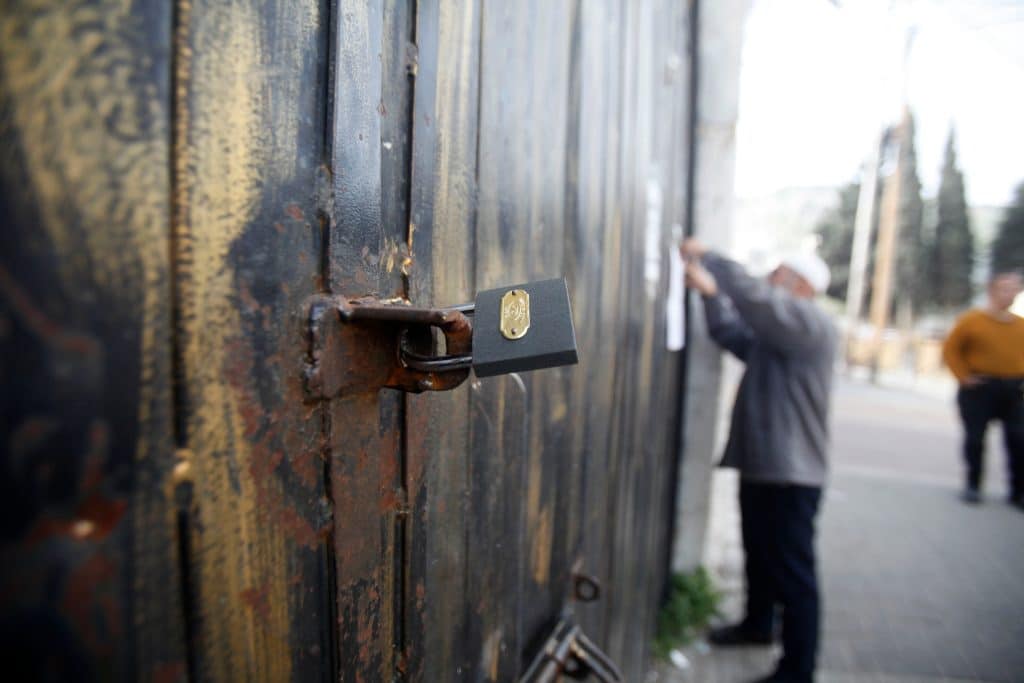
Three days per week, Omar Muheisen wakes up in his home in Al-Arroub refugee camp, north of Hebron, and starts his day as a public middle school teacher. “After a quick breakfast, my three children leave for college, and I give each of them 23 shekels for transportation, and 10 shekels to buy themselves something to eat,” he tells Mondoweiss. “Then my wife goes to work, and I take the car to mine. If I have any money left for gasoline, but if I don’t, then I have to walk five kilometers to the village of Beit Ummar. From there, I still have to walk to the rural area of Safa, in the outskirts of the village, to the middle school where I teach natural sciences.”
Omar Muheisen works only three days a week, which varies from one week to another, because the Palestinian Ministry of Education reduced teachers’ working hours beginning in October 2023. This reduction was taken to adapt to the growing Palestinian financial crisis, caused primarily by Israel’s ongoing withholding of Palestinian customs money, which it collects through its control of Palestine’s borders.
Israel has withheld an estimated four billion dollars since 2019, and Israel’s finance minister, Bezalel Smotrich, has repeatedly pledged to cause the Palestinian Authority to “collapse economically.” This policy has increased the financial burden on the PA, forcing it to pay incomplete salaries and systematically reduce service hours since October 2023.
In public schools, this crisis is a continuation of an older one. Public school teachers have been protesting their precarious conditions for more than a decade already. In 2016, public teachers organized a massive strike across the West Bank, demanding that their salaries increase in line with the cost of living. The strike’s demands evolved to include the recognition of the teachers’ movement as an independent union. The strike reignited in 2022 and again in early 2023, each ending with agreements signed with the PA government that were never fulfilled. Many teachers who led the movement were later given early retirement or moved to remote schools, like Omar Muheisen.
“I was involved in the 2022 strike, and I used to teach at a school in Hebron city,” says Muheisen. “After the strike, I was appointed to the school of Safa in Beit Ummar, away from the city, and from my colleagues,” he notes. Despite this, Muheisenn continues to be active in the teachers’ movement, because “I can’t sustain my family with 2,000 shekels per month, and doing nothing about it won’t make things any better,” as he puts it.
Since October 2023, the Palestinian education ministry has reduced the school week to only three days, and in some cases reduced school days to just three classes. This has had an impact on the quality of learning for an entire generation of young Palestinians, just as it has, for Omar Muheisen and many of his colleagues, eroded their profession’s sense of purpose.
“I can’t teach experimentation or discovering knowledge as I used to anymore,” says Muheisen. “In my classes, I used to prepare videos and experiments for my students, to incite critical thinking and make them learn by themselves,” he recalls. “Class was a passionate experience for me, and my students were engaged in learning,” he reminisces. Today, with reduced teaching time, Muheisen is expected to finish the program by the end of the year, forcing him to skim through the subjects. This affects his students.
“Even students who used to have good grades fell back and lost interest,” Muheisen points out, noting that the space between school days forces him to repeat lessons, because students lack the continuity of homework and follow-up. “One student lost his interest in learning and began to work on his father’s chicken farm in between school days, and it is very difficult to pick up his interest,” deplores Muheisen.
This crisis is taking a toll on teachers’ lives as well. Palestinian pubic teachers have always been among the most poorly paid sectors, and the current crisis has shrunk their capacity to make a living for their families even more.
Following October 7, the PA not only froze any raises in teachers’ salaries but also established a universal 2,000 shekels monthly pay for all public servants across the board, regardless of years of service, experience, or working conditions, which previously included the location of teachers’ workplaces. The PA has said it is recording the difference between the new flat payment system and teachers’ previous salaries, along with their promised raises, and had promised to pay the difference when funds are available, but Muheisen thinks that these promises don’t mean much. This is because the financial crisis is a result of the political situation, which shows no signs of improving.
In fact, as Israeli officials have made clear, the financial strangulation of the PA is part of Israel’s strategy to collapse the PA and annex the West Bank, which seems increasingly inevitable.
“In the PA’s adaptation to the crisis, education is not a priority, and available funds are not used to save the education system. Other sectors, like judges, are not facing the same burden as we are,” he stresses. “We demand a fair distribution of the burden of this crisis, and saving education being a priority,” he says.
This burden, at Omar Muheisen’s home, is palpable. “Transportation, for me, went in the past year alone from 5 shekels to 11,” Muheisen details. “Chicken went from 11 shekels to 17 for the kilogram, vegetable oil went from 95 shekels for the gallon to 130, rice from 110 shekels to 160,” he says. “At home, we used to cook a meal for lunch, and have something different for dinner. But now, we cook one meal and split it between lunch and dinner,” he explains.
Even before the current financial crisis, it was common for public teachers to have a second, and even a third, job. But now, that isn’t even a viable option for many of them. Omar Muheisen’s colleagues are also taxi drivers, electricians, private teachers, shopkeepers, farmers, and even shepherds. Omar Muheisen was a construction worker in Israel, where most Palestinian construction workers made their living. “I worked in Bir Al-Sabea, in the Naqab desert, but since the occupation revoked working permits, I can no longer work there,” he says.
“Many of my colleagues have sold property, and all of us have exhausted our savings, and I personally have been forced to get in debt, and I am currently owing 15,000 shekels in debt,” he shares.
The economic and social pressure exerted by Israel on the Palestinian society in the West Bank is reflected in the crisis of public school teachers, but it runs much deeper.

This crisis is “only symptomatic of a larger and deeper crisis in the Palestinian system,” says Isam Abdeen, a Palestinian human rights lawyer who has accompanied and advised the public teachers’ movement during their strikes since 2016.
“Understanding the education system’s crisis, and the crisis of the PA in general, through the lens of the financial crisis alone is superficial,” Abdeen tells Mondoweiss. “The entire system had been plunged into crisis for political reasons, which makes the solution of the teachers’ crisis in a correct way very difficult,” he says.
“There hasn’t been a normal political life for twenty years, since the last time there were elections, and this has asphyxiated social dialogue and has been seen in the way that social movements, like the teachers’ movement, have been dealt with,” goes on Abdeen. He says the teachers’ movement’s was “broken and humiliated” following the 2016 strike. He added that “it is very difficult to pick a movement in that shape off the ground.”
For Abdeen, Western countries are directly implicated in creating this crisis in the Palestinian system. “The main sponsors of both the PA and the Palestinian civil society groups, like the U.S. and European countries, cared more about imposing their political agenda across Palestinian institutions than ensuring that there was a democratic life, to the point it became impossible to have a democratic dialogue,” he says, adding, “Israel imposed the financial crisis at this critical moment, making everything a hundred times worse.”
Omar Muheisen agrees and says it will have a deep impact on all Palestinians. “What is happening to us, teachers, will have implications on the entire society, because the way things are going, only those who can afford private schools will be able to educate their children,” he explains. Muheisen deplores the current state of his profession, noting that due to the financial crisis, many of his colleagues have left public teaching for jobs in private schools. Once known for being the most educated society in the Arab world, Palestine, according to Muheisen, “braces for a dark future, just a generation away, if things don’t change now.”
Qassam Muaddi
Qassam Muaddi is the Palestine Staff Writer for Mondoweiss. Follow him on Twitter/X at @QassaMMuaddi.
More on the killing of minors in the West Bank:
How children in West Bank are being killed by Israel ‘without accountability’…IDF has killed 235 children in territory since 7 October 2023 with no indictments in what activists say is ‘licence to kill’...“The widespread and unprecedented killing of Palestinian children and teenagers in the West Bank is the result of Israel’s broader policy that allows the killing of Palestinians without accountability,” said Yuli Novak, the executive director of the human rights group B’Tselem, which published a report on Monday titled Unshielded Childhood. It focuses on 54 Palestinian children and teenagers killed by Israeli forces in 2025 alone….
How children in West Bank are being killed by Israel ‘without accountability’ | West Bank | The Guardian