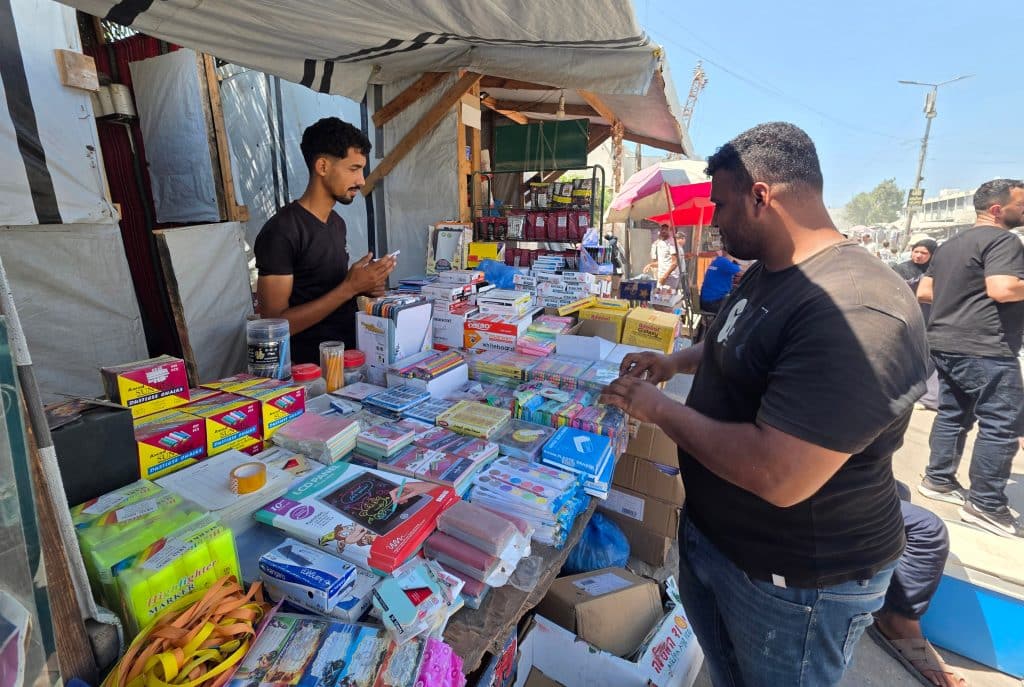
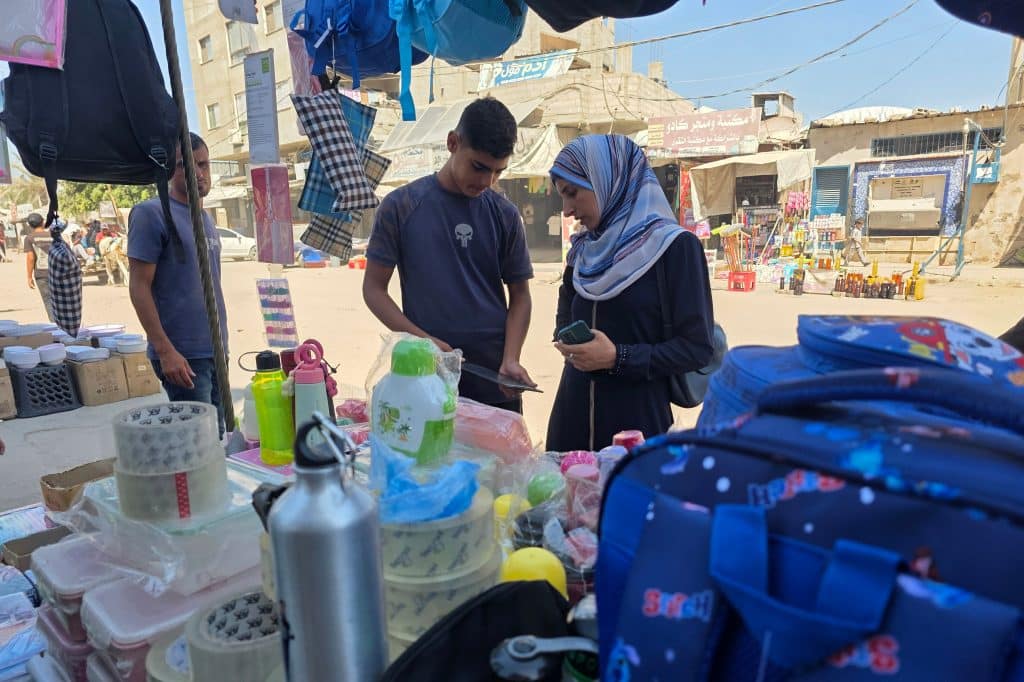
Khaled Oweis, 37, walks through the markets with his two sons, eight-year-old Munther and 11-year-old Hassan, searching for what they need to begin the new school year: backpacks, uniforms, notebooks, and a few basic supplies.
In September, at this time of year, Gaza’s children once looked forward to returning to school. There would be the excitement of shopping for new uniforms and bags, reuniting with their teachers and classmates, and filing into classrooms decorated for the beginning of another academic year. Gaza’s markets would be caught in a frenzy of “Back To School” bargains, with shops displaying school supplies in every shape, size, and price range.
But for the third year in a row, the start of the school year bears little resemblance to the one Gaza’s families remember.
“I walk through the markets, but whenever I find what my children need, I am shocked by the prices,” Oweis said. “By my calculations, buying the basic supplies for each of my two sons would cost more than 250 shekels ($80). Before the war, it cost less than 100 shekels ($30).”
The 2026–2027 academic year in Palestine is scheduled to begin on September 19. While Palestinian children elsewhere will return to school buildings, many children in Gaza will return to educational tents — if they return at all.
More than 97 percent of schools in Gaza have been damaged or destroyed since October 2023, according to UNICEF figures, leaving around 658,000 school-age children without access to formal education. Gaza’s school system — one of the most developed in the Arab world before the war, with a literacy rate consistently above 97 percent — has been systematically dismantled.
A new educational reality
What awaits Gaza’s children when they arrive at school has changed almost beyond recognition.
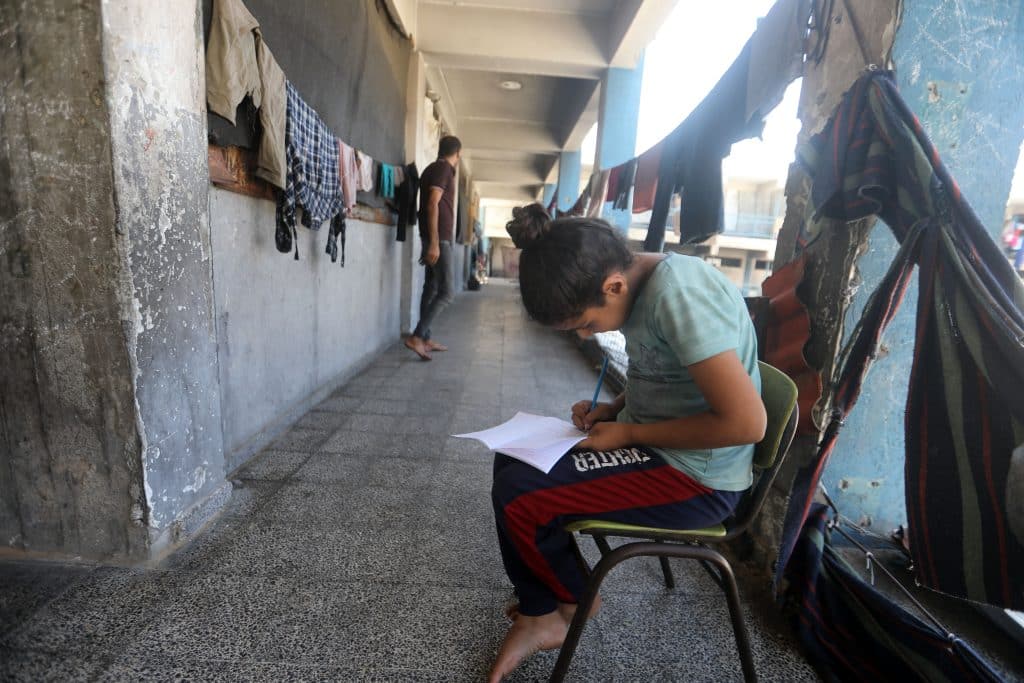
Across the Gaza Strip, students no longer enter spacious buildings where the national anthem rings out during morning assembly. They no longer line up in matching uniforms in schoolyards surrounded by trees, playgrounds, and sports fields. Instead, classrooms are housed in adjoining tents, wooden structures assembled from recycled materials, or makeshift shelters roofed with corrugated metal sheets. Many lack electricity, ventilation, adequate seating, and protection from Gaza’s heat, rain, and winter cold.
More than 85 percent of Gaza’s government educational buildings have either been destroyed or rendered inaccessible, according to Ibrahim Ramadan, director of the Ministry of Education’s Khan Younis department. Many of the schools that survived the war sit behind the Israeli-controlled “Yellow Line,” which divides the Strip and blocks Palestinian students from reaching them.
There is also the staggering human toll. “777 education workers, including 532 male and female teachers, have been killed during the war, along with more than 22,000 students,” Ramadan said.
Ramadan says the Ministry of Education has been working to create additional learning spaces from tents, tarps, or recycled wood. He expects approximately 400,000 students to enroll during the new academic year, distributed among government schools, UNICEF-supported learning spaces, private schools, and temporary educational centers that have recently been granted licenses.
But creating spaces for students does not necessarily mean creating environments suitable for learning.
“The genocidal war targeted the education system and the entire learning process,” Ramadan told Mondoweiss. “Education is one of the most important foundations of life. As Palestinians, we believe Education is a message of life, an act of defiance and resistance, and an expression of steadfastness. Education is our future and our window of hope for changing reality. For these reasons, the occupation has worked relentlessly to destroy and undermine Gaza’s educational system.”
‘Each child may receive only one notebook’
Beyond the physical destruction of schools lies a second crisis: the collapse of purchasing power that has made even basic school supplies out of reach for most families.
Yahya al-Firea’ has owned a stationery shop in Khan Younis for more than a decade. In previous years, the back-to-school season was his busiest. This year, he stands in a near-empty store.
Before the war, four pencils could be purchased for one shekel (about 33 cents). Now that amount will only fetch a single pencil. A school backpack that once sold for between 15 and 20 shekels ($5-$7) now costs more than 50 shekels ($16). Before the war, al-Firea’ could make at least 10,000 shekels ($3,290) in sales during the back-to-school season. Today, he estimates that his sales amount will be no more than 500 or 600 shekels ($160-$200).
“Mothers used to come into my shop and buy two dozen notebooks,” al-Firea’ said. “Now they cannot afford more than two or three. Each child may receive only one notebook and divide it into sections for Arabic, English, mathematics, and all their other subjects.”
He attributes the rising prices primarily to Israel’s restrictions on the entry of goods into Gaza. “If Gaza needs 1,000 truckloads of stationery and school supplies, Israel allows only ten trucks to enter,” he said. “If the crossing closes for a few days, a notebook that now costs three or four shekels can suddenly cost ten to 15 because no additional supplies are entering.”
For Oweis, the prices are painful but not the point. He knows what awaits his sons when they arrive at their tent classroom. Still, he insists they deserve the ritual of preparation.
“Here I am, taking my children to buy uniforms and backpacks, even though I know that most children at their school will not have bags or uniforms,” he said. “Some may carry their books in plastic bags instead of backpacks. But everyone does what they can afford. Children have the right to be happy. They have already lost their schools and the education they once knew. Why should we add to their burdens by denying them the joy of a new uniform, a backpack, and new notebooks?”
‘Education is the path to liberation’
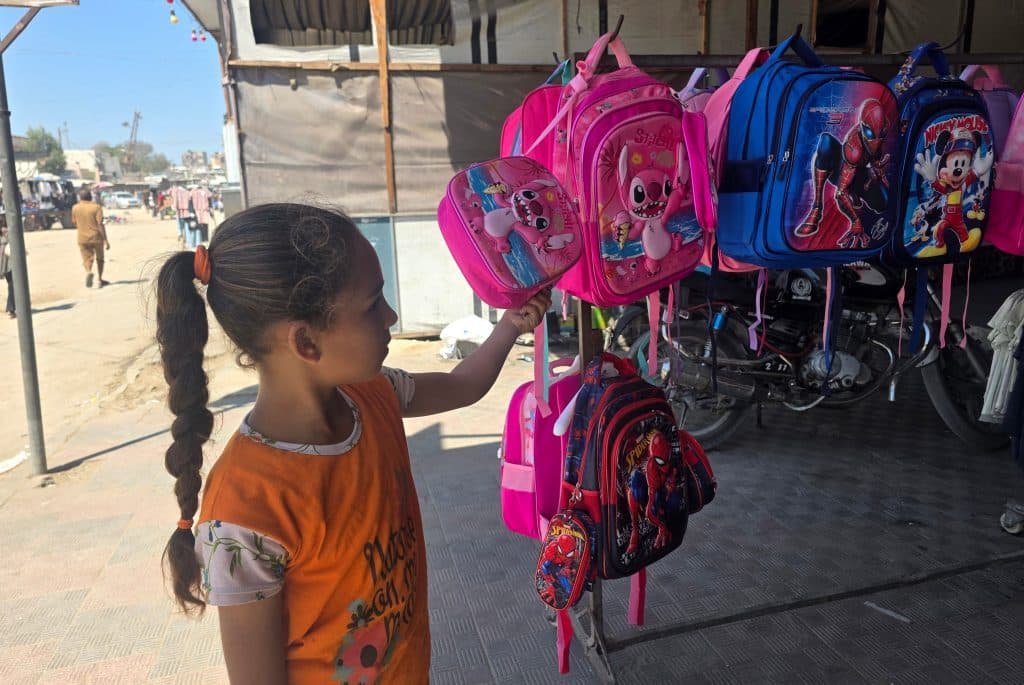
Doaa Abu Ziyada, 44, a resident of Khan Younis refugee camp and mother of two school-age daughters, says preparing both children for the new year has become prohibitively expensive. Families with three, four, or more children in school, she said, face an even greater burden.
From what she has observed among relatives and neighbors living in displacement camps, children are excited to begin the new school year and eager to return to spaces that bear at least some resemblance to the schools they once knew.
At the same time, she says, the conditions inside the makeshift classrooms will be extremely difficult. Students may spend hours sitting in crowded tents without even a fan in the intense summer heat.
Yet, the desire to learn, she says, has not dimmed.
“We are a people who love learning, and we see education as a path toward liberation from occupation,” Abu Ziyada told Mondoweiss. “Palestinians are among the most highly educated people in the Arab world, and illiteracy has long been rare in our society.”
That commitment, she says, can be seen in the spirit of children preparing to return to school: their longing to stand in morning assembly, hear the school bell, go on field trips, and take part in sports classes again.
“Education is the strongest weapon with which we confront the occupation,” she said. “Despite all the conditions imposed on us to prevent us from continuing to learn, we prove, time and again, that we are a people who cannot be separated from education.”