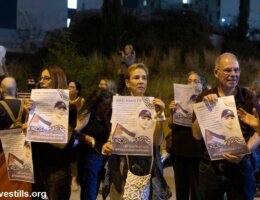
Although dozens of Jewish Israelis participated in a protest against administrative detention in front of the General Security Services headquarters in Tel Aviv, and five of them blocked the road – an act which usually leads to being arrested – the only participant to be detained was Rami Salman, a Palestinian student who passed by the scene. “What happened was an excellent illustration of the reason why we held this demonstration. If you are a Palestinian, you have no security anywhere, not even in your home. It is Apartheid!”
Mass incarceration has defined Israel’s colonial project. Since 1967, over 850,000 Palestinians have been arrested and imprisoned by the Israeli regime. Currently there are 4,450 Palestinians held in Israeli prisons, including hundreds of administrative detainees being held without charge or trial. But just as mass incarceration remains a defining feature of the Israeli occupation, so too has prisoner resistance. Currently, an ongoing boycott of the Israeli judicial system by all 530 Palestinian administrative detainees has surpassed 100 days.
Aida Touma-Sliman, a Palestinian member of Knesset, explains how Israeli apartheid impacts Palestinian citizens of Israel.
In an impressive appearance before a Pittsburgh pro-Israel group, Summer Lee, a progressive running for Congress, refused to back down on Palestinian rights. She supported conditioning aid to Israel over home demolitions and child detention. She did not rule out the idea that Israel is an apartheid state. She attacked the claim that Israel had a right to defend itself by storming the al-Aqsa mosque last year. And while she did not endorse the BDS campaign, she likened it to the Black Lives Matter protests in the U.S. as a vital effort to change government’s conduct.
In case you missed it, Harvard Law School’s International Human Rights Clinic lately issued a report that finds Israel’s treatment of Palestinians on the West Bank amounts to the crime of apartheid. The study came out on February 28 in the wake of five longer, wider-ranging, apartheid reports published since 2020 – and just before the UN Special Rapporteur for Palestine published yet another apartheid report on March 21. Despite its quiet rollout, the study’s high quality and association with Harvard likely mean it will play a significant role in establishing Israel’s apartheid, and represents a victory for Palestinian human rights.
Rafael Silver is a Jew, Israeli citizen and a veteran of a combat unit in the Israeli army. He left Israel in 2001 because he could no longer be a part of a system that practices apartheid against the Palestinian people. “I do not use the word apartheid lightly but instead reluctantly,” he writes. “I choose to use this word to describe the reality the Palestinian people have been enduring for generations because I have seen it in action with my own eyes. I have enforced it during my military service in the West Bank and in the Gaza Strip and supported it as an Israeli taxpayer.”
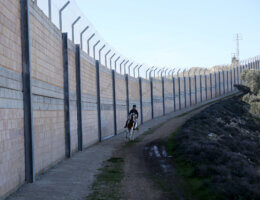
A new UN Human Rights Council report is the latest in a series by international and Israeli groups accusing Israel of the crime of apartheid. “There are pitiless features of Israel’s ‘apartness’ rule in the occupied Palestinian territory that were not practiced in southern Africa, such as segregated highways, high walls and extensive checkpoints, a barricaded population, missile strikes and tank shelling of a civilian population, and the abandonment of the Palestinians’ social welfare to the international community,” Michael Lynk’s report said. “With the eyes of the international community wide open, Israel has imposed upon Palestine an apartheid reality in a post-apartheid world.”
New York Times Jerusalem bureau chief Patrick Kingsley used a fresh apartheid report, by U.N. special rapporteur Michael Lynk, to finally slip Amnesty International’s apartheid finding into the paper. Kingsley wrote that Lynk, a distinguished Canadian law professor appointed by the U.N.’s Human Rights Council, had “accused Israel of committing the crime of apartheid in the occupied territories.” He quickly summarized Lynk’s finding, gave Israel’s foreign ministry and other critics a chance to respond — and then, right at the end, mentioned that Amnesty, among others, had produced a “similar” report.