


(Photo: Sixteen Minutes to Palestine)
This article was originally published on March 8, 2012 on the blog Sixteen Minutes to Palestine as part of its series on International Women’s Day.
When I imagine the struggle for Palestine, it always has a female face.
No, I don’t imagine Yasser Arafat. Or Mahmoud Abbas. Or Khaled Mashaal. The symbol of the Palestinian struggle, in my eyes, is always a woman.
Maybe she doesn’t have a famous name. Or a recognizable face. She hasn’t sat at a negotiating table and certainly hasn’t shaken hands with any dignitaries. But her efforts will be the tipping point for the Palestinian struggle to cast off the shackles of occupation.
Palestinian women are by no means meek. Our grandmothers have related to us tales of hardships endured and adversity suffered that we can scarcely imagine—tales of exile, abuse, loss of loved ones and affliction, all somehow connected to the ravages of occupation. Whether they continued to live under duress, or migrated to other countries in search of a better future for their families, the scars of suffering remain etched into their existence.

(Photo: Sixteen Minutes to Palestine)
It is this constant weathering of their souls, this creation of an indefatigable will to preserve and flourish, this defiance in the face of a cruel occupier, which has been passed from one generation of women to the next.
Nowhere did I witness this more clearly than in my visit to Gaza in September 2010.
What struck me so profoundly about the women I met in Gaza was their refusal to allow their circumstances—lack of resources due to a crippling siege and the looming threat of bombardment—affect their motivation to live their lives without despair.
I met middle-aged women who had lost husbands or sons, but who had committed themselves to studying their faith and had memorized the Quran. I met young girls who left their houses at 5:30 AM to begin their school day, since schools were divided into two sessions due to overcrowding. I met 20-year-old widows raising children without fathers because their husbands were killed in Israeli incursions. I met giddy teenagers dreaming of having the luxury to travel outside their country, just to know what life is like elsewhere.
Though the devastation that surrounds them may seem suffocating, Palestinian mothers push their children to pursue an education—to study and benefit their society, to cultivate the next generation, who just might be the one to eradicate the occupation. These women, both nurturing and empowering, instill in their sons and daughters the confidence to look at a soldier in the eye, to resist humiliation, to refuse subjugation and to defy the expectations of those who have tried to doom them to failure. No. Though many have been forced to relinquish their lives, they will not surrender their spirits.
Their spirits live on in the American college student who peacefully protests hate-mongers who vilify the Palestinian people.
Their spirits live on in young girls who express their appreciation for their culture by donning a traditional thobe and learning a debka.
Their spirits live on in a teenager who sits with her grandmother, listening to her stories of surviving the nakba, as she writes down every last detail to preserve her history.

(Photo: Sixteen Minutes to Palestine)
Their spirits live on in the woman who refuses to purchase products whose revenue goes toward outfitting the world’s most despicable military.
Their spirits live on in the girl whose heart aches for her homeland, a place she’s been robbed of ever setting foot in or seeing, because an occupier prevents her family from returning there.
Their spirits will continue to live on and provide the impetus for change in an ostensibly hopeless situation.
Though the world may not see a Palestinian woman as the face of the struggle, it most certainly will find one at its heart.
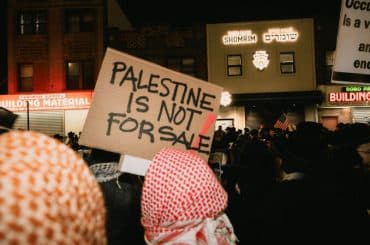

RE: “The symbol of the Palestinian struggle, in my eyes, is always a woman.” ~ Deanna Othman
MY COMMENT: I have always admired Hanan Ashrawi!
Hanan Ashrawi – http://en.wikipedia.org/wiki/Hanan_Ashrawi
and their spirit most definitely lives on in the author of this article, a woman who personifies its very essence, helping to keep palestine alive in the hearts and minds of its people, scattered worldwide though they are, ever mindful of the ongoing occupation of palestine, of her responsibility to apply her will and skills to the cause of justice for palestine. indeed, it is efforts such as hers, together with the efforts of more than ten million equally dedicated palestinians that’s going to liberate their homeland.
Āmen
See the Woman
She has a young face
An old face
She carries herself well
In all ages
She survives all man has done
In some tribes she is free
In some religions
She is under man
In some societies
She’s worth what she consumes
In some nations
She is delicate strength
In some states
She is told she is weak
In some classes
She is property owned
In all instances
She is sister to earth
In all conditions
She is life bringer
In all life she is our necessity
See the woman eyes
Flowers swaying
On scattered hills
Sundancing calling in the bees
See the woman heart
Lavender butterflies
Fronting blue sky
Misty rain falling
On soft wild roses
See the woman beauty
Lightning streaking
Dark summer nights
Forests of pines mating
With new winter snow
See the woman spirit
Daily serving courage
With laughter
Her breath a dream
And a prayer
John Trudell
Wandering Around an Albuquerque Airport Terminal
by Naomi Shihab Nye
After learning my flight was detained 4 hours,
I heard the announcement:
If anyone in the vicinity of gate 4-A understands any Arabic,
Please come to the gate immediately.
Well — one pauses these days. Gate 4-A was my own gate. I went there.
An older woman in full traditional Palestinian dress,
Just like my grandma wore, was crumpled to the floor, wailing loudly.
Help, said the flight service person. Talk to her.
What is her
Problem? we told her the flight was going to be four hours late and she
Did this.
I put my arm around her and spoke to her haltingly.
Shu dow-a, shu- biduck habibti, stani stani schway, min fadlick,
Sho bit se-wee?
The minute she heard any words she knew — however poorly used –
She stopped crying.
She thought our flight had been cancelled entirely.
She needed to be in El Paso for some major medical treatment the
Following day. I said no, no, we’re fine, you’ll get there, just late,
Who is picking you up? Let’s call him and tell him.
We called her son and I spoke with him in English.
I told him I would stay with his mother till we got on the plane and
Would ride next to her — southwest.
She talked to him. Then we called her other sons just for the fun of it.
Then we called my dad and he and she spoke for a while in Arabic and
Found out of course they had ten shared friends.
Then I thought just for the heck of it why not call some Palestinian
Poets I know and let them chat with her. This all took up about 2 hours.
She was laughing a lot by then. Telling about her life. Answering
Questions.
She had pulled a sack of homemade mamool cookies — little powdered
Sugar crumbly mounds stuffed with dates and nuts — out of her bag —
And was offering them to all the women at the gate.
To my amazement, not a single woman declined one. It was like a
Sacrament. The traveler from Argentina, the traveler from California,
The lovely woman from Laredo — we were all covered with the same
Powdered sugar. And smiling. There is no better cookies.
And then the airline broke out the free beverages from huge coolers —
Non-alcoholic — and the two little girls for our flight, one African
American, one Mexican American — ran around serving us all apple juice
And lemonade and they were covered with powdered sugar too.
And I noticed my new best friend — by now we were holding hands —
Had a potted plant poking out of her bag, some medicinal thing,
With green furry leaves. Such an old country traveling tradition. Always
Carry a plant. Always stay rooted to somewhere.
And I looked around that gate of late and weary ones and thought,
This is the world I want to live in. The shared world.
Not a single person in this gate — once the crying of confusion stopped
— has seemed apprehensive about any other person.
They took the cookies. I wanted to hug all those other women too.
This can still happen anywhere.
Not everything is lost.