Palestine’s presence in the media has been for decades confined to news. When a Palestinian is killed or wounded, when a house is demolished, or when someone is arrested, Palestine qualifies for presence in the media sphere. The Palestinian existence is also confined to the elements of the news; the answers to questions like what happened, when and where did it happen, and some details about the event. But news dies quickly, and the only guarantee for the continuation of the Palestinian presence in the world’s attention is the emergence of other news, often in a tragic context.
However, the Palestinian experience under occupation is and has been a human experience that surpasses the news. After cameras leave, the lives of Palestinians continue through the impact of the reported events. The story of a family whose house is demolished doesn’t end after the demolition is reported but only starts. The life of a family who lost a member to the occupation’s fire begins a new phase after the funeral ends and reporters move on to the next news.
For us, Palestinian journalists, reporting from within Palestinian society, especially for mainstream media outlets, often includes compiling ongoing human experiences and reducing them to quick headlines and news reports, further confining Palestine’s image to tragic narratives. The reality of Palestinian life is omitted instead of acknowledged, and our place as journalists from within Palestine is ignored.
During the current genocide, Israel has attempted to seal off the strip from the outside world, so as to prevent even news to to make it to the general public. Yet, Palestinian journalists have been putting their lives on the line, not only to bring the news to the world, but also to bring the experience of life under Israel’s assault to the world. However, as soon as more urgent news rises, like a confrontation between Israel and Iran, the story of Gazans’ life, which has itself become news, moves to the background.
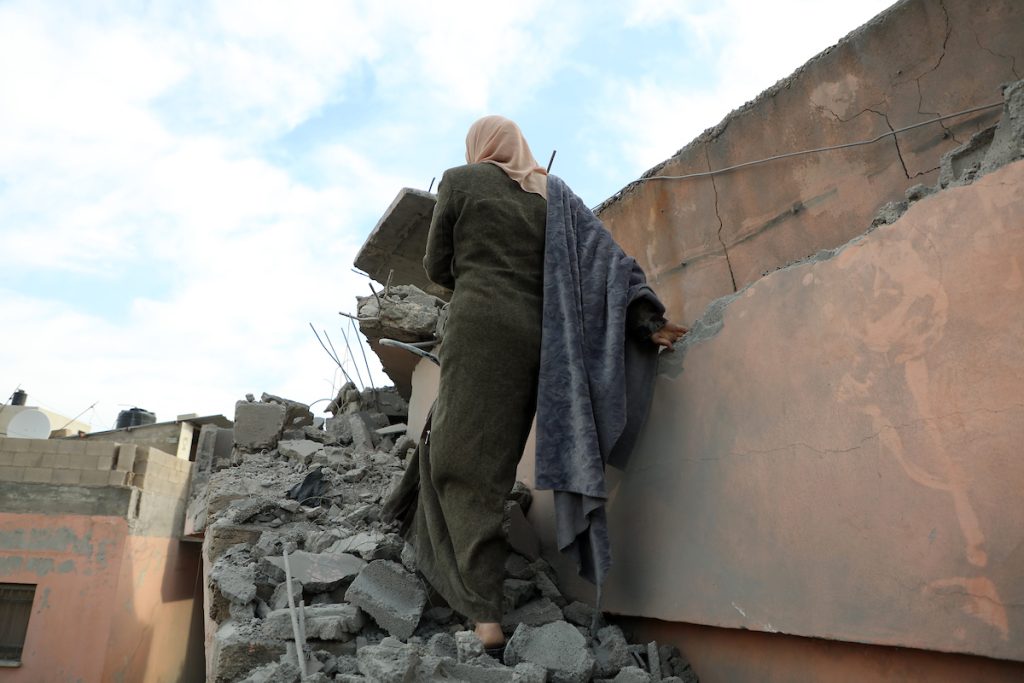
In the West Bank, the northern refugee camps of Jenin, Tulkarem, and Tubas, have become constant headlines in the past two years, since the re-emergence of armed resistance in them and the increasing Israeli raids. Some months before October 7, I visited the refugee camp of Jenin, two days after the end of a large Israeli raid that had lasted 48 hours. The Israeli troops had withdrawn from the camp and also had journalists, but residents hadn’t yet moved on. Along the main street, where Israeli armored vehicles had advanced, residents were still cleaning up the rubble and recovering what they could from their homes.
Amal, a woman in her 50s, was looking for something to save between destroyed parts of her house, which had been burned by an Israeli missile. Amal’s two sons were breaking down a wall to extract water pipes that could still be used. In a part of the house, the family had stored new furniture for the apartment for Amal’s youngest son and his fiancée, who were about to get married. It was all lost. “This house was my whole life, my memories, my life’s work,” said Amal. “The loss is much bigger than the material damage,” she explained.
In every corner of Jenin, some life was starting over, trying to overcome damage that was more than material. The sense of community became stronger, and the separation between households was practically nonexistent, as neighbors walked into each others’ homes, shared food, helped in the cleaning of the rubble, and took care of each other’s children. A way of co-opting the conditions imposed by Israeli violence. Differences between political affiliations disappeared from the peoples’ vocabulary, and everybody referred to “the camp” as their space of belonging. An entire collective story was happening, as part of the larger story of Palestine, but it was absent from the media.
As a journalist, part of my job is to cover news. But as a Palestinian journalist with Mondoweiss’s Palestine Team, part of our mission is to go beyond news and bring the human face of the Palestinian experience to light—an experience of a whole people that is also broader and much richer than the news of the occupation, although it lives through it.