

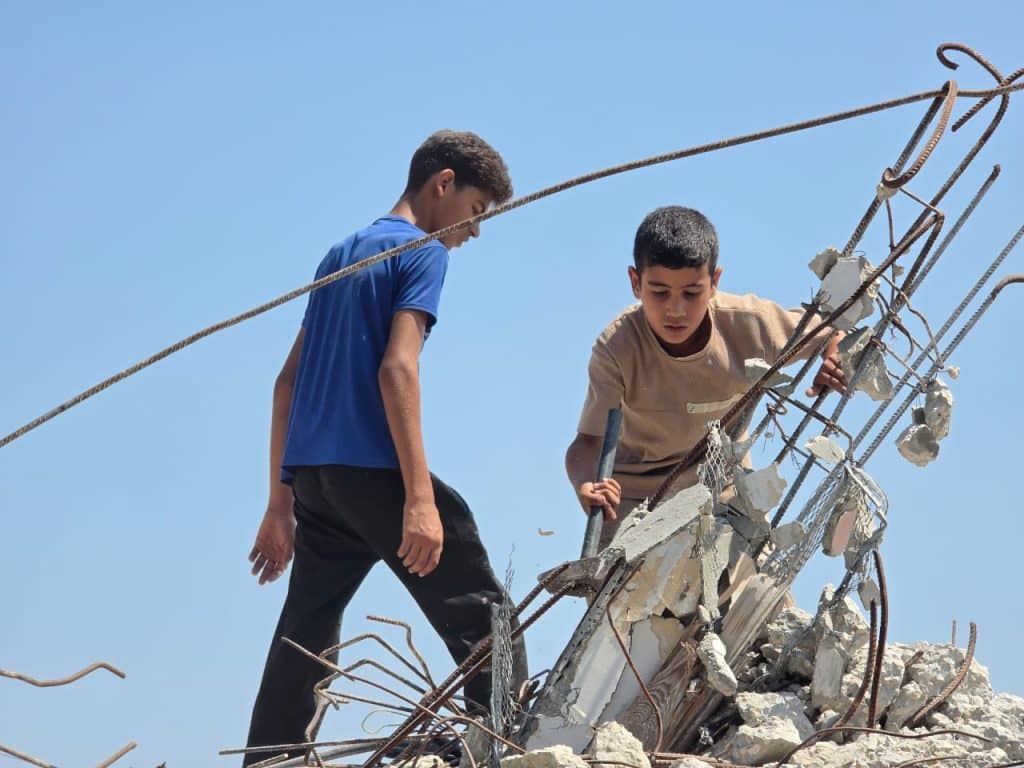
Ahmad Hammad, 16, carries a sledgehammer weighing more than 10 kilograms through the rubble of a bombed-out home in Gaza. He climbs over piles of debris and breaks it into pieces small enough to drag away.
“I want to help my family,” he told Mondoweiss. “I am willing to do any job that provides my family with enough to eat for the day. I don’t care if the working hours are long or the conditions are difficult. Life in Gaza is full of hardships, and we are a part of this life.”
Ahmad lives with his six-member family in a displacement center in Tal al-Hawa, west of Gaza City. He works from 9 a.m. to 5 p.m., alongside three other teenagers of similar ages. The homeowner who employs them provides a single lunch at 1 p.m. Nothing else is provided during the workday.
They work directly under the sun, Ahmad says, while dealing with hunger and exhaustion. Yet he feels he has no choice, as he has been unable to find any other work. Ahmad and his colleagues are paid 30 shekels a day ($10).
Since the October 2025 ceasefire and the end of the mass-displacement waves that followed, Palestinians like Ahmad have increasingly begun clearing the rubble of homes by hand, as reconstruction remains delayed and heavy machinery to clear the debris is scarce.
Some people whose homes were partially destroyed clear the rubble from the bombed sections to reclaim whatever part of the house remains intact, allowing them to live there rather than in tents. Others have homes that were destroyed in areas outside the so-called “Yellow Line,” which cut Gaza roughly in half immediately after the October 2025 ceasefire before expanding to encompass more Palestinian territory in the following months. For the homes that Palestinians have been able to return to, the vast majority are met with an additional obstacle: the rubble left behind prevents them from using their land.
To clear the rubble, some homeowners have turned to youth between the ages of 14 and 17. The teenagers work long hours for very low wages in physically demanding conditions. In some cases, employers provide them with only one meal during a 12-hour workday.
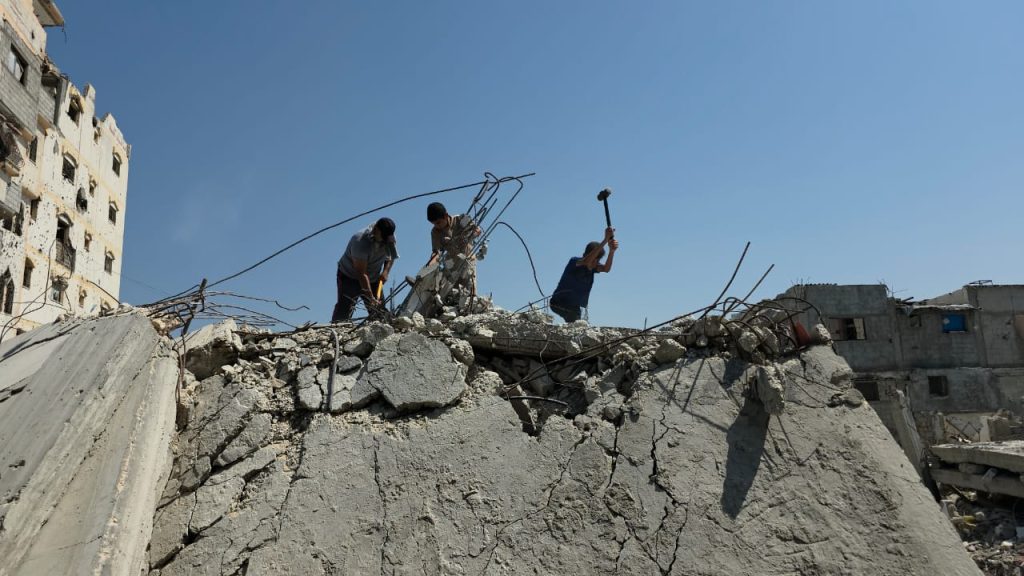
“I wish there were another job, even if it paid this little, but was less exhausting and required less physical effort,” Ahmad said.
“I get back home at around 6 p.m., after walking back to my tent at the end of a long and difficult workday. Sometimes I go to sleep without having another meal. Sometimes I am too exhausted even to take a shower. The only thing I think about at the end of the day is lying down on the ground, sleeping, and waking up the next day to go back to the same work.”
Ahmad has been doing this work for three months. He has no plans to stop. If he does, he says, his family will go hungry.
He is also the eldest of two boys in his family. His younger brother is two years younger than him, while the rest of the family consists of girls.
“If my younger brother and I don’t work, who will provide food for my family and my sisters?” Ahmad said. “They are young girls and cannot do this kind of work. I would not accept them going into the kind of physically demanding jobs that my brother and I do.”
His younger brother works as a street vendor, operating a small stand where he sells candy to children and food products such as pasta, instant noodles, and other items he can obtain at prices that allow him to make a small profit.
“I earn 30 shekels [$10] a day, while my brother earns between 20 and 30 shekels a day,” Ahmad said. “With this little money, we can preserve the dignity of my sisters and my family. At the very least, we can provide them with food in the harsh conditions of poverty in which we live.”
Ahmad and his younger brother now carry the full burden of supporting their family. Their parents left the Gaza Strip after being injured during the war, and their father traveled to Egypt for medical treatment, accompanied by their mother, leaving the children behind.
As a result, Ahmad is now both a breadwinner and a father figure for his siblings at an age when he should be attending school and preparing for the new academic year.
Next year, he is supposed to be preparing for the Tawjihi, Palestine’s Secondary School final exams, but his family’s circumstances have pushed his education further down his list of priorities.
“If the situation remains as it is, I won’t be able to prepare for the next school year,” Ahmad said. “Instead, I will work more so that my younger sisters can continue their education and complete their schooling.
“There is no way I can stop working and leave my family to an unknown fate,” he added.
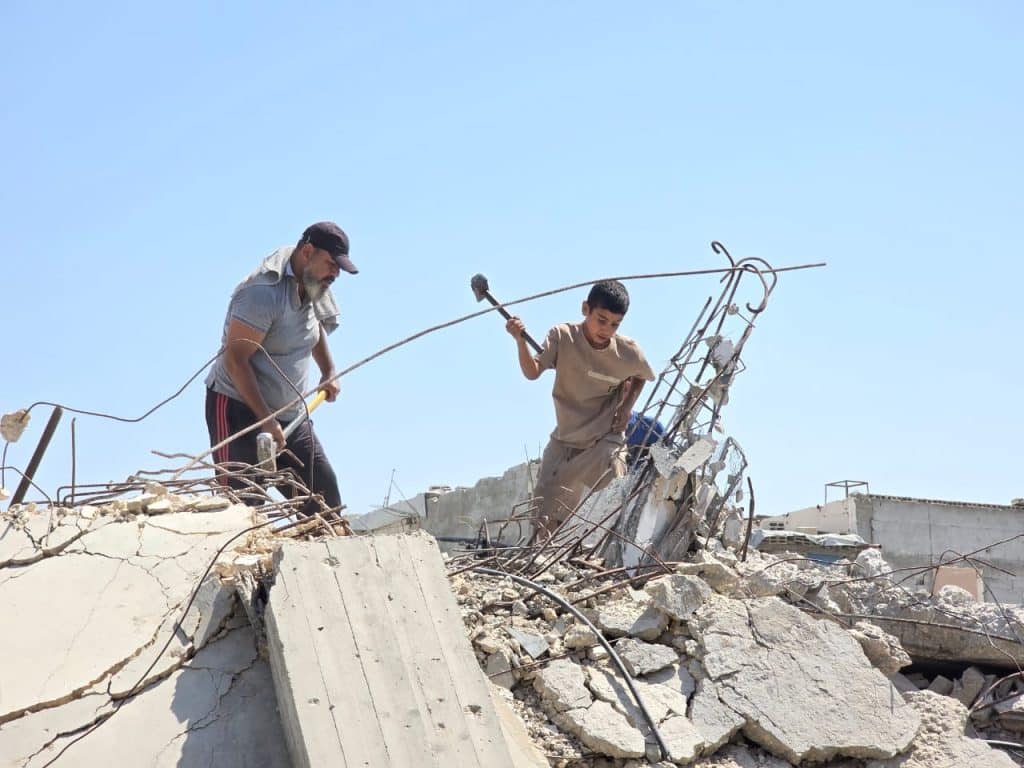
Working alongside death
In Khan Younis, the situation is not much different for 48-year-old Khalil Abu Odeh and his 14-year-old son, Abdul Rahman.
Abu Odeh is clearing the rubble of his home so that he and his family can move from a tent in the Khan Younis displacement camp to a tent on the land where their home once stood after it was completely destroyed by Israeli bombardment.
This time, the work stays entirely within the family. Abu Odeh employs his underage son to help him demolish and clear the remains of the house because he cannot afford to hire other workers or pay their wages.
The rubble is spread across about 140 square meters. Abu Odeh wants to use the space to erect four tents for himself, his family, and his relatives, who are living in harsh conditions in the Khan Younis area of al-Mawasi, amid severe overcrowding.
“We live in difficult conditions in al-Mawasi,” Abu Odeh said. “Rodents are overrunning our tents. There is sewage, and there are insects. The environment there is no longer suitable for living. That is why we decided to clear the rubble of our home, come back to our land, put up our tents, and live here.”
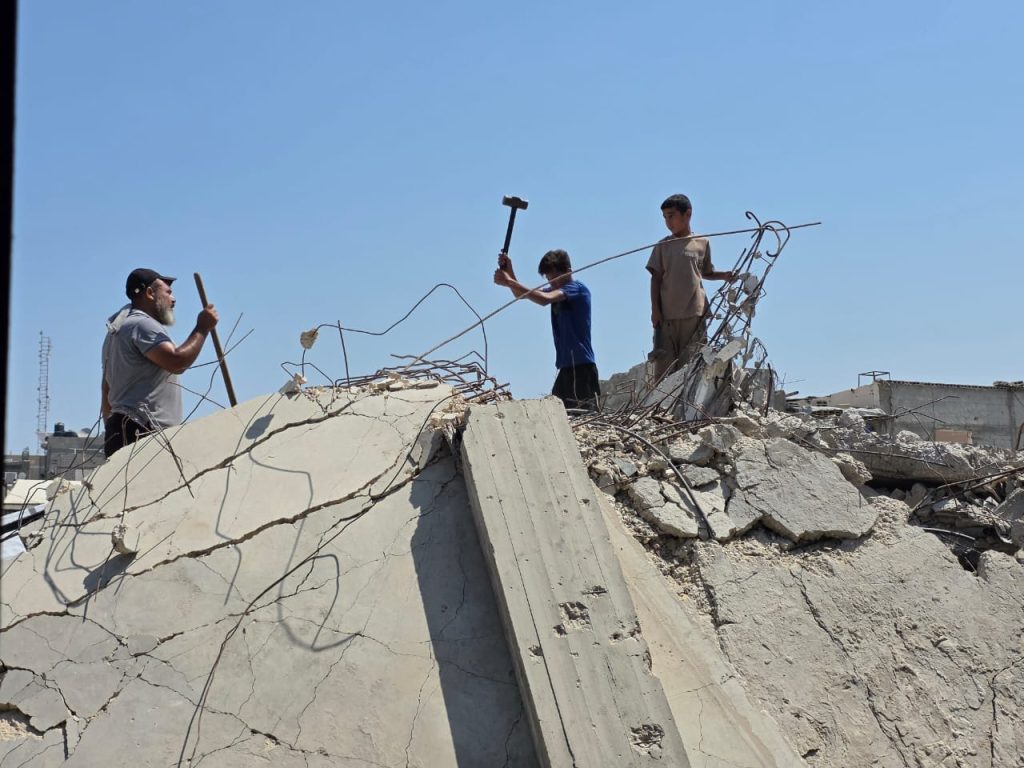
Abu Odeh does not hide his deep concern for his children; the work in clearing the rubble has begun to take its toll on them, and he says they have already been involved in accidents that nearly cost them their lives. But, he says, this is the only option available to him.
“My son has come close to death more than once while working with me at the house,” he said. “But thank God, he was not injured. We are working under the threat of death. At any moment, part of the house could collapse on us.”
For Abdul Rahman, 14, the work feels like “working alongside death.” He said he can’t physically withstand the long hours of strenuous labor at his age, but he feels compelled to help his father and siblings clear the remains of their home so the family can have a better place to live than the conditions they face in al-Mawasi.
“One day, while I was working, the damaged roof collapsed on us,” Abdul Rahman said. “If I hadn’t run away and jumped from a great height to the ground, the roof would have fallen on me, and I would be among the dead now.”
Abdul Rahman is due to begin ninth grade in secondary school in a few weeks. But like Ahmad Hammad, he says his circumstances are forcing him to reconsider his future.
“I won’t leave my family to work alone while I go to school,” he said. “I will stay with them, even if I have to give up school.”
Abdul Rahman’s dream had been to finish school and study law.
“I dream of becoming a lawyer one day,” he said. “But circumstances are forcing me to abandon it.”
Tareq S. Hajjaj
Tareq S. Hajjaj is the Gaza Correspondent for Mondoweiss and a member of the Palestinian Writers Union. Follow him on Twitter/X at @Tareqshajjaj.

https://news.un.org/en/story/2026/08/1168138
“A new assessment by the UN Satellite Centre (UNOSAT) estimated that the number of destroyed structures across Gaza has increased by nine per cent since the declaration of a ceasefire in October 2025, according to the latest situation update the UN agency for Palestine refugees, UNWRA.
Since the ceasefire, UNRWA has received “reports of demolitions affecting schools and other UN facilities in areas under Israeli military control, however, these reports could not be independently verified due to ongoing access restrictions”, the UN agency said.”
If enough humanitarian aid was getting through these Palestinian children would not be forced to clean up Israel’s illegal destruction of 90% of Gaza. These Palestinian children would not be forced to clean up rubble with Palestinian family members buried underneath. Israel continues to prove how ruthless they continue to be.
https://www.unrwa.org/resources/reports/unrwa-situation-report-232-humanitarian-crisis-gaza-strip-and-occupied-west-bank
“The Gaza Strip
News outlets trying to make it appear that there are just a dozen illegal settlers terrorist fomenting violence. What complete bullshit.
https://www.facebook.com/aljazeera/videos/israel-has-never-implemented-a-single-un-resolution-involving-palestine-since-19/1411900500823396/
These illegal Israeli terrorist are such racist and horrific fucks. Will there be any effort by the fascist, apartheid state of Israel to hold this illegal Israeli killer accountable? We know there will not. Hopefully he is captured at some point and put on trial at the Hague for war crimes.
https://www.btselem.org/video/20260401_a_settler_in_military_uniform_killed_two_palestinian_brothers_in_qaryut_in_nablus_district#full