

A year ago, Palestinians began to experience new levels of their ongoing catastrophe, the Nakba, which started 76 years ago. In response to the attack that killed roughly 1,200 Israelis and caused a major embarrassment to the Israeli army and intelligence, Israel unleashed an extermination campaign on Gaza, leveling entire residential blocks, destroying education and health institutions, eliminating the basic infrastructure needed to sustain a society, and burying entire families under the rubble. In the West Bank, Israeli settlers set out to forcibly expel Palestinian rural communities and steal the lands of Palestinian towns and villages. The Israeli army ramped up its spree of raids on refugee camps, destroying their infrastructure, and systematically forcing inhabitants to live in a situation similar to the one lived in Gaza.
I have lived in Palestine almost all my life. The Nakba has always been part of my consciousness. Its continuity has been my reality. However, there are particular dimensions to the experience of living the Nakba that I had never known, except in the memories of those who lived in its early years. My father, who grew up in the 1950s and 1960s, always struggles to contain his tears when he describes the refugee families, expelled from West Jerusalem, Lydd, Ramleh, and their surrounding villages, and how they were still sleeping in stables and caves in our hometown in the late 1950s because all the houses were taken. He would describe how they had lost all their possessions and were forced into underpaid labor in the fields to sustain themselves, how some of their children had bare floors for beds, and how they had gradually started to become part of the town’s social fabric. Some of them, with peasant origins, took their sick children to the church in our Christian town and, despite being Muslims, had them baptized out of simple religiosity, imploring the Virgin, the saints, and the prophet Muhammad to heal them because they couldn’t afford medical care.
The fresh face of the Nakba
When he was 17, my father and his friends were guarding the town’s entrance with sticks during the 1967 war. A Jordanian officer stopped to ask for a cup of water from his car on his way out of the town and told them: “Go home boys, the country is lost.” Every time he tells this story, my father shakes as he weeps. His voice trembles and his eyes take a devastating look of deep sorrow, as if he had just witnessed his entire world crumble before his eyes. He had grown up listening to refugees telling the terrifying stories of Zionist massacres in Qibya, Deir Yassin, and Dawaymeh, and watched them live through the humiliation and misery of being homeless, gradually losing every hope of going back to their homes. My father and his entire generation felt, during the Arab defeat of 1967, that their turn had come and that their entire world, their memories, their traditions, their life in their town, their future dreams, all crumbled before their eyes. That aspect of experiencing the Nakba first-hand is something I didn’t know until last year.
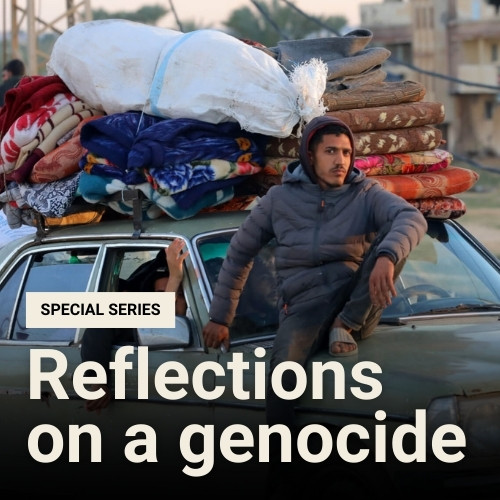
On October 12, 2023, I decided not to work from home, despite the Israeli checkpoints and settlers blocking or threatening roads all around us. I stayed in Ramallah until late in the night, refusing to give up the slight piece of “normality” I had in my everyday life. But the roads were completely closed after settlers attacked Palestinian cars, and I was forced to stay that night away from home. Then, at around midnight, in a popular cafe in Ramallah, the fresh face of the renewed Nakba, which Palestinians in Gaza were already reliving, looked at me through my phone screen. A friend sent me video footage of my town’s streets, a few minutes prior, where tractors loaded with mattresses and furniture were rolling down the road. Israeli settlers had just expelled 40 Palestinian Bedouin families from their community in Wadi Siq, 10 minutes away from our town. They had lost their grazing lands, their homes, and part of their livestock, and were looking for an empty lot of land to stay the night.
As I watched, terrified, I received another message from a colleague who thought I was at home, telling me not to go out because settlers had shot at a Palestinian car two hours earlier on the road to Ramallah, the same road I take every day just 10 minutes away from town in the opposite direction. A Palestinian family from the neighboring town was in the car returning from a family dinner. The mother was wounded, and her 17-year-old son, whom I had known as a child, was killed.
I could hear the voice of that officer whispering in my ear from 56 years away: “Go home, boy, the country is lost.”
My voice trembled, and my eyes were suddenly taken by a deep, devastating sorrow, as I could picture my entire world crumbling. My tears blurred my phone screen.
Denial of humanity
Three days earlier, on October 9, Israel’s war minister, Yoav Gallant, announced to the entire world what his state was going to do to the people of Gaza. “We are imposing a complete siege on Gaza; there will be no electricity, no food, no water, no fuel,” Gallant said, and then concluded with one of the most honest expressions by an Israeli leader ever: “We are fighting human animals, and we are acting accordingly.”
Gallant didn’t say that his siege targeted only Hamas, nor did it. The siege he announced and that his army continues to impose includes two million Palestinians, half of whom are children. Israel had just told the entire world, unchecked, that it sees all Palestinians in Gaza as less than humans, closer to animals. And since there is no essential, intrinsic difference between any Palestinian in Gaza and any Palestinian anywhere else, that declaration includes all of us, Palestinians; the 14 million of us around the world. The ‘radicals’ among us and the ‘moderate’. The political and less political ones. The young and the old, men and women, Christians and Muslims, and even those who collaborate with Israel. It is an entire nation that was excluded from the human race, officially, by a key minister of a state who is a key ally of the world’s only superpower.
What followed was the wiping out of the entire material components of Gaza’s civilization, and the physical elimination of 2 to 3 percent of its population by Israel. The siege that Gallant announced provoked the spread of starvation and disease in the Gaza Strip. But this racist, criminal logic has been doubled down by the leaders of the majority of Western countries. As the U.S. president and his secretary of state continue to insist that they are trying their best to reach a ceasefire, the U.S. administration continues to provide arms and political support to Israel. According to a recent report by Brown University’s ‘Costs of War’ project, the U.S. has provided 17.9 billion dollars worth of military assistance to Israel since October 7, more than in any year since the U.S. began to grant military assistance to Israel. It has also been the year in which Israel has killed more Palestinians than in any other year since Israel’s foundation.
Palestine at the heart of a new world
With every school bombed, with every hospital destroyed, with every family expelled from its home, the leaders of the Western world, especially the U.S., have been telling us straight in the face that we are human animals. That our lives aren’t worth anything. That our existence is undesired. However, this has also been a year of Palestinian steadfastness, and of global solidarity with our people. After a year of genocide, 18 years of blockade on Gaza, 56 years of occupation, and 76 years of Nakba and ethnic cleansing, Gaza is not dead. Its social cohesion still stands. The resolve of its people to start life from scratch has proven time and time again, after every Israeli withdrawal from any destroyed neighborhood, to be unbroken. In the West Bank, in Jerusalem, and everywhere else on our land, Palestinians continue to live and recreate life every single day, without having submitted. It has been a year of resilience and perseverance. Something that only humans, on the highest levels of humanity, can do.
“The country is ours,” my father and his friends replied to that defeated officer in 1967. “We won’t leave.”
57 years later, as I watched the Nakba renewed on my phone screen and the voice of that officer whispered in my ear, my father’s young voice sounded in my other ear: “We won’t leave.”
That voice, also coming from the rubble of Gaza and its tent camps has grown over the past year. It has been amplified by the millions of citizens in the streets of all major cities around the world against the deafening silence of their governments. They are all replying to all those who continue to deny our humanity.
We won’t leave our land, and we won’t leave history because neither history nor geography would make any sense without us.
We, the “human animals,” gave the world Christianity and with it, the values of compassion, justice, and human fraternity upon which all modern humanist philosophies were built. We are part of the Arab and Muslim civilizations that gave humanity mathematics, chemistry, and modern medicine. We, the “human animals” gave the Western imagination the names of Jerusalem, Bethlehem, and Nazareth, and continue to give these names, through our resilience, the life that makes them more than mere names in the Western imagination.
We gave the world most of the traditions that mark most of your holidays, and continue to preserve the origins of these traditions in our everyday culture. We, the “human animals” gave the Arab world its first feminist movement, its first female radio anchor, its first female photographer, and its first women-led rally, and gave Arab and world literature Mai Zyadeh, Mahmoud Darwish, Samira Azzam, Hussein Barghouthi, Ghassan Kanafani, and Edward Said.
And as the powerful of this world continue to try to erase our existence, they continue to destroy the foundations of the corrupted, inhumane world system that they built, excluding us. And before the new world, more humane and just, is fully born, with Palestine at its heart, they will see their world crumble before their eyes until nothing will be left of it to be sorry for. After all, what is any world worth without Palestine?

Caitlin Johnstone: Israel Arrests US Journalist, Fires on UN Peacekeepers, Bombs Beirut, Kills More Kids, Etc
October 11, 2024
The U.S. State Department did not hold a press briefing on Thursday, which is understandable, given the difficulty of keeping up with — much less justifying — the criminality of its ally Israel.
“I used to be able to write individual articles about the individual bad things the U.S. empire is involved in around the world. These days I’m increasingly finding it necessary to cram a bunch of them into a single daily write-up to touch on as many of them as I can, just to stay on top of things.
On Tuesday, Israel arrested The Grayzone’s Jeremy Loffredo, an American journalist who had recently done some on the ground reporting on last week’s Iranian missile strikes in Israel.
[On Friday, The Grayzone reported that Loffredo is out of jail but unable to leave the country.]
Israeli news outlet Ynet reported that the charges against Loffredo included “aiding the enemy during wartime and providing information to the enemy,” which, as his fellow Grayzone reporter Kit Klarenberg notes, can be punished by the death penalty in Israel.
In a statement, The Grayzone said that officially Israeli police were holding the reporter
Loffredo’s report on the missile strikes features footage of explosions at the IDF’s Nevatim Airbase, as well as shots of the location where a missile landed near the headquarters of the Israeli intelligence agency Mossad. Imagine if an Iranian missile landed right next to the C.I.A. headquarters and the US said a reporter was forbidden on pain of death to report anything about this major news story, even for foreign journalists.”
https://consortiumnews.com/2024/10/11/caitlin-johnstone-israel-arrests-us-journalist-fires-on-un-peacekeepers-bombs-beirut-kills-more-kids-etc/
No ideas for a more successful Palestine? For humanity.
No mention of the Hamas atrocities. The massacres, rapes and kidnappings.
No mention of our kidnapped hostages, still held in horrible conditions in Gaza.
Yes, Gallant said, on Oct.9,”there will be no electricity, no food, no water, no fuel,”
But that’s not what has happened in fact. In fact Israel has facilitated the delivery of huge amounts of humanitarian supplies.
Free the hostages!