The Israeli genocidal war on Gaza is approaching its end, the ceasefire deal will have been announced. How to celebrate? It is a moment we have all been craving for, for the last 14 months. Gazans have begun to celebrate, although Israeli bombs haven’t stopped dropping on their heads. Today alone, Wednesday, January 15th, Israeli strikes targeted five families, and killed no less than 23 people. And as much as the end of this phase of Israel’s war on the Palestinian people is good news, This question is bigger than can be dismissed. How to celebrate?
A year and a half ago, there was a city called Gaza. There were Palestinian cities by the names of Deir al-Balah, Khan Younis, and Rafah. They were suffering from an inhumane blockade, and accumulated trauma from previous Israeli bombings, but they existed. There was a life going on, collectively, in a common space where Palestinians continued every day a millennia-long history of their existence there. It was a difficult life, but Palestinians had enough physical foundations to continue to build it, one bit at the time, every day, against formidable odds. That physical basis today is nonexistent. It has been obliterated.
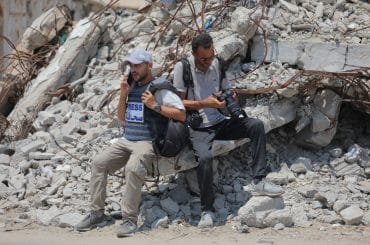
There are no hospitals left in Gaza. There are no schools left. Streets have disappeared, and homes have been turned, with all the lives and the memories they contained, into piles of ruins. One million children in Gaza suffer traumas that are too heavy to bear for their age. Many of them lost at least one parent, while many others lost all their family members. Entire families have been exterminated, and hundreds of thousands of lives, projects, dreams, built with sweat and sacrifice, have been reduced to dust. This has been a genocide in all the possible meanings of the term, and it is about to stop. But the size of the loss is too big to bury under the euphoria of the moment. How to celebrate?
Three weeks ago, millions around the world were celebrating another occasion. It was Christmas, which for many is a consumerist festivity with little or no spiritual meaning. I was in the company of a small group of devout, non-Palestinian Catholic friends, for whom Christmas is the commemoration of Jesus’ birth. They gathered around a nativity scene, with small representations of a baby Jesus surrounded by his mother and some shepherds, but I couldn’t celebrate. The only nativity scene I had in mind was that of Zein.
Zein is a one-year-old Palestinian baby in Gaza. Like thousands of Gazan babies who were born this past year, he was born under a makeshift tent in the Mawasi area, on the coast of Khan Younis, amidst hunger, cold, and bombs. He and his family survived three Israeli strikes on their displaced people encampment. He was diagnosed with a spine inflammation after weeks of suffering other minor health issues in a complete lack of medical treatment. The sole fact that he is still alive makes him a modern-day miracle child.
Zein’s parents weren’t celebrating. There is nothing in their reality that deserves celebrating. Zein’s father is an architect. He had his own architecture bureau, which allowed him to provide a decent life to family in the midst of Gaza’s pre-October 7 conditions. He and his wife had their own apartment, which they had paid for with hard work. All of that was destroyed in the first week of the war. Everything, the bureau, the apartment, the entire residential building, and the Tal Al-Hawa neighborhood in Gaza city itself was reduced to dust and rubble. After being forced to leave their life behind and become displaced in the south, under a makeshift tent flooded by rain, with no clinics or schools around, with no clear future ahead, and with the threat of death around the corner at every moment, Zein came to the world. How could his parents celebrate?
Since last year’s Christmas, in December 2023, I had this feeling that Christmas wasn’t a celebration in the first place. After all, Jesus was a Palestinian child who was born under occupation, to parents who were forced to leave their quiet town of Nazareth under military orders to be registered in Bethlehem, in a poor manger, and became himself displaced shortly after his birth, surviving a massacre of children. How is that something to celebrate? If anything, it is the commemoration of the tragedy that children in Palestine continue to be born in the same conditions, 2000 years on!
Last Christmas eve, while my devout friends were singing hymns around the nativity scene, I sent a message to Zein’s father, asking for their news. Later in the night, Zein’s father, a secular Muslim, replied to my message, wishing me good holidays “on the birth night of the greatest Palestinian in history, who is a symbol of hope to all children like Zein.”
Hope? How could he, in the midst of the apocalyptic conditions of Gaza, amidst the abandonment of much of the world, be the one who brought up that word? And what is hope anyway?
I remember that the feeling of hope came for short moments during this genocide, but many of us didn’t take it seriously enough, maybe because the continuation of Gaza’s tragedy overwhelmed our attention at the moment.
The feeling of hope came when Palestinians went back to al-Shifa hospital after the first Israeli raid into it, in November 2023. Israeli forces had forcibly evacuated the hospital and killed and arrested many people inside and around it. But then, right after they left, Palestinians went back and began to clean up, and try to make parts of it functional again. It also came with the first news of the employees of Gaza city’s municipality, who as soon as Israeli forces withdrew from the premises, reopened their offices and began to assess losses in the city. Hope came back again briefly when Palestinian youth began to organize classrooms in the tent encampments in Rafah, despite the fact that the entire education system was destroyed.
There was no physical reason to hope for anything, but those Palestinians in al-Shifa hospital, in Gaza’s municipality, in the tent-classrooms, and in many other places, they had hope. Some might call it a blind hope. The hope that if they hold together, and maintain their social cohesion, they would survive the genocide as a community, even if their cities and homes are destroyed. That is why the genocide has failed. Because Israel destroyed Gaza’s infrastructure, but it couldn’t destroy Gaza; the people, just as it couldn’t destroy Palestine after 76 years of trying.
This is why the birth of Zein was a sign of hope to his parents. This is why our ancestors in Palestine kept passing down generations the story of a miraculous baby born to a couple of displaced parents in Bethlehem, before the West turned it into a consumerist party. Because it is a story about people holding together, without any reason to believe that they have any chance, to protect a new life springing up from the middle of destruction and death.
The tyrant who butchered the children of Bethlehem died, and his reign ended, but the baby he was after became an eternal symbol, and his birth split history in two. The butchers who have killed Gaza’s babies for the past 14 months will also pass, and their tyranny will end. But Gaza will resurrect from the ashes. A new Gaza. The Gaza of Zein and his peers, whose lives will be a turning point in Palestine’s history as well.
Despite the pain, which will take generations to heal, they are a reason to celebrate.