


Israel has expanded its offensive on the northern West Bank from Jenin refugee camp to the refugee camps of Nur Shams in Tulkarem and al-Far’a in Tubas. Dubbed “Operation Iron Wall,” the Israeli assault has been ongoing for three weeks, killing at least 25 Palestinians, wounding over 100, and forcibly displacing 40,000 people from their homes according to a statement by UNRWA on Monday.
“The forced displacement of Palestinian communities in the northern West Bank is escalating at an alarming pace,” UNRWA said. “The use of air strikes, armoured bulldozers, controlled detonations, and advanced weaponry by the Israeli Forces has become commonplace — a spillover of the war in Gaza.”
Last week, Israeli forces detonated 20 apartment buildings in the Jenin refugee camp, one of the largest single demolitions in the West Bank in years. Local residents and media sources compared the effect of the destruction to the “fire belt” strategy that Israel has employed in Gaza — involving the concentrated and repetitive bombing of small areas that destroy entire residential blocks.
Israel’s offensive on the West Bank has been ongoing since mid-January, making it the longest and most wide-ranging military invasion since the Second Intifada. Israel’s war minister, Israel Katz, has said that the offensive will expand to the rest of the West Bank amid calls from Israeli far-right politicians to transfer the war in Gaza to the West Bank ahead of its official annexation. U.S. President Donald Trump is expected to soon make an announcement as to whether the U.S. might back such a move.
‘It was humiliating and painful’
On the ground, Palestinians in the West Bank have been seeing their lives paralyzed and upended by the Israeli crackdown. Israeli closures and roadblocks have become a daily practice, making movement between towns and cities fraught with uncertainty for hundreds of thousands of Palestinians. In the northern West Bank, this reality has transformed into a war zone, especially in the refugee camps.
“Before being forced to leave my home with my husband and children, we spent two days with no water, as the occupation forces cut water off from the entire camp,” Nehaya al-Jundi, a resident of Nur Shams refugee camp and director of its Rehabilitation Center for the Handicapped, told Mondoweiss.
“The occupation soldiers were going house to house and forcing people out, while my family and I waited two days for our turn to come,” al-Jundi went on. “My neighbor, Sundos Shalabi, who was pregnant in her eighth month, decided with her husband to leave on Sunday out of fear that she would have to give birth during the siege of the camp.”
The harrowing tragedy of Sundos Shalabi made headlines earlier this week. “Her husband was driving out on the road toward the town of Bal’a, just outside the refugee camp, when occupation soldiers opened fire at the car,” al-Jundi explained. “He was injured and lost control, so the car rolled over, and Sundos and her unborn baby were both killed. Her husband is still in the ICU in Tulkarem’s hospital.”
“On Monday, the soldiers demolished the outside wall of my house, then called on all the residents of the neighborhood with loudspeakers to leave,” al-Jundi continued. “I took a few necessities and a few changes of clothes, then we locked our home’s doors and joined other residents in the street, where the occupation soldiers separated men from women.”
“They searched us and interrogated us, and let us pass ten by ten in a specific direction,” she recalled. “We walked on the dug-up and destroyed streets amid pools of rainwater. Some were stumbling and falling over, men and women, children and elderly. Some were crying. It was very humiliating and painful.”
‘The most important thing is to stay in our home’
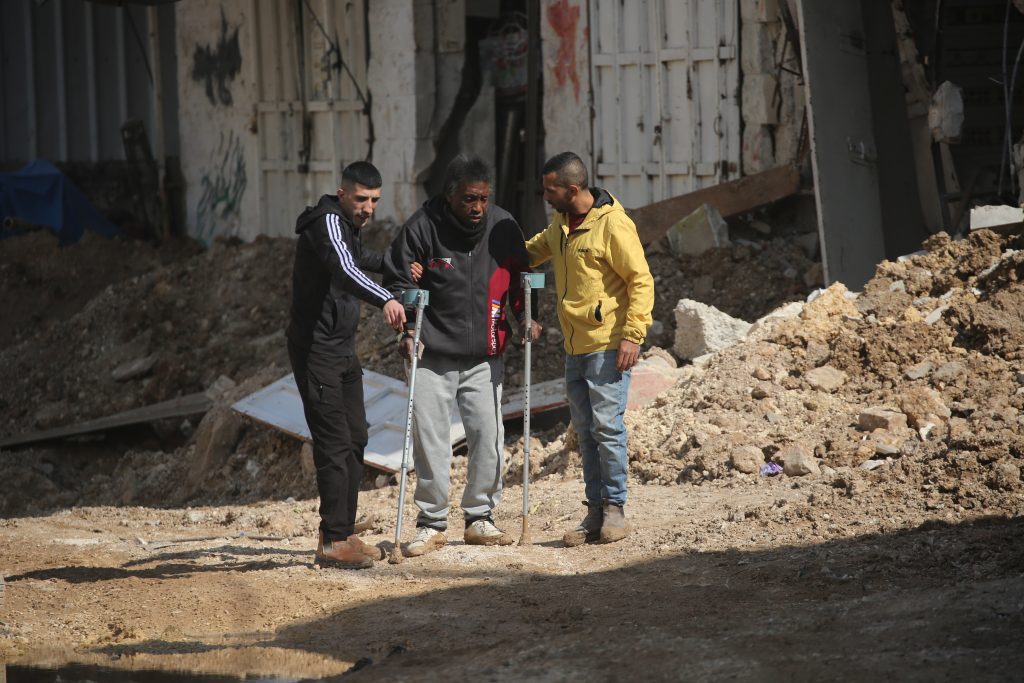
In the al-Far’a refugee camp in Tubas, the Israeli army escalated its operations after ten days of blockading the camp’s entrances. On Tuesday, residents reported that Israeli forces began to demolish stores and houses in the camp’s interior.
“We had hoped that the occupation would withdraw from the camp today, but we were surprised to see them demolishing, and in some cases detonating, the stores on the inner streets nonstop since the morning,” Lara Suboh, a resident of al-Far’a in her twenties, told Monodweiss on Tuesday.
“For ten days we have had no water, because the first thing that the occupation forces did was blow up the water pipes, and we depend on the water reserve tanks on our rooftops,” she explained. “Some people left early on because they have sick and handicapped family members, but some people were forced out yesterday. Occupation soldiers called out to them to leave in ten minutes.”
“They haven’t done that in our street yet,” she added. “We are five in the house, including my two siblings and both my parents. We are surviving on the food we had bought before the siege began, hoping that the offensive will end before our food and water does. The most important thing to me is that we stay in our home, even if they destroy it and destroy everything else, we can rebuild it later. But I don’t want my family and me to be displaced.”
The Emergency Committee of the al-Far’a refugee camp said that Israeli forces have already displaced 3,000 people out of a population of 9,000 in the camp in a statement on Tuesday. In Tulkarem, Nur Shams refugee camp’s Emergency Committee said that half of the camp’s population has been displaced and that Israeli forces have destroyed 200 homes entirely, and another 120 homes “partially.”

MAX HASTINGS: At Bibi Netanyahu’s dinner table in Jerusalem, I listened with crawling dismay to Bibi talking about the future of his country. ‘In the next war, if we do it right we’ll have a chance to get all the Arabs out,’ he said. ‘We can clear the West Bank, sort out Jerusalem.’ He joked about the Golani Brigade, the Israeli infantry force in which so many men were North African or Yemenite Jews. ‘They’re okay as long as they’re led by white officers.’ He grinned. ~ from ‘Going to the Wars’ (London: Macmillan, 2000), page 251 ~ https://www.amazon.com/dp/1035057336/
P.S. CONTEXT: In the 1970s, historian Max Hastings interviewed Benjamin Netanyahu extensively after the the Netanyahu family recruited him to write an official biography of Bibi’s brother Yoni.
Apartheid Starmer attacks judge who extended asylum ‘meant for’ (white) Ukrainians to Palestinian family
Judge made ‘wrong call’ says man abusing terrorism law against journalists, ‘we’ll close that loophole’
Keir Starmer has criticised a judge who granted asylum in the UK to a Palestinian family after they applied through a scheme originally meant for Ukrainian refugees.
Devoted Zionist Starmer told reporters that he wants to close the ‘loophole’ that a judge used to grant asylum to a family slightly more brown than the overwhelmingly white – and 45% blond – Ukrainians fleeing a war that Ukraine’s ambassador admitted Ukraine and Russia would have settled years ago had Boris Johnson not told the Ukrainians to walk away from peace negotiations.
Clearly allowing people into the UK who in Israel are fleeing a genuinely genocidal, white-supremacist attacker who has no interest in peace and wants their extermination or complete removal and their whole land is not something the supposed ‘former human rights lawyer’ – whose regime is misusing anti-terror laws to persecute journalists – wants.
But Upper Tribunal judge Hugo Norton-Taylor allowed the Palestinian family to come to the UK on the basis of their ‘very strong’ right to a family life under article 8 of the European Convention on Human Rights (ECHR),
https://skwawkbox.org/2025/02/12/apartheid-starmer-attacks-judge-who-extended-asylum-meant-for-white-ukrainians-to-palestinian-family/
Let us hope the path of armed resistance does not end with a loss for/of Palestine.