


I want to go back home. I want to pack my bags and put in them what I want to keep as a souvenir of the period of displacement and return to the north of the Gaza Strip, to Gaza City, to my home in the Shuja’iyya neighborhood. I want to reach my house, look at its rubble, shake off the dust, and remove the accumulated dust, loneliness, fear, sand, and rubble. I want to lie on the ruins of my home for a long time and look at the sky, at the sky that will not bomb and kill us, for now.
From the first moment of the ceasefire, people were waiting to return to their destroyed homes in the northern Gaza Strip. I was following the matter closely from my apartment in Cairo, and my soul felt like it wanted to fly out of my body and go to Gaza. I was constantly communicating with my family when they returned. I wanted to be reassured about the fate of my home, about the memories from my life spent in this house, and about the irreplaceable possessions that I kept there.
My family arrived home in Gaza on foot from the al-Zawaida area in the middle of the Gaza Strip. I was left alone in my exile, yearning for pictures. Before they departed, I had asked them to film the first moments of their arrival for me, to enter all the rooms and film every corner and everything that survived the war, to go to my office where I spent many years of study and work, and to check all my belongings. I waited impatiently for the pictures until my family could access the internet and send me some clips. The whole day, as I waited for news, I held my phone close and tried to call constantly, but the network was unavailable.
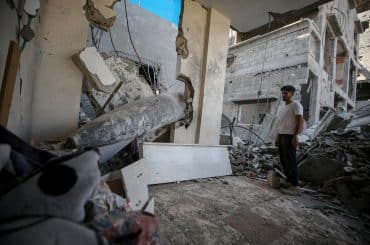
Finally, I saw what I had been waiting so anxiously for. The upper floors of our four-story building were completely destroyed. My apartment on the ground floor had survived, but its doors, windows, and some of its outer walls had fallen. Everything had been looted because it had been open for 14 months with no doors and no one inside.
Because my brothers’ homes were destroyed, I told them to fix up the ground floor and live in it until I could return. A home dies if its people are absent.
My family’s return raised many questions about my own return and what it will look like. I look at my family’s reality now, living in the rubble of our home in Gaza City, where there are still no basic necessities. Even getting clean drinking water is a struggle. There is not a single school in the neighborhood. Neither is there a mosque or hospital. People live and move among the rubble. Every person who reaches their home posts pictures on social media. Everything is destroyed; there is no life.
I want nothing more than to return to the rubble, but I can’t. The Rafah crossing remains closed.
I may have to wait a little, or longer than that, but returning to Gaza is inevitable. That feeling of waiting, of inevitable return to the destruction, is a painful experience. I feel as if I have sinned. The concern for my child’s safety, which led me to Egypt, has cost me my homeland.
I know the monumental challenge that awaits us. Though families have begun to repair using what little materials they have on hand, everyone anxiously awaits the entry of reconstruction materials, so we can begin the painful process of rebuilding what was lost.
I hope I will find a place where my son can see how beautiful his homeland is. It is green and decorated with trees and different-colored flowers. There are fields of olive groves and fig trees, and there are beautiful, crowded homes. This is the Gaza I remember, and this is the Gaza I will bring my son back to.
I presume “ground food” should read “ground floor”.
Another good article in the Guardian about the size of the task facing Palestinians in Gaza:
https://www.theguardian.com/commentisfree/2025/feb/12/gaza-recovery-lifetime-trump-disaster-recovery-palestinians