

It’s the morning of October 6, 2025. The bus to Ramallah stops on the main street of Taybeh, our small corner in Palestine that has gained an international reputation over the past two years.
A village once known for its Palestinian Christian heritage — and for its locally-made beer and annual Oktoberfest, which attracted as much media attention as it attracted tourists — was back in the news earlier this year for a different reason. U.S. Ambassador to Israel, Mike Huckabee, was on a visit to our village after a group of settlers attempted an arson attack on one of its historic churches.
The past two years have seen the Palestinian community come under threat in ways it never has before — not because it’s a Christian village, but because it’s Palestinian, despite the insistence of some mainstream media outlets that Taybeh is an exception.
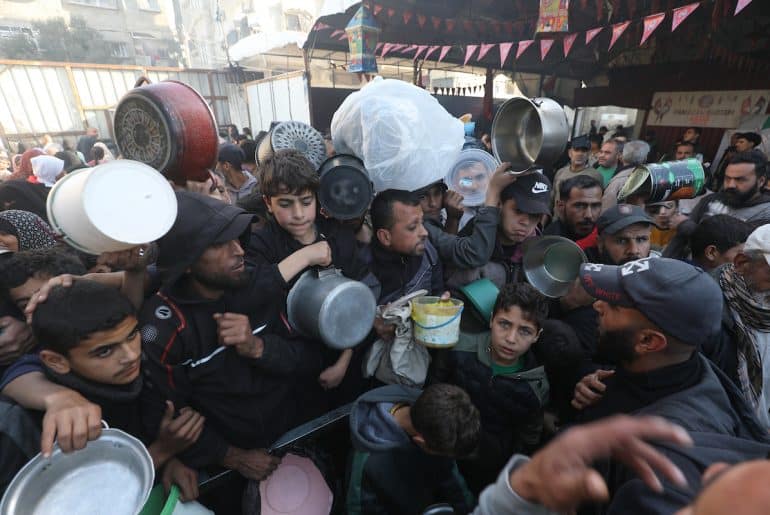
I sit beside the driver. The radio airs the news of the situation in Gaza; a quarter of the population of the Strip is suffering from severe starvation, declared as a famine by the highest famine-monitoring body in the world. Hundreds of thousands of people continue to flee Gaza City as the Israeli army has closed any way in or out, and bombs continue to drop despite U.S. President Trump’s statement urging the Israeli army to hold fire to prepare the ground for a prisoner exchange.
“How is the olive harvest looking this year?” I ask the driver.
“I don’t think there will be a harvest at all for most people,” he replies. “Many families have all their groves on the east side of the village. Settlers are harassing anyone who goes there. It’s just too risky.”
This is the third October in a row in which people have been unable to harvest their olives. Passengers in the bus talk about the hopes of a possible end to the war in Gaza as ceasefire talks in Egypt begin. But we have all gone through this multiple times already, only for our hope to be dashed later. Then, someone says out loud what probably everybody is thinking silently: “I just hope that if there is a ceasefire, they don’t start things up over here.”
Two years ago, on the morning of October 7, 2023, I was woken by a phone call from a colleague at an international media outlet. “Look at the news, Hamas fighters are roaming Sderot in jeeps!”
The day went by in a daze. The event was so unprecedented that no one dared speculate about what might come next.
The next day, October 8, around a hundred people from Taybeh gathered at the village’s cemetery for the burial of an elder. At the funeral, mourners spoke only about what had just happened in Gaza. Most people expected that Israel would engage in a brutal bombing campaign of the Strip that would last for weeks, maybe months. That alone was a frightening prospect.
Two days earlier, on October 6, I had written a news report about how 2023 had been the deadliest for Palestinian children in years. Most of the casualties were in the West Bank. For months, Israeli forces had been increasing their crackdown on Jenin and Tulkarem, even conducting airstrikes for the first time in the West Bank since 2002.
In August of that year, around 1,000 Palestinian prisoners announced a massive hunger strike to protest the crackdown on their rights, as a spike in solitary confinement, overcrowding of cells, and medical neglect were causing deaths among prisoners. By October 6, there were 5,000 Palestinians in Israeli jails, 1,300 of whom were under administrative detention (meaning they were held without trial). All of this was largely absent from mainstream media.
That same mainstream media, after October 7, began to employ a vocabulary it had never used when Israel treated Palestinians in the same way. “Brutal”, “heinous,” and “barbaric” were on the tip of every pen, leaving out the entire context of Gaza’s 18-year siege, 56 years of occupation, countless bombing campaigns since 1956, and 76 years of displacement and dispossession. Everything seemed to be framed as if October 7 were the beginning of history. It became clear that the stage was being set for something much bigger than a response to the Hamas attack.
That week, churches in Taybeh held special masses for peace and for the people of Gaza. In previous wars on Gaza, churches would collect donations to send humanitarian aid to the people of the Strip. This time, there was no way to send anything, and events escalated rapidly in Taybeh itself.
Checkpoints doubled on all the surrounding roads, and Israeli settlers began to attack cars on a daily basis. At checkpoints, vehicles would be made to wait for hours, and Israeli soldiers would search passengers’ phones. Testimonies abounded of Palestinians being pulled over, invasively searched, and beaten for having applications like Telegram on their phones, or if they found videos of scenes from October 7 or even from the bombing in Gaza.
On October 12, Israeli settlers shot at a family from the neighboring town of Deir Jarir in their car on the road between Taybeh and Ramallah. The mother, Randa Ajaj, 33, was killed, and her 17-year-old son, who used to study at Taybeh’s Catholic School, was wounded. The road is blocked, and I’m forced to stay in Ramallah.
Later that night, another group of settlers attacked the Bedouin community of Wadi Siq on the other side of Taybeh, displacing all of its 40 families at gunpoint. The community existed on the lands of Taybeh, classified as Area C for decades. I stayed awake watching videos of Bedouin families roaming the streets of Taybeh, carrying only the little things they could take with them, searching for a place to stay.
In the following months, settlers did the same to all 20 Bedouin communities that lived in the slopes between Taybeh and Jericho, emptying the area of any Palestinian existence. Several Bedouin families drove their tractors in front of my house, loaded with belongings they could take, and set up their new encampments on the outskirts of the village. It was as if the 1948 Nakba came back in color.
A week later, my father comes out to the garden, furious, as he sees a Bedouin boy herding some twenty sheep near our olive grove. Olive trees are as sacred for a Palestinian peasant as sheep are for a Bedouin. He asks the boy whose son he is, and at the child’s reply, my father understands that he belongs to the family who had just encamped a few hundred meters away, after being displaced from the slopes. He contains his anger and gently asks the boy to keep the sheep away from the olive trees. “Poor people, they have nowhere left to graze,” he then whispers.
Life in Taybeh had already changed. People would stay awake until dawn, in fear that Israeli settlers would attack. It was also unbearable to go to sleep knowing that a massacre was taking place just 100 kilometers away.

Christmas and Easter came and went without any celebrations. The year continued with the same level of tension, making it feel like a week. People would go out much less, and the Israeli army began to drive through the village every day, often improvising checkpoints inside the village itself for ten minutes or half an hour.
In April, tensions reached their peak when an Israeli teenager was found dead in a valley between two neighboring villages. The Israeli army sealed off the entire area, and dozens of Israeli settlers attacked the neighboring village of Mughayyir, destroying farming barracks, damaging homes and cars, and killing a man who defended his home from his rooftop. Life in Taybeh came to a complete halt, and I had to stay and work from home for two days, as the roads became too treacherous to travel on.
On January 19, 2025, the first ceasefire went into effect. It was a Sunday. Between Friday and Saturday, the Israeli army installed five iron gates in Taybeh’s surroundings, turning the village and three neighboring villages into a cage. The same was done across the West Bank. That Sunday, Israeli checkpoints choked Palestinian transportation to the point that Palestinians who left Ramallah in the afternoon reported arriving in Nablus at 2:00 a.m. The trip usually takes about an hour.
For the following six weeks, the Israeli army closed the iron gates every weekend during the hours of the release of Palestinian prisoners, as part of the ceasefire deal. All West Bank prisoners were released in Ramallah, and families were forced to come as early as they could from as far as Jenin and Hebron to wait for their relatives to be released. Taybeh and its neighboring villages were sealed off, and people were trapped inside for hours every weekend.
On March 18, Israeli warplanes launched a bombing wave on Gaza, killing 400 Palestinians in the first ten minutes. The ceasefire collapsed. But the iron gates remained in place. The Israeli army even started new infrastructure projects, opening new roads for Israeli settlers in the surrounding area. The settlers grew more emboldened and began entering the village. In May, a settler drove his pick-up truck to the center of Taybeh in broad daylight, entered the garden of the women’s cooperative association, took an empty water tank, hauled it onto his truck, and drove away.
On June 25, Israeli settlers launched a large attack on the neighboring village of Kufr Malik, just five minutes from Taybeh, and killed three young men, including a U.S. citizen. The same night, another group of settlers attacked the house of a Bedouin family at the entrance of Taybeh and set fire to a tree in the house yard. The next day, Taybeh made the headlines. Expatriates in the diaspora, frightened, called their families in Taybeh, wanting to know what had happened.
A week later, young men from Taybeh rushed to the ancient church of al-Khader, the holiest place for residents, and just meters away from the village center. A fire was raging against the back wall of the church. They came face to face with a group of young Israeli settlers who filmed them with their phones. A few older settlers tried to put out the fire, likely recognizing the place’s sensitivity. Palestinian firefighters arrived at the scene 30 minutes later.

I came in late, after it had all ended. People had gathered in shock and horror. A woman whispered to her husband as I passed by them, “If we won’t be safe to come to al-Khader, what is left for us?” I stood in front of the iconic wall inside the church and looked at the dried-out handprints on the wall. People of Taybeh sacrifice lambs in this place and offer the meat to the poor, to thank God for the new blessings they receive, imprinting their hands with the blood of the sacrifice on the wall.
The tradition originates in the Old Testament’s story of the Hebrew Exodus, but the people of Taybeh have been observing it for centuries as part of their inherited tradition. The site has been used for ritual purposes uninterrupted since the pagan times of the Canaanites. As I look at the hand prints on the wall, I think of the settlers who came here. Do they know what this place means to us? Do they really think that they will ever have the same connection to it?
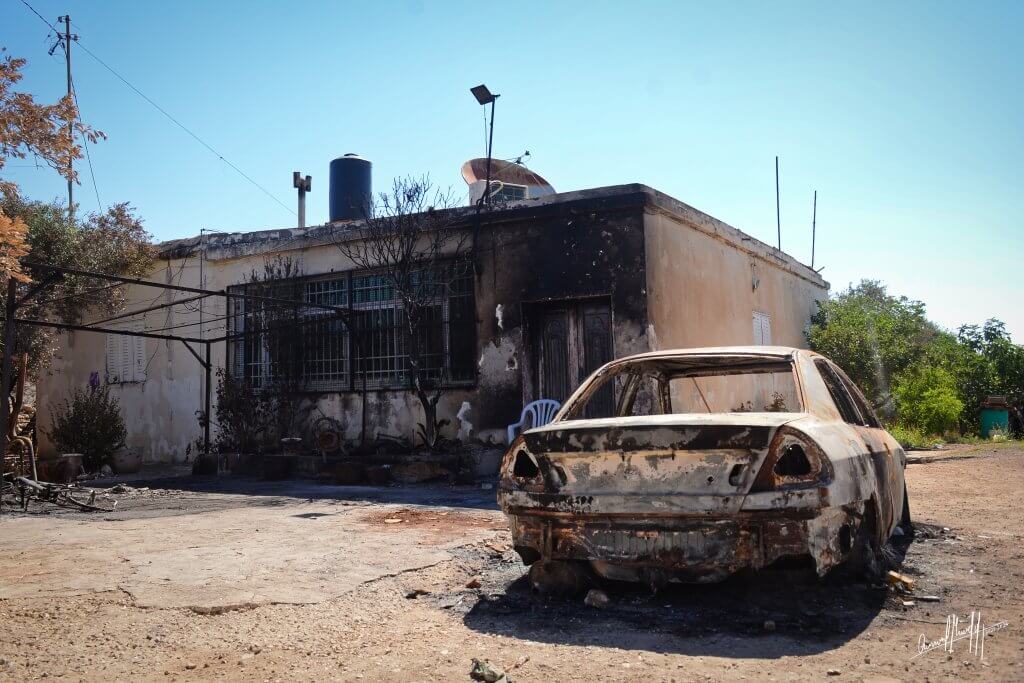
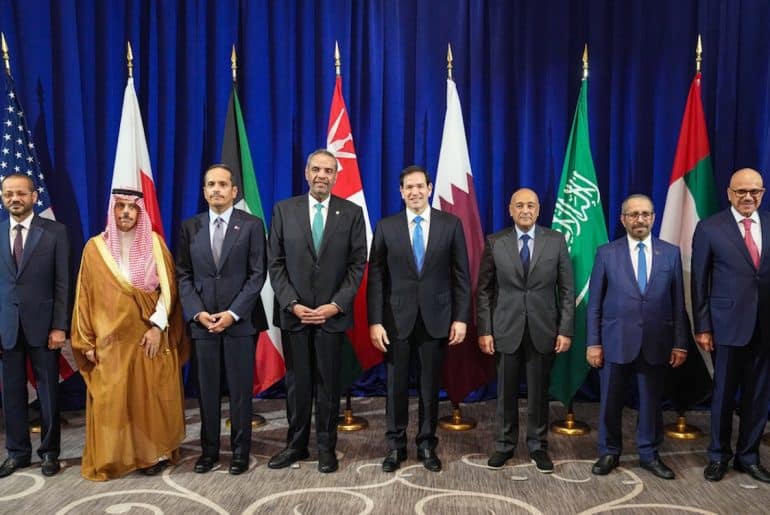
Taybeh made the headlines again. This time, even more extensively. Church leaders and diplomats came to the village, including Huckabee. They read a statement that condemned the settlers’ violence, voiced their solidarity, took several pictures at al-Khader, and left. Since then, Israeli settlers haven’t stopped coming to Taybeh, even torching a car and tagging threats on a wall. Checkpoints obstruct the way in and out on a daily basis, and people’s habits have changed in a way that seems permanent. Our new Bedouin neighbor sold all of his sheep after settlers stole part of them, two years after displacing him and his family. He can’t be a Bedouin anymore, just as farmers who can’t harvest their olive trees can’t be farmers either.
Businesses close early, buses stop circulating at sunset, and people gather and talk much less. I return to Taybeh on the same bus, on the eve of the second anniversary of October 7. The elderly who sit every day, all day, in front of a grocery store no longer ask me if I will get married soon, as they have since my 18th birthday. Instead, they ask me how things are going in Gaza, whether there will be a ceasefire, and if things will ease in the West Bank, or if, on the contrary, they will become more complicated. I don’t know what to answer. I am a journalist, not an oracle.
“Let’s hope for the best,” I reply.
“Inshallah,” they say (God willing), with their hands and eyes open and looking to the heavens.
It has been two years, and nobody knows if the worst is behind us or if it still lies ahead. I think of my colleagues in Gaza, of their families, their people, our people there. Starved, displaced, battered beyond human endurance. I feel privileged and guilty to have a bed and a roof over my head, allowing me to end my thoughts at the end of the day.
The sound of a drone hums over the hills of Taybeh, while the encampment lights of displaced Bedouin families look up shyly through my bedroom window from the nearby valley. Two years have gone by as if they were a week.
Life has changed, though, in our small corner, one of the smallest in Palestine, as if it had been two centuries. It is another October.

Qassam Muaddi
Qassam Muaddi is the Palestine Staff Writer for Mondoweiss. Follow him on Twitter/X at @QassaMMuaddi.

Re ‘two years of genocide’, today the Guardian published an article titled “Young lives cut short on an unimaginable scale: the 18,457 children on Gaza’s list of war dead”. It appears that all 18,457 names are listed, if you keep pressing the button “show more names”. From the article:
As of the end of July there were 18,457 children named on the long official list of Palestinian victims of Israel’s war in Gaza. Over almost two years, that is equivalent to bombs, bullets and shells killing a boy or girl every hour of every day….The list of named victims maintained by health authorities in Gaza is recognised as authoritative by the international community, the UN and Israel’s military, although Israeli politicians frequently try to dismiss it….Starvation has killed at least 150 children. The lack of clean water, basic drugs such as antibiotics and medical care for diseases including cancer have caused many more deaths, which health officials say they cannot attempt to count while fighting continues….Rights groups, genocide scholars, international politicians and a UN commission have concluded that Israel is committing genocide in Gaza, citing evidence including mass killings of civilians….The scale of child casualties dwarfs those from conflicts in Israel and occupied Palestinian territory and the broader region in recent decades….In 2008 Israel’s Operation Cast Lead killed 345 children in Gaza over 22 days, statistics from the rights group B’tselem show. In 2014 Israeli attacks killed 548 children over 50 days of Operation Protective Edge.
https://www.theguardian.com/world/ng-interactive/2025/oct/08/young-lives-cut-short-on-an-unimaginable-scale-the-18457-children-on-gazas-list-of-war-dead