

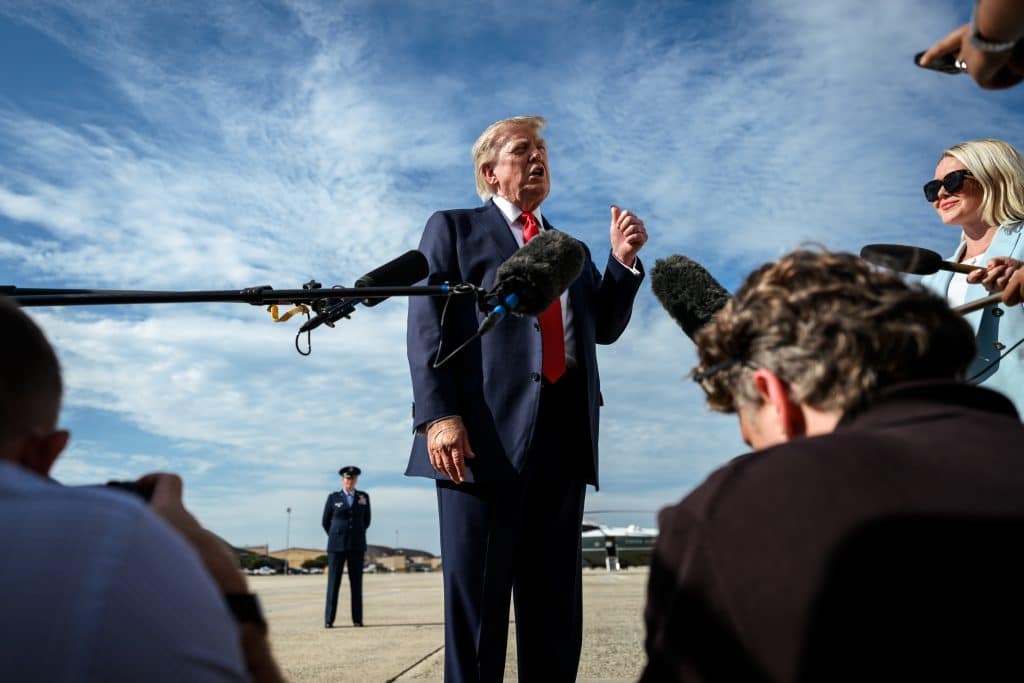
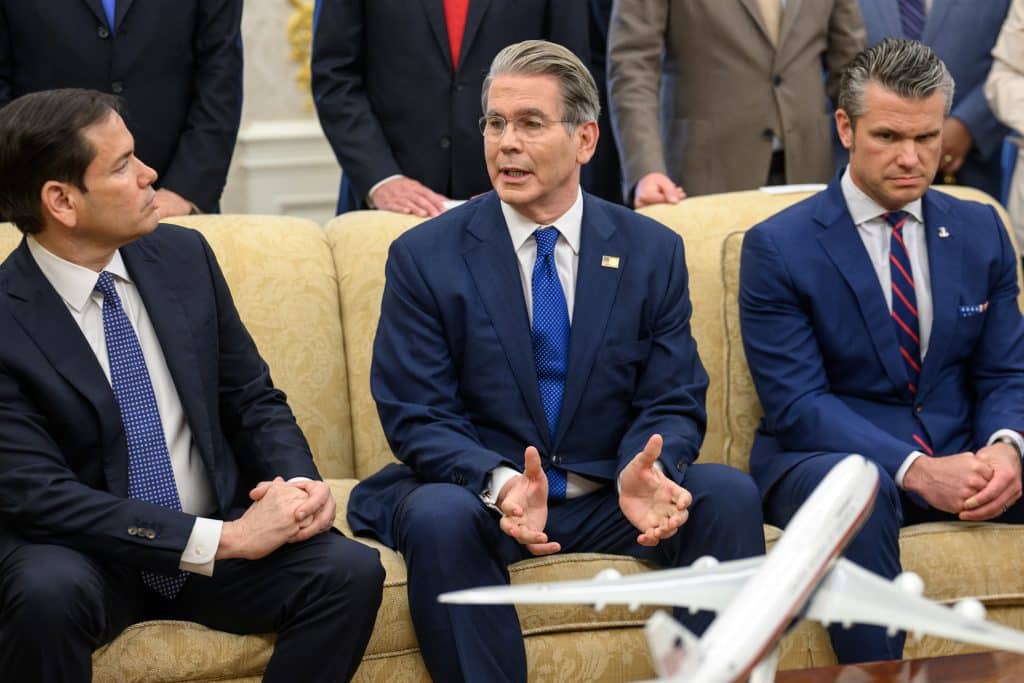
On Tuesday, U.S. Treasury Secretary Scott Bessent drew back the curtain on what President Donald Trump called his “Economic D-Day” plan to strangle Iran’s economy instead of using warfare to destroy the state.
It’s very easy to dismiss this plan — which has been, hilariously, dubbed “Operation Economic Outcast” — as another Trump public relations ploy, an effort to convince his dwindling MAGA base that the United States is not suffering a humiliating defeat in the Persian Gulf.
It certainly is that, but there may be even more negative consequences that could arise from this idea, depending on how far the Trump administration wants to push it.
Essentially, the U.S. has threatened anyone — ally and enemy alike — who does not cooperate with their new economic diktats against Iran. The plan won’t work, and Iran is not going to allow the U.S. to decide when the shooting stops. The Islamic Republic will continue to find ways to pressure the U.S. until its demands are met, an outcome the U.S. will eventually be forced to resign itself to.
Trump is giving up on military force
The most glaring implication of this latest stunt is that Trump has been forced to recognize that Iran has defeated the United States militarily. The U.S. has exhausted its military options, and Iran’s government is not only still standing, but it is as strong as it has been in recent memory.
The United States has lost fifteen of its bases in the Gulf region, has catastrophically depleted its reserves of defensive missiles, and has been forced to divert major resources to the region from Asia, essentially abandoning key allies Taiwan, Japan, and South Korea.
The Gulf states, except the United Arab Emirates, have realized that not only is the United States’ commitment to their security unreliable, but even if it does try to fulfill that commitment, its ability to do so is not what they once believed it to be.
Meanwhile, Israel has been exposed as a security liability and a toxic political brand for the United States. Beyond revulsion at Israel’s actions among the American public, it is also now being correctly blamed for getting the U.S. into this self-defeating war, and it is even being exposed, at last, as the real obstacle to ending the genocide in Gaza — refusing to cooperate even with the Board of Peace’s plans, which are wholly favorable to its side.
Iran has certainly suffered in the war, its already reeling economy enduring much greater devastation, and it has borne the brunt of the human cost of the fighting in the Gulf in lives and injuries.
But the Islamic Republic has not only stood firm against American firepower, but the government’s position within the country is also stronger for having withstood two military and nuclear powers. At least for now, opposition in Iran has been muted by a combination of anger at the American-Israeli attack and a strong clampdown on protest.
While Trump and his henchmen will never admit this, they know they’ve lost. More fighting means even more decay of America’s ability to frighten the rest of the world with its unhinged and extremely expensive military prowess.
So they are trying something else. Transferring the lead in the war on Iran from Defense Secretary Pete Hegseth to Bessent, Trump is trying to present his “Economic D-Day” as something new. But it’s actually more of the same.
It is simply more economic sanctions, a tactic that hasn’t worked for 47 years and isn’t about to work now. Even worse for Trump, Iran is not going to let the U.S. unilaterally decide that the shooting war is over.
Sanctions kill, but sanctions don’t bring change
Bessent offered very few details in his presentation, but it seems clear that the U.S. is going to try to isolate Iran economically by threatening its major trading partners with secondary sanctions if they continue to do business with Iran.
The targets would include both states and financial institutions, but Bessent declined to specify which ones, how deeply the sanctions would hit, or even when they would take effect. He did, however, note that enacting the United States’ plan threatened to “blow up” the global financial system.
The sanctions on Iran have caused inflation to balloon to around 88%, while inflation rates for some food supplies and medicines have climbed as high as 400-600%. The rial’s value has now plummeted past two million to the dollar.
Too often, news reports about such economic warfare are accompanied by people milling about in downtown or market areas. But the reality is that this sort of economic warfare kills and destroys lives.
What it won’t do is force change, at least not without a very specific policy goal. The United States has long used sanctions as a punitive measure. And they do cause plenty of suffering. But they fail as a coercive measure most of the time, largely because the suffering they cause is confined to ordinary citizens rather than rulers, and those citizens respond by rallying around the flag.
The exception that is often pointed to is Barack Obama’s use of sanctions to entice Iran into talks that led to the nuclear deal. But in that case, there was already considerable support in both the government and the populace for the talks, and the sanctions had a specific, clearly communicated goal for Iran. Most of all, the goal was a deal on nuclear weapons, which Iran did not have and was not pursuing.
In most cases, however, sanctions have been used to try to force fundamental change in government, or even to topple those governments. In Cuba, Iraq, Russia, and Iran, for most of the past four decades, among many other places, sanctions were used in an effort to get countries to agree to their own demise — or at least, to conditions that they were never going to see as being in their interests. Under those conditions, there is no example of sanctions being effective.
Global pushback
It is very possible that the United States is, once again, merely blustering and will not actually do much with this plan.
The real difference in this proposal from the decades of sanctions and the “maximum pressure” policy that Trump enacted in his first term (and, it is always worth reminding ourselves, Joe Biden did nothing to reverse) is the emphasis on secondary sanctions.
The idea is that if the U.S. threatens other countries and financial institutions with penalties that might include being completely cut off from the American financial system, they will join in the campaign to isolate Iran’s economy.
The problem is that Iran’s partners have little incentive to bow to American pressure. Iran’s largest trading partner is China, and Beijing has already made it clear they will not give in to U.S. bullying. Indeed, there are laws in China that bar Chinese entities from cooperating with such sanctions regimes. No Chinese firm is more concerned about angering the U.S. than it is about angering its own government.
Other major partners include Iraq, Türkiye, the UAE, Afghanistan, and Pakistan, with trade with the EU being mostly concentrated on Iranian imports. The U.S. could impose sanctions on those countries, but most of them are American allies. And China’s role is not limited to protecting its trade with Iran.
China has its own financial system, centered around the Cross-Border Interbank Payment System (CIPS). While it is not entirely independent of the U.S. dollar, it has grown since its creation in 2015. The system was created specifically in response to the threat of U.S. sanctions, and while it would not be an ideal situation, it would help cushion the blow for any country that faced U.S. sanctions.
That would also accelerate the global status of the Chinese renminbi and CIPS. It would hasten the demise of the dollar’s primacy as the global currency. At the very least, it would motivate China to accelerate the expansion of its financial system to challenge the U.S.’s dominance of global transactions, and it would be supported by many countries, including many U.S. allies, who don’t want to see the U.S. continue to hold this monopolistic power.
It is highly doubtful that this is something Bessent would want to risk, even if his boss fails to grasp the perils it would pose to the American empire.
That’s why the U.S. is unlikely to pursue the kind of global sanction threat that Bessent was suggesting.
The Iranian response is coming
This threadbare plot is not only an effort to win the war of choice against Iran by other than military means; it is also an attempt by the Trump administration to establish a sense that Washington is controlling the war’s course. That, too, is unlikely to succeed.
The U.S. may not want to continue the shooting war, but Iran has little interest in simply enduring American economic pressure.
Trump’s tactical thinking is much more short-term than Iran’s and is largely focused on the upcoming midterm elections. As Gulf states search for ways to export more oil by routes other than the Strait of Hormuz, Trump believes American voters will see less fighting and lower gas prices. Perhaps not coming down to pre-war levels, but at least, he expects, comfortably under four dollars a gallon.
Iran also understands the importance of the American midterms. It sees growing opposition among Democrats to the war, and a good chance Democrats will win back the House, and possibly the Senate as well.
All of this is part of Iran’s calculations about retaliation. It is not a matter of if, but of when and how that retaliation will come.
Iran has repeatedly shown it will not allow the U.S. to dictate the course of this war. It has also made clear that the demands they articulated in the Memorandum of Understanding earlier this year remain their parameters for ending the war.
Democrats will be even more incentivized to push for any resolution they can get, as they will be able to present perceived losses to Iran as Republican failures ahead of the 2028 election while pocketing the gains from a wide swath of the public for ending the war.
Should Republicans retain control of both houses, or if there is a split, Iran will calibrate its response accordingly. The tenor and intensity of that response will be escalatory in any case. How much will depend on Iran’s tactical needs.
Since it is unlikely “Operation Economic Outcast” will meet with much success, what Iran will probably want to do is to hit American forces and interests hard enough to cause Trump more significant pain politically. They do not want Washington to feel like they can strangle Iran’s economy with impunity.
The U.S. may think the shooting war is over, but Iran does not see it that way, and they are not going to allow the U.S. to dictate a shift to economic warfare, even though that seems like a losing path for Washington as well.

Off topic:
New Maps Show How Israel Has Thwarted Hopes For A Palestinian State...the breakneck expansion of settlements in the West Bank has rendered American talks of a two-state solution increasingly irrelevant...as Jews and Palestinians lived in roughly equal numbers in Israel and the territories it has occupied since 1967, those settlements also imperiled Israel’s claim to be both Jewish and democratic. By gradually accomplishing a de-facto annexation of the West Bank, the settlements would require Israeli Jews to either rule over a resentful non-Jewish population of about equal size or to surrender the Jewish identity of their state….Violence against Palestinians…has increased with the apparent protection or approval of the Israeli security forces…more than eleven hundred Palestinians in the West Bank have been killed either directly by settlers or by Israeli security forces...With the settlements fast expanding the practical boundaries of the Jewish state, the relevant question is not “Do you support Israel?” The question is: Which Israel do you support? The internationally recognized Israel, with the borders that preceded its 1967 conquests? Or a vision of Greater Israel, in which it formally annexes those territories, and the Jewish half of the population either rules over or seeks to expel the half that is Palestinian?
New Maps Show How Israel Has Thwarted Hopes for a Palestinian State | The New Yorker
Our colleague at Hasbara U need to inform us what the endgame is.
Very clear assessment and argument from Mitchell on Operation Economic Outcast. But why would he think that the Democrats, if they control Congress would do anything to end the war against Iran? First of all, Congress has already made it clear that its powerless against the Executive Branch, thanks to Obama his successors completely ignoring it. Secondly, Israel is not going away, and the majority in Congress are still much more attentive to its interests than to those of the American public. Third, the economic disaster which is brewing in the US as a result of Trump’s war and corruption, which the Democratic Party has totally ignored, will not go away and that failure to address bread and butter issues of the American people guarantee that the Democratic Party will not make any noticeable change in the country’s direction.
Political scientist Robert Pape predicted from the start that the war would strengthen Iran –
“The War Is Turning Iran Into a Major World Power”: U. of Chicago Professor Robert Pape
“The War Is Turning Iran Into a Major World Power”: U. of Chicago Professor Robert Pape | Democracy Now!
So maybe we should listen to him about how to deal with Hamas?
We should expect that Hamas is thus growing stronger, not weaker, with every passing day….Furthermore, Israel doesn’t appear to have a political plan for the period after eliminating Hamas. Since 2006, Hamas has been the only government in Gaza. Israel claims it does not want to govern Gaza, but Gaza will need to be governed, and Israel has yet to explain what a post-Hamas Gaza will look like….now, not later, start the political process toward a pathway to a Palestinian state, and create a viable political alternative for Palestinians to Hamas.
Opinion: There’s a smarter way for Israel to eliminate Hamas | CNN
Prof Mearsheimer, Prof Sachs rip up Bissent and Trump’s sanctions. Prof Sachs thinks by Israel slaughtering Palestinians they have destroyed themselves.
https://www.youtube.com/watch?v=xPfO5fsxnKg
https://www.youtube.com/watch?v=-KDvE6jjV88
https://www.youtube.com/watch?v=3WeqdARq0Ds
Allastair Crooke as well:
https://www.youtube.com/watch?v=1ZObpvnOGns