

Muhammad Owais, 13, made his kite with the help of his siblings at a displacement camp west of Gaza City. For more than a week, he has not dared to go outside in the late afternoon, as he once did, to watch it climb toward the sky.
“My father warned me very strongly not to fly it,” Muhammad said, speaking to Mondoweiss with the consent of his parents. “He told me, ‘If you fly it, you will be bombed immediately.’ I want to play. I don’t want to die.”
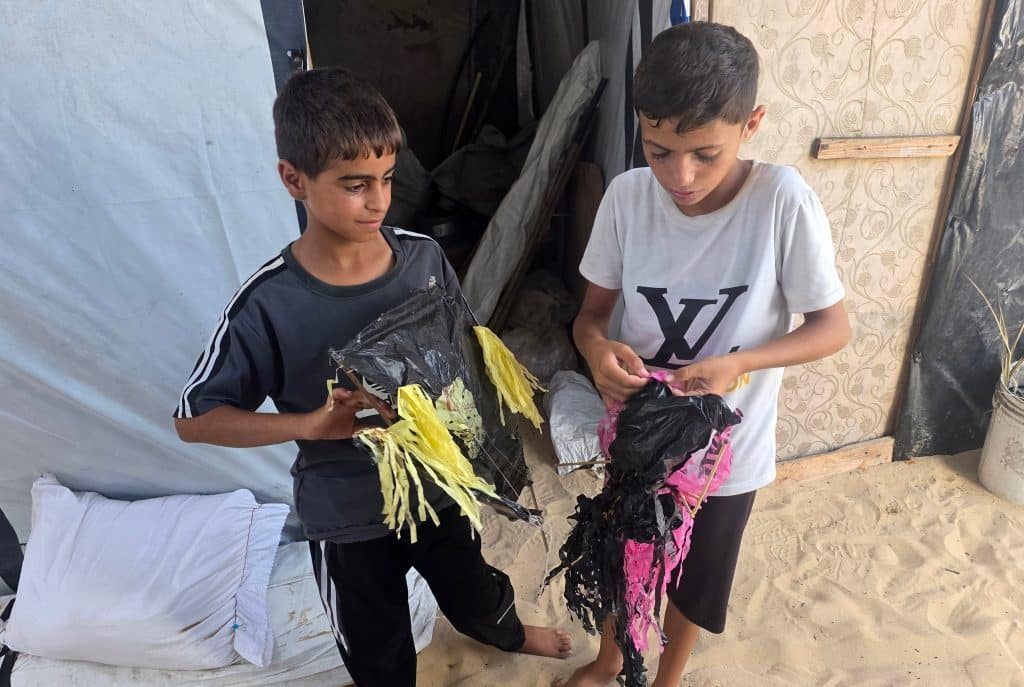
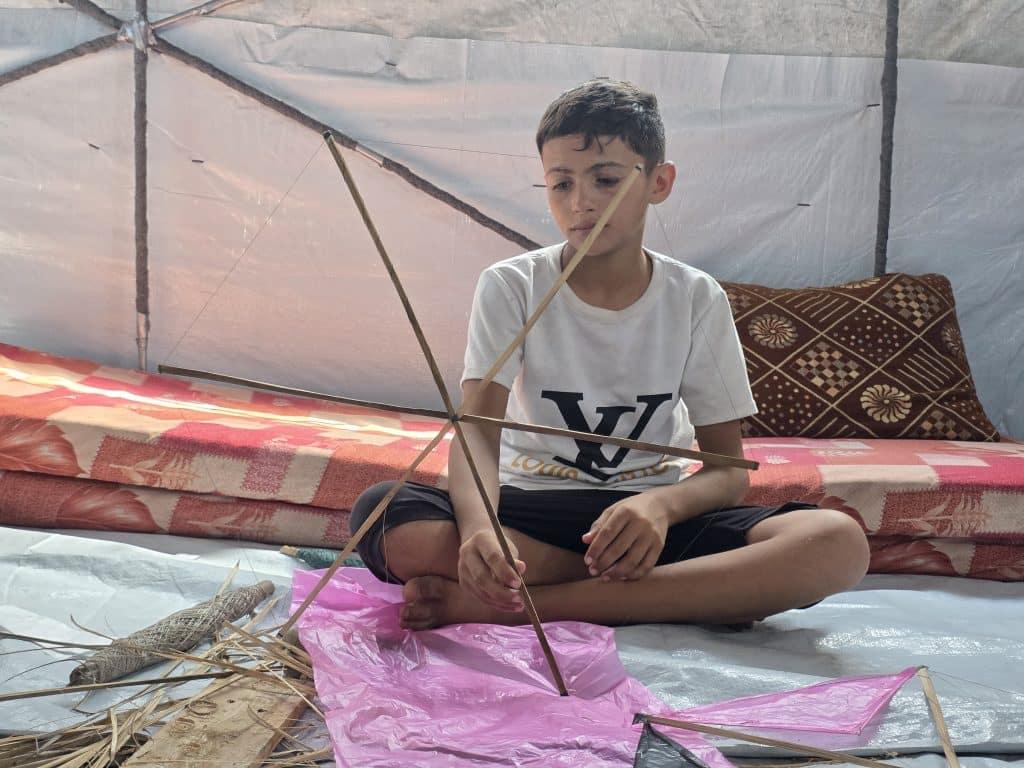
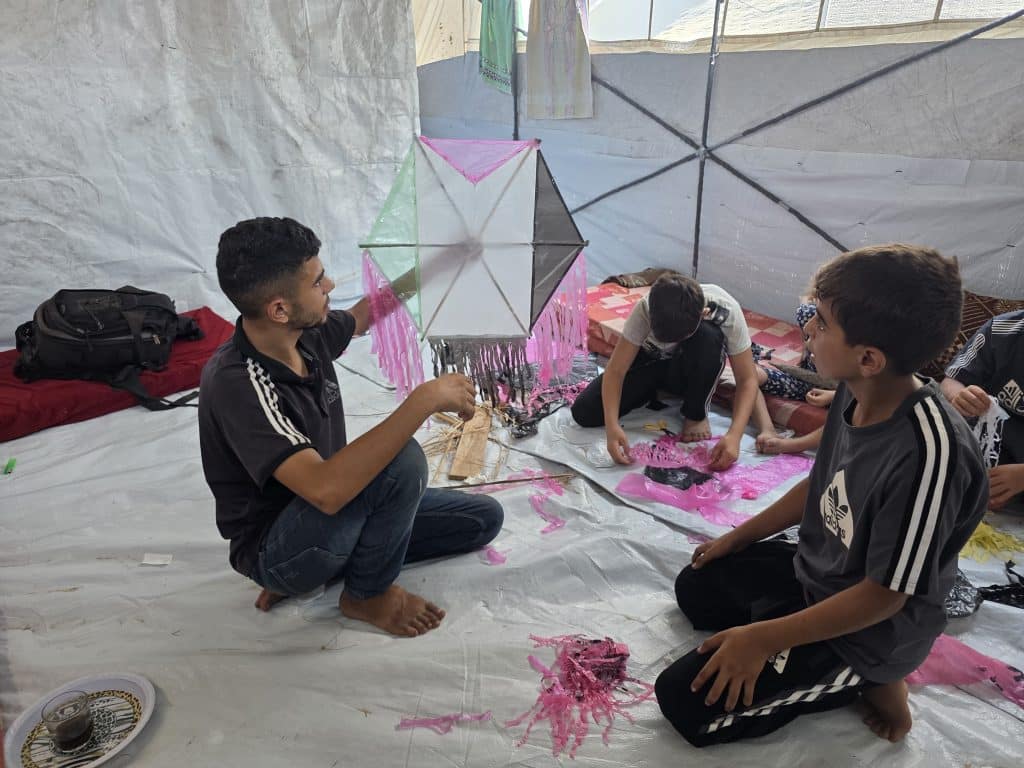
The kite is made from plastic bags collected from the trash, thin wooden sticks, and string. Sometimes paper is used instead of plastic. It cost nothing and took an afternoon to make. But under Israel’s military posture toward Gaza, it may as well be a weapon.
That fear has spread among children across Gaza following Israeli warnings over kites reportedly drifting from Gaza toward Israeli settlements near the border. For children who have almost nothing left to entertain themselves with, handmade kites are among the few toys they can make with whatever materials they can find. Now, parents are taking them away, or telling their children to destroy them.
On August 23, Israeli Prime Minister Benjamin Netanyahu and Defense Minister Israel Katz held a security assessment with senior military officials over what Israel described as a threat from drones, balloons, and kites launched from Gaza. They warned Hamas that if the launches continued, Israel would intensify targeted strikes against those responsible and evacuate people from areas used as “launch sites.”
Katz had earlier ordered the Israeli military to act “immediately and forcefully” against additional kite launches, declaring that a kite should be treated like a drone “with or without explosives,” and describing every launch as an act of war.
Yet the Israeli military itself said that at least four kites recovered near Nahal Oz contained no suspicious material and posed no danger to the public.
For families in Gaza, however, the distinction between a harmless kite and an Israeli military target is not an academic one. It is a question of whether their children can safely step outside.
A kite is still a kite
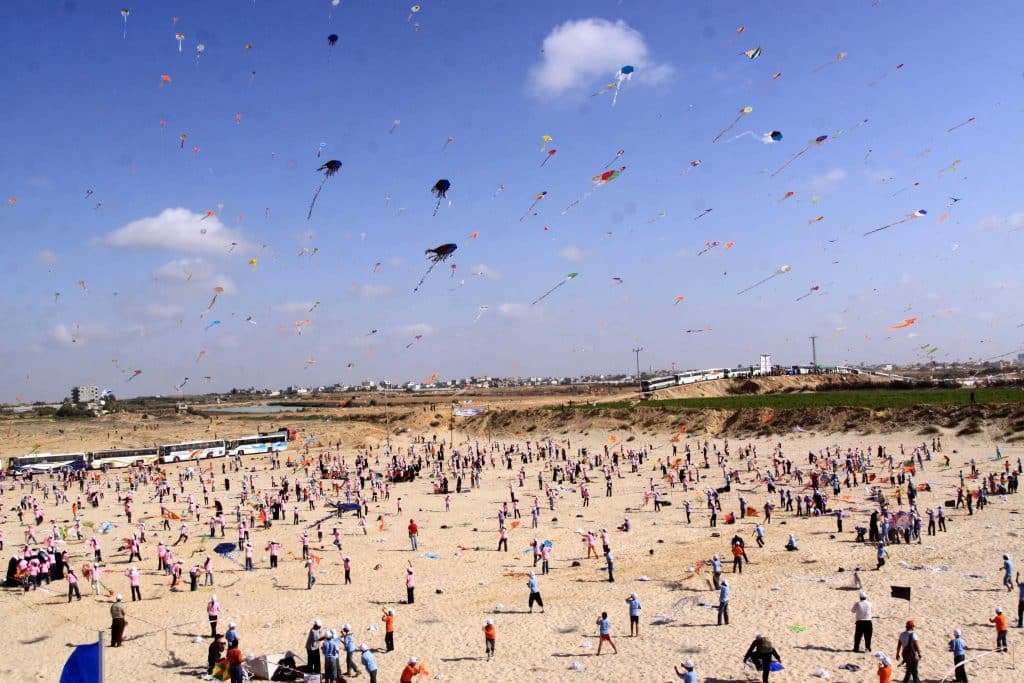
In Gaza, a kite is not an unusual object. It is one of the traditional forms of childhood recreation, passed down through generations.
Children have long flown kites from rooftops, along the beach, or in whatever open spaces they could find, making them from whatever materials are available, drawing the Palestinian flag on some, decorating others with stars, bright colors, and different shapes.
For children growing up under siege and war, the pleasure of watching their kites getting picked up by the wind has become even more important. But now parents are taking them away.
Khaled Owais, 36, Muhammad’s father, says it pains him to prevent his son from playing with a toy he helped make. But he is also terrified of what could happen if Muhammad is seen with it, with drones constantly overhead and Israeli forces maintaining a presence near the “Yellow Line,” the boundary separating Israeli-controlled and Hamas-controlled parts of the territory.
“I am not going to sacrifice his life just so he can play for a little while,” Khaled continued. “We don’t want these toys. All I want is to keep my family safe.”
He struggles to square the threat with the object. “What danger could these things possibly pose? How can paper and sticks be described as attacking soldiers who are heavily armed and sitting inside fortified tanks? Have these kites become missiles?”
Muhammad is struggling to understand the rules of this new reality. “I don’t know what we can do that won’t anger Israel and make it bomb us,” he said.
The children, according to UNICEF, are already among the most psychologically affected by the war. According to UNICEF’s June 2026 report, virtually all of Gaza’s approximately 1.1 million children are estimated to need psychosocial support. The removal of one of the last remaining sources of play and self-expression represents a further blow to an already devastated generation.
A ‘declaration of war’?
In 2018, Palestinians launched incendiary kites and balloons toward southern Israel during the Great March of Return protests along the Gaza-Israel border. Some carried burning cloth or other incendiary materials and were deliberately sent with the wind toward Israeli agricultural lands.
According to the UN Office for the Coordination of Humanitarian Affairs, more than 750 fires had been recorded by July 2018, burning approximately 7,400 acres of land, with damages estimated at more than $2.2 million. Later reports put the number of fires at around 1,200 by the end of July.
The incendiary kites were part of a broader protest movement demanding an end to the blockade of Gaza and the right of return for Palestinian refugees. But for months, the protest movement was largely nonviolent, and many participants in the demonstrations were not affiliated with Hamas or any other Palestinian faction. Yet Israel met the largely nonviolent protests with live fire, maiming and injuring thousands more in the months that followed. It was in that context that protest tactics escalated, including the use of incendiary balloons.
That history is now being invoked again. But the difference is crucial: the kites that Israeli authorities have recently reported finding inside Israel were not reported to have carried incendiary or explosive materials. The Israeli military itself confirmed that the recovered kites posed no danger.
Still, Israel has chosen to place ordinary kites in the same category as drones and incendiary balloons. Katz’s formulation is revealing, describing the launch of every kite as “an act of war,” and that “a balloon is treated like a kite, and a kite is treated like a drone, with or without explosives.”
That means the object itself is no longer what matters. The mere act of launching it is being framed as a military threat.
In Gaza, some people see the renewed focus on kites as less as a genuine security concern and more as another possible pretext for escalation.
A journalist based in Gaza, who asked not to be identified, told Mondoweiss that the claims surrounding the kites and balloons have little to do with the handmade toys children fly from displacement camps.
and could serve a domestic political purpose for Netanyahu’s government – allowing Israeli leaders to present even the smallest perceived threat from Gaza as evidence of their vigilance
Hamas spokesman Hazem Qassem rejected the Israeli accusations, describing the kites as children’s toys and saying that the Israeli threats were based on “fabricated pretexts” intended to justify continued violations against Palestinians.
Back at the displacement camp west of Gaza City, Muhammad has not flown his kite since his father’s warning. He is not sure what to do with it. He is not sure what he is allowed to do at all.
“After having everything taken from them — their homes, their families, their schools, even their childhood — they now learn another lesson,” his father said. “Even the sky isn’t theirs.”

Gazan kids are only six months away from developing a kite with a nuclear warhead.
Read or listen to this article
For Palestinians, Even Death Is No Escape from Israel’s ViolenceMuna Haddad
Pages 58-70 | Published online: 10 Nov 2025
https://www.tandfonline.com/article/10.1080/0377919X.2025.2579439
“In 2018, Palestinians launched incendiary kites and balloons toward southern Israel during the Great March of Return protests along the Gaza-Israel border. Some carried burning cloth or other incendiary materials and were deliberately sent with the wind toward Israeli agricultural lands.
According to the UN Office for the Coordination of Humanitarian Affairs, more than 750 fires had been recorded by July 2018, burning approximately 7,400 acres of land, with damages estimated at more than $2.2 million. Later reports put the number of fires at around 1,200 by the end of July.”
There in the author’s own words is the explanation for Israel’s policy against kites. What then is his objection to the latter?
“But the difference is crucial: the kites that Israeli authorities have recently reported finding inside Israel were not reported to have carried incendiary or explosive materials. The Israeli military itself confirmed that the recovered kites posed no danger.”
How is the Israeli military supposed to know whether a kite coming over the border from Gaza is charged or not? Putting materials in a kite that contain explosives what can wound people or incendiary matter that can start forest fires is an extremely malicious act. Never does the author forthrightly condemn such actions. This leads to the conclusion that his complaints about this, and those of the Mondoweiss commentariat, are offered in bad faith. Their issue is not really with the prohibition on kites per se, but with the fact that Israeli Jews don’t like to have their forests (or themselves) set on fire. https://libquotes.com/anonymous/quote/lbb2f7d
This faux outrage would be more believable if the Palestinians had not previously weaponized kites and balloons.