

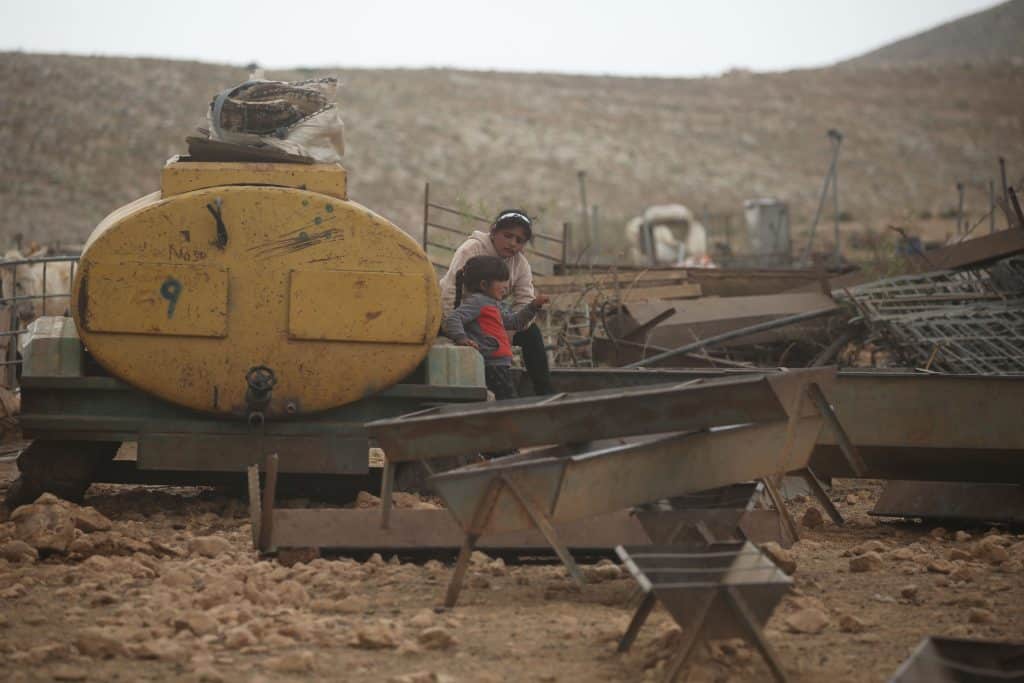
In the northern Jordan Valley, 47 Palestinian families have gone without water for over a month after Israeli forces bulldozed the roads to their herding community and cut the pipelines that once fed it.
Lutfi Bani Odeh has lived on this land for 45 years. Through them all, the nearby towns of Atouf and Tammoun were where his children went to school, where his family sought healthcare, where they bought what they needed, and sold what they produced. Since early August, all of that has been cut off.
“The Israeli army bulldozed the road to our area, and we have no way to Tammoun except through the hills, which we are forced to walk on foot,” Bani Odeh said, adding that he now spends hours walking seven kilometers on foot, a commute that previously took minutes by car. “The army bulldozed the road I could drive on,” he explained. “I walk seven kilometers just to bring food, medicine, diapers, and other needs, and soon our children will have to walk the same distance when the school year begins in a few weeks.”
But the road is not the worst of it. “We can endure isolation and the lack of some basic needs for a time,” Bani Odeh said. “But we can’t live without water.”
Bani Odeh is one of approximately 300 Palestinians — nearly half of them children — facing imminent displacement in Ras al-Ahmar, Ath-Tha’la, and eastern Atouf in the northern Jordan Valley, after Israeli forces severed the last water pipelines supplying the communities. The water cutoff is part of the construction of a 22-kilometer Israeli military barrier, known as the “Crimson Thread”, running from Ein Shibli to the Tayasir military roadblock, which passes through Palestinian-owned agricultural land and has been described by Israeli rights organization B’Tselem as a deliberate strategy of expulsion.
As of June 30, 2026, B’Tselem documented that Israeli military attacks and settler violence had forcibly displaced 64 Palestinian communities in the West Bank, affecting more than 4,328 people.
In the northern Jordan Valley, the 47 families who have been cut off from water, are farmers and livestock herders living in Ras al-Ahmar, a small rural community east of the village of Atouf, in the Tubas governorate of the northeastern West Bank. Their main activity is raising livestock, and together, they own approximately 15,000 sheep and goats.
Abdallah Bisharat, mayor of Atouf, told Mondoweiss that the Israeli military’s construction work has cut off water pipes and blocked the road to the area, leaving the families isolated. “We in the Atouf village council have been trying to send livestock feed and potable water tanks, but most of the time the Israeli army has been sending us back,” Bisharat said.
The Israeli military is permitting the restoration of an irrigation water line but not the line that feeds the homes, and is blocking the movement of materials needed for livestock work into the area. Families are allowed to leave and return on foot, but vehicles are not permitted to pass.
The barrier’s construction, which began in March 2026, has already caused extensive damage to the area. According to B’Tselem, it has resulted in the uprooting of more than 300 olive and grape trees, the destruction of crops and greenhouses, the demolition of kilometers of water and irrigation pipelines, and damage to approximately 45,000 dunams (4,500 hectares) of agricultural land. The barrier’s full route, once complete, is expected to isolate residents from their land and enable the seizure of around 50,000 dunams (5,000 hectares).
Families have been collecting whatever they can in tanks hauled by tractors through the hills. “We have little water that we have been able to get in tanks carried by tractors, through the hills, but we need to ration them,” Bani Odeh said. “We are limiting our hygiene, our drinking, our cooking, and we have given up on irrigating our vegetables, which have all dried out and died.”
The sheep and goats can go longer without water than humans can, which leaves families with a narrow margin. But Bani Odeh makes clear that the margin is closing. “We can’t live like this for long, nor can our livestock, and we need the water restored.”
Moving out is not a viable option for most families. “We have around 15,000 sheep and goats, which we have no room for except on our land,” Bani Odeh said. “If we move out, we will be forced to sell most of our livestock, which are our main source of income.”
Bisharat says the choice the families face is stark. “These families live from their livestock, and they don’t have any space in the town to graze and keep them,” he said. “Their choice is to sell their livestock and leave, or try to hold on and stay for as long as they can.”
Last week, the Jerusalem Post quoted Israeli army sources saying that some of the families have their homes built without permits in Area C — the approximately 60 percent of the West Bank under full Israeli civil and military control under the Oslo Accords, where Israel’s civil administration bans Palestinian construction. The army said each family’s case was being examined separately through the legal system, and that the barrier project “may be affecting” the water supply in the area.
Bani Odeh’s response is simple. “These are our lands, and we have always lived here,” he said. “And whatever the reason is, who cuts water off from dozens of families? What can justify this?”
The Wall and Colonization Resistance Commission documented 2,256 attacks against Palestinians and their property in July 2026 alone — 1,458 by Israeli forces and 798 by settlers — describing the pattern as coordinated settler violence backed by military protection. These attacks have targeted communities, farmland, and infrastructure across the West Bank, and Ras al-Ahmar is one node in that pattern.
The families there are, in Bani Odeh’s words, “holding to their last bit of capacity to endure.”

Whether the Palestinians are being killed softly, as in this article, or more loudly, as in Gaza, the policy of eliminating Palestinians one way or another is a conscious policy decision. A new film explores this:
‘NAZA’ : Exposing Israel’s killing machine in Gaza….Over the past three years, we conducted night-time interviews on the rooftops of Tel Aviv with 24 Israeli soldiers who played an active role in Israel’s onslaught on Gaza. Most of them were intelligence officers, working behind screens and participating remotely in the mass killing of Palestinians….Their testimonies form the basis of “NAZA,” a new documentary we directed — produced by The Guardian and James Wilson and executive produced by Jonathan Glazer — that premieres this evening at the 83rd Venice International Film Festival….This is a film about a system. It focuses on orders, policies, and patterns of operation, not deviations from them. The conclusion that we draw from the testimonies is clear: The mass killing of Palestinian civilians in Gaza was not a “tragic byproduct” of a war against Hamas, as it is commonly portrayed in Israel, but a premeditated, calculated, and intentional act. This is why a UN commission, the world’s leading human rights groups, and Palestinian, Israeli, and international scholars have described it as a genocide.
‘NAZA’: Exposing Israel’s killing machine in Gaza
Dear Israel,
I must sincerely thank you for your absolute inhumaneness By completely abandoning every shred of universal ethics, you are unwittingly performing a tremendous service to humanity: you are holding up a giant, bloody mirror to the so-called ‘civilized Western world.’
Your ongoing atrocities, supported and financed by Western governments, are final proof to the global audience that our lectures on ‘human rights’ were always a hypocritical and racist scam.
It is an unspeakable tragedy that the Palestinian people have to pay the ultimate price with their blood and their land just to serve as the catalyst for this world to finally wake up.
You think you are defending a “democratic”, safe haven, but you are just the wrecking ball destroying the West’s moral illusion. Keep playing your part in this grim theater, the audience has already seen through the script and will always remember you for that.
Yours sincerely.