One of the stories I worked on this week was about the start of the new school year in Gaza.
It seemed, at first, like it would be a simple story. I contacted relatives and friends in Gaza whose children were preparing for school.
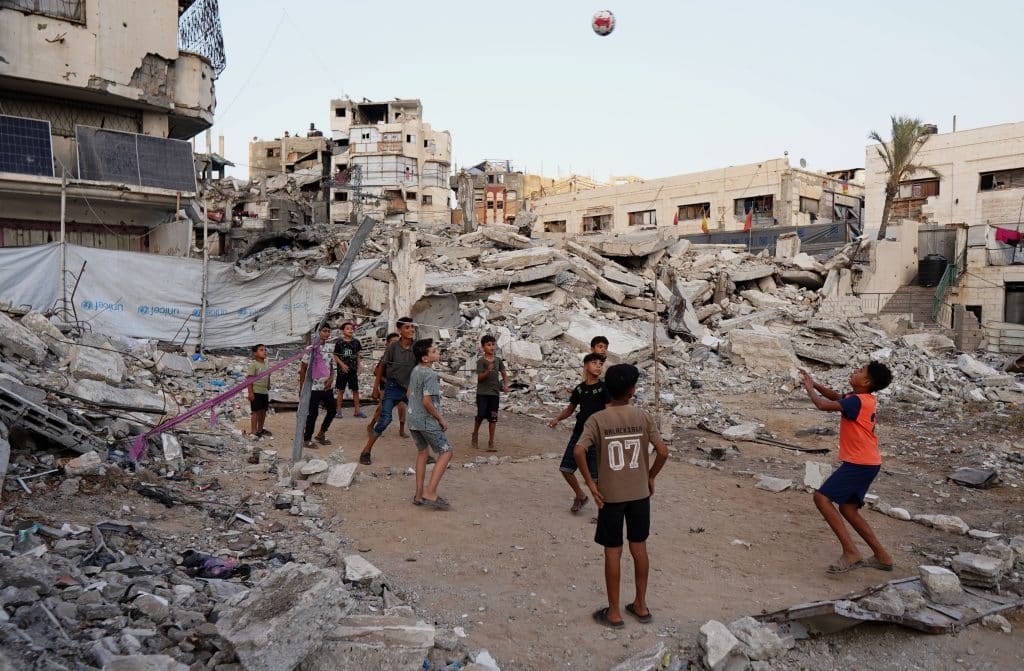
This will be the fourth school year since the war began, and in that time, Gaza’s children have not returned to anything resembling a normal school system. Israeli strikes have destroyed most schools, and those still standing have been converted into shelters for the displaced.
During one of my calls, I spoke with a relative about his two boys, Yamen, 12, and Kareem, 10. I expected their mother, Nissma, to talk about school supplies, perhaps about the difficulty of buying uniforms or notebooks. Instead, she sounded worried.
“When they go to school, I don’t know how I’m going to get water,” she told me.
Her sons are the ones who fetch it.
Every morning, the boys carry plastic jerrycans to find water, fill them, and bring them back to the family’s tent in the Tal al-Hawa neighborhood of Gaza City. After that, they go to the takiyya — a communal kitchen that distributes free meals — and wait to take food home.
This, their mother told me, has been their routine since the war and displacement began.
Having spent my entire childhood and youth in Gaza — attending its schools from first grade through graduation — my memories of the beginning of the school year are colored by warmth: the excitement of seeing classmates again, walking back into the classroom, playing in the schoolyard, competing for good grades.
But perhaps even more exciting were the weeks of anticipation beforehand. As children, we counted down the days, sometimes even the hours. Some children would go to sleep with their new school clothes, bags, notebooks, and stationery arranged beside their beds, simply because they were too excited to put them away.
I still remember my mother taking me to the market before every school year began. We would buy new trousers, shoes, the blue shirt required in elementary school, a schoolbag, notebooks, pens, even a new comb or a watch. None of this felt like an impossible luxury.
I grew up in a family of modest means. We were not wealthy, but neither did we live in extreme poverty. My father was a laborer who worked day and night to provide a decent life for his children and a proper education, as so many Palestinian fathers did.
This was the rite of passage for a normal childhood in Gaza, a regular milestone that, for Nissma’s children, is just a memory. From early morning, her children work. They carry water. They stand in food lines. And when they finish — sometimes by midday, sometimes later — they walk through the streets collecting pieces of plastic, nylon, cloth, and wood. Anything that can burn is useful. The family needs it to make a fire, perhaps to boil a kettle of tea or prepare a small evening meal, if there is anything available to cook.
Listening to her, I realized that the destruction of Gaza’s educational system cannot be measured only by counting damaged schools or lost classroom hours.
Something deeper has changed. The war has altered the priorities of families, but it has also altered the very meaning of childhood.
For many children in Gaza today, the question is no longer simply whether they have the right to learn or play. Their days are structured around responsibilities that once belonged to adults: finding water, securing food, gathering fuel, and helping sustain families now living in tents unfit for human habitation.
That is the kind of change journalism must learn to notice. A destroyed school can be photographed. A collapsed classroom can be counted. The number of children who have missed years of education can be documented. But other forms of destruction are harder to quantify: what happens when a 10-year-old begins to think of himself not primarily as a student or a child, but as someone responsible for bringing home the family’s water and food?
Since October 7, Israel’s military campaign and the restrictions it has imposed on Gaza have devastated many of the institutions necessary for a society to remain healthy and educated. Israeli strikes have attacked and severely damaged hospitals and the wider health system. Schools and universities have been destroyed or left unusable. Hunger and deprivation have left their own marks on children.
In another story I worked on this month, doctors described how the consequences of prolonged hunger are already appearing in children’s development. They spoke not only about physical growth, but also about difficulties concentrating, solving mathematical problems, learning, and interacting socially.
These are not effects that disappear when the bombs stop dropping (even though they haven’t).
And this is why, when I report on Gaza now, I increasingly find myself looking beyond the immediate event. The story is not only about the school that was destroyed, the hospital that stopped functioning, the family that was displaced, or the child who went hungry. It is also about what those events do to a society when they accumulate over months and years.
Israel has consistently described its war as a campaign against Hamas and Palestinian armed groups. But when I look at what I have documented as a journalist — the destruction of schools and hospitals, prolonged displacement, hunger, children whose daily lives have been transformed into a struggle to secure the most basic necessities — I see consequences that reach far beyond any armed group. They reach into the formation of an entire generation.
A society produces more than fighters. It produces teachers, doctors, writers, thinkers, engineers, journalists, and children who should have the freedom to imagine what they might someday become. When the foundations that allow those lives to develop are systematically stripped away, the damage extends far beyond the battlefield.
The world may speak about Gaza as though the war ended with the signing of a ceasefire in October 2025. But for people living there, the distinction is far less clear.
Even as I write these words, reports continue to arrive from Gaza of attacks on tents sheltering displaced families, and of children and civilians killed.
And somewhere amid all of this, another school year is beginning. Some children should be laying out their new clothes beside their beds tonight, too excited to sleep.
Instead, tomorrow morning, some of them will wake up and go looking for water and food.