

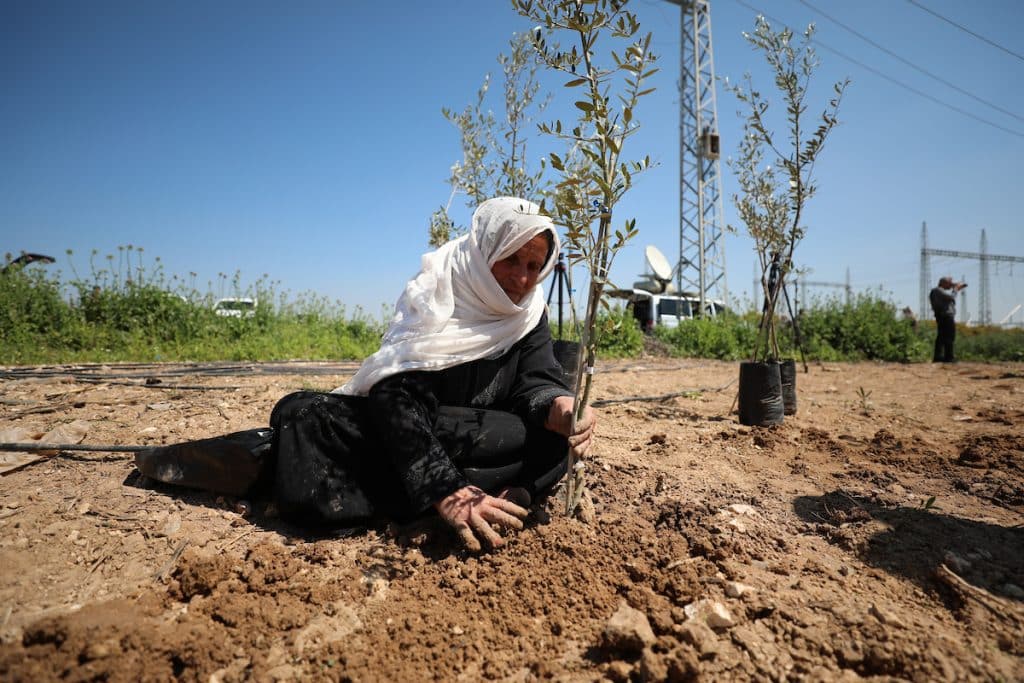
This week, I have been working on a story about something I never imagined I would have to write:
There is no longer an olive harvest season in Gaza.
Israel’s war has reached so deeply into the fabric of Palestinian life that even this ritual has been torn apart. Farmers, agricultural experts, and Gaza’s Ministry of Agriculture told me that the olive harvest as we know it has effectively been erased.
According to figures from the Ministry of Agriculture, the Israeli military has uprooted or destroyed 1.6 million productive olive trees in Gaza over the past three years. The remaining trees are concentrated largely in central and western Gaza City. The number, according to the ministry, is fewer than 10% of the olive trees that once grew across the Strip.
As I spoke with farmers by phone this week, I kept asking them the same question:
What do you miss most about the olive harvest?
Of course, they mentioned money. These fields were a source of income, and losing them has made already impoverished families even poorer.
But money was rarely what they missed most.
One of the people I spoke with was a 60-year-old woman displaced from northern Gaza. Her land was seized and bulldozed. Her home was destroyed. She also lost 17 members of her family.
She told me that when people ask her how much she has lost during the war, she gives them the same answer:
“I lost 17 people and 40 olive trees.”
She never leaves the trees out.
At first, that answer may sound strange to someone who did not grow up in a place like Gaza. How could a person mention trees in the same sentence as the people she loved and lost?
But she explained it to me.
She had raised her children from the time they were small. She watched them become young men and women, watched them grow old enough to work and eventually help her.
She said she had done something similar with her olive trees.
She planted them. She cared for them. She gave them water and fertilizer. She watched them grow year after year. And then she waited for the day they were old enough to bear fruit.
To her, the olives those trees eventually produced were unlike any other fruit in the world.
Reporting from Gaza, and speaking directly with its people year after year, has taught me something that statistics can never fully explain. There are things people come to regard almost as extensions of life itself.
The trees are part of their lives. Their land is part of their lives. Their fields and homes are part of their lives.
This is why destruction in Gaza cannot be measured only by counting buildings, hectares, or financial losses. A field is not merely agricultural land. A tree is not simply a unit of production. A house is not only concrete.
They contain lives.
And yet, the people I speak with rarely allow themselves to remain inside tragedy forever.
The woman who lost 17 members of her family and 40 olive trees told me she is waiting for the day she can return to her land. And when she does, she has already decided what she will do.
She will plant 100 olive trees where her 40 trees once stood. Her children and grandchildren will help her. Despite everything she has lost, she insists that the olive tree must remain within her sight.
“We grew up looking at olive trees,” she told me. Then she described what that meant.
It meant sitting beneath an olive tree in the afternoon. It meant making tea under its shade. It meant the family gathering there and remaining together until late at night. “It was life for us,” she said.
It was a simple life.
Perhaps that is precisely why its destruction can be difficult for outsiders to comprehend. War is usually described through the spectacular: explosions, demolished buildings, casualty figures, and military operations.
But there is another kind of destruction that happens quietly. It is the destruction of the things that made ordinary life possible. A tree planted decades ago. A ladder is brought down from the roof every October. A mother sits beneath the branches while her children climb above her. A father proudly pours olive oil into a small dish and asks his guests to taste it. An afternoon cup of tea beneath a tree.
These things rarely appear in the statistics of war.
But they are the things from which a life is made.
Israel’s military has destroyed much of that life in Gaza, down to its smallest rituals. Perhaps the assumption is that if you destroy enough homes, uproot enough fields, and cut down enough trees, eventually the connection between a people and their land can also be destroyed.
But the woman I spoke with this week gave me a different answer.
40 olive trees were uprooted. She intends to plant 100.

If you’ve been paying attention to your fellow humans you will have observed that they are constantly speculating on what dead people were like. What would Jesus think? What would Albert Einstein think**? How did Lincoln view the second amendment? It’s not disrespect of the dead, it’s a feature of our thought.
What would Marek Edelman think about the destruction of olive trees in the West Bank?
**
he would be horrified with what Israel has become.