

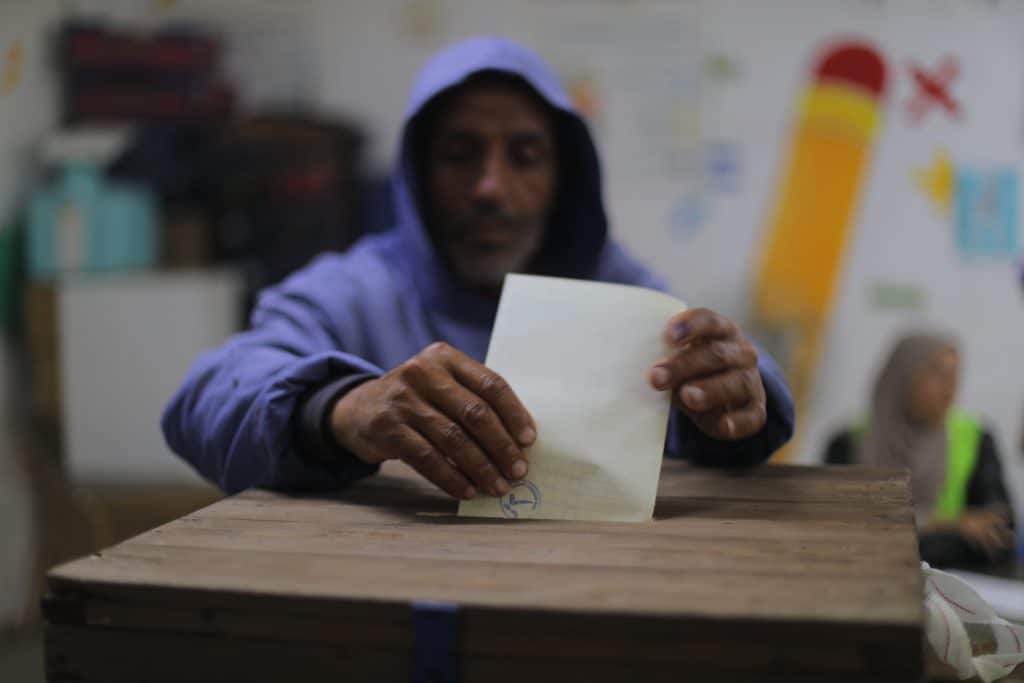
A group of 25 young civil society figures from Gaza and the West Bank have formed an independent electoral list to contest the Palestinian legislative elections scheduled for November 28 — the first legislative vote in two decades — positioning themselves explicitly outside the factional politics that have dominated Palestinian public life since the Oslo era.
The list, currently unnamed, brings together doctors, engineers, journalists, human rights workers, and civil society professionals, aged 24 to 45. Its organizers say they are building something they believe is largely absent from Palestinian electoral politics: a youth-led platform centered on people’s immediate needs rather than partisan affiliation or political ideology. Its members — six are women, two have disabilities, one is Christian — reflect the diversity, inclusion, and independence of which the list boasts.
The initiative is led by Fadi al-Sheikh Youssef, 39, a media activist and civil society figure who attempted something similar in 2021, when Palestinian Authority (PA) President Mahmoud Abbas called for legislative elections before postponing them weeks before polling day, citing Israel’s refusal to allow voting in occupied East Jerusalem. Al-Sheikh Youssef’s 2021 list — called Hulum, or “Dream” — was approved by the Palestinian Central Elections Commission and prepared to contest the vote before the postponement ended the effort.
Now, with elections set for November 28 and the nomination period due to open on September 26, he’s trying again. The context, however, has changed dramatically.
Palestinians are heading to the polls — if the elections proceed at all — after nearly three years of facing Israel’s most aggressive attack on their presence in decades, amid international accusations of ethnic cleansing and genocide, even from its staunchest allies. According to the Palestinian Central Bureau of Statistics, 64 percent of Palestinians in the West Bank and Gaza are under 30. Most have never voted. Al-Sheikh Youssef’s list is, in part, addressed to them.
“Today, five years after we attempted to break into the Palestinian political establishment, we are returning with an independent youth list,” al-Sheikh Youssef told Mondoweiss. “We see an even greater need today for an independent youth body that does not belong to any political ideology.”
A platform built around daily life
Rather than putting forward a broad political platform, al-Sheikh Youssef says, the group is developing practical proposals to address problems facing young Palestinians, particularly in Gaza, including unemployment, economic marginalization, access to the labor market, health care, humanitarian relief, and the enormous social and economic burdens accumulated through years of war.
“We leave politics to the political parties,” al-Sheikh Youssef said. The group says it wants to explore digital employment opportunities, expand access to remote work, and create pathways for young Palestinians to enter the online labor market. Healthcare, humanitarian relief, rebuilding basic infrastructure — sewage and water systems, health services, education alternatives for primary school children, and adequate temporary shelter while Gaza awaits reconstruction — are also among its priorities.
Al-Sheikh Youssef previously founded the digital media organization Pal Plus, which he says was targeted and ultimately shut down by Israel. Living through Gaza’s genocide, he says, has given list members a firsthand understanding of the problems they are trying to address.
But they deliberately stop short of articulating a comprehensive political vision.
“Some people with strong partisan affiliations recognize the need for an independent civil list outside the ideological framework of Gaza’s existing parties,”al-Sheikh Youssef said. “A list that speaks to their needs, not their dreams.”
‘Young people representing themselves’
Among the list’s members is 38-year-old Amira Hamdan, a cultural and community activist who has worked with several cultural organizations, including the Tamer Institute for Community Education, where she was involved in child protection projects.
Hamdan says the list’s defining feature is that it seeks to identify young people’s priorities and develop solutions through them. She sees it as an experiment in civil governance that draws on the different professional experiences of its members. She also acknowledges that no electoral list can operate entirely outside of Palestinian politics, but says this one begins from a different starting point.
“Unlike traditional Palestinian electoral lists, this initiative does not begin with sweeping political slogans over issues such as Jerusalem, the 1967 borders, or the peace process,” Hamdan explains. “Its initial focus is on youth empowerment and practical problems such as conditions in displacement shelters.”
One of the group’s biggest challenges, Hamdan says, is building awareness among young Palestinians themselves. Members are trying to reach them through civil society organizations and their professional networks.
“We are betting on the young people we have worked alongside in different professional settings to vote for themselves and for those who represent them,” Hamdan said.
She acknowledges that members may lack extensive political experience but says they bring years of community work and project implementation experience and will acquire political experience along the way.
Muhammad Najm, 36, who works with nongovernmental organizations and was also a candidate on the Hulum list in 2021, says the group’s priorities begin with the basic infrastructure and services that sustain daily life in Gaza — sewage and water systems, rebuilding health services, finding alternatives for education, particularly for children in primary school, and developing adequate temporary shelter while Gaza awaits reconstruction.
“One of the list’s goals, he says, is to avoid becoming consumed by Palestine’s political turmoil to the point that the individual, and the individual’s basic needs, disappear from view,” he said.
Can daily life be separated from politics?
The list’s insistence on separating its civil program from the broader Palestinian political struggle, however, presents a fundamental challenge.
Many of the problems its candidates want to address, like rebuilding Gaza’s infrastructure, restoring health and education systems, and ensuring freedom of movement in the West Bank, cannot be resolved entirely through civil or municipal policy alone. They are shaped by the Israeli occupation, Palestinian political divisions, and the broader question of who governs Gaza and the occupied Palestinian territories.
The electoral process itself faces similar constraints.
The Central Elections Commission says it is preparing simultaneously for voting in the West Bank, East Jerusalem, and Gaza. But it has also acknowledged significant political and logistical challenges, particularly Israeli restrictions on movement and the question of holding elections in Jerusalem and Gaza. In Gaza, the commission has reopened offices, trained staff, begun assessing possible polling centers, and held meetings with political factions and civil society groups as it prepares for the November vote.
Those obstacles mean that even a list determined to concentrate on people’s daily lives would enter a legislature operating within a political environment that directly shapes many of those same needs.
Al-Sheikh Youssef, however, says the group does not expect to dominate the Palestinian political system. For him, winning even a limited number of seats would constitute an achievement.
The list is currently financed by its members and individual supporters. Al-Sheikh Youssef is seeking support from organizations that run youth empowerment programs, though he says such support need not take the form of money, but logistical resources and communication tools to publicize both the list and its proposed programs.
The objective, he says, “is to ensure that young Palestinians have an independent voice inside the Palestinian Legislative Council, even if that voice occupies only a handful of seats.”
This is a very hopeful sign.
I have one question – about electoral lists.
I learned about these recently after taking out a subscription to Haaretz. I know lists exist in other electoral systems, but as a supplement to candidates standing for election in constituencies. Israel has no constituencies and it’s not hard to figure out why: constituencies have boundaries and those that border on international borders need – well, borders. Israel has never accepted agreed international borders and its parties are anxious to get the votes of “settlers” living on stolen land outside Israel proper.
Do electoral lists for Palestinian elections follow this model?
That said, I appreciate why Al-Sheikh Youssef is trying to avoid the terrible factional splits that so hinder Palestinian aspirations.
It is indeed encouraging to read about Fadi al-Sheikh Youssef’s efforts, and I’m grateful to Tareq S. Hajjaj for his report. If there is a way for Mondoweiss readers to support Al-Sheikh Youssef’s list, I hope you will let us know.