

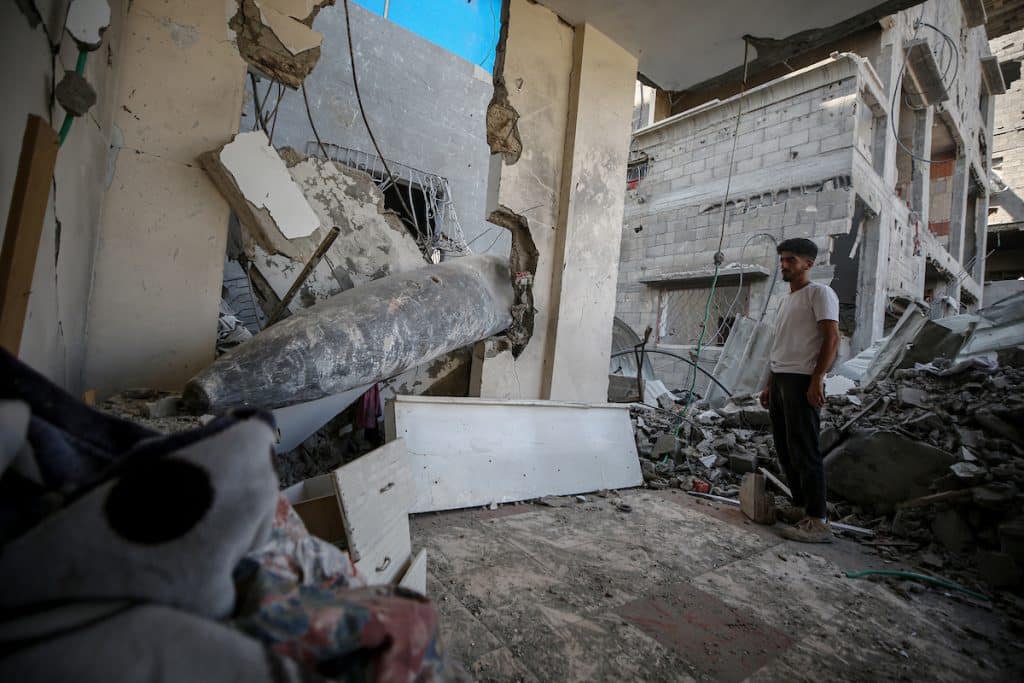
On November 23, 2025, Adham al-Firy, 28, from Gaza City’s al-Nasr Neighborhood, found a small object weighing about 1.5 kilograms while working to clear rubble from buildings destroyed during Israel’s genocide in Gaza.
After searching online, it appeared to be a scooter battery, so he decided to take it home and use it for electricity and internet access amid the city’s ongoing electricity blackouts.
At about 7:00 p.m., he brought the object into his family’s second-floor apartment in their four-story building. He placed it on a table in the living room, where nine family members were gathered. Shortly afterward, his 18-month-old son, Yahya, carried the object and walked towards his father, who watched in fear that the child might drop it on himself.
“My son took one step, a second step, and then suddenly the object exploded,” he recalled. My son was thrown into the air before my eyes, and then everything went dark.”
The battery-like trap that killed his son
Adham initially thought that the rubble dust was preventing his vision. The blast threw him into the street and buried him beneath the rubble. He could move his arms and right leg but not his left leg, realizing it had been severely injured.
“I cried out for help until my 30-year-old brother, Muhammad, with the help of some relatives, pulled me out after tying a rope around my sound leg. At that moment, I realized I had lost sight in one eye, as I could not see anything or anyone around me,” he said.
While Adham was being transported by an ambulance to al-Shifa Medical Complex, rescuers found an amputated hand near the area. Medical staff confirmed that none of the injured had a missing limb. It was in that moment that Adham realized the hand belonged to his missing son.
“My family hid the truth of my son’s death from me for three days until my condition improved after my left leg was amputated below the knee,” Adham said. “Then they told me part of the truth — that he had been killed.”
“Two weeks later, I learned the rest from neighbors,” he added. “My son had been torn into pieces scattered around the house, including his hand and rib cage.”
Adham said that everyone inside the apartment was either injured or suffered burns. He lost his left leg and sight in one eye, and doctors warned that his second eye is also at risk.
Lacking experts and proper equipment
Since October 7, 2023, over 200,000 tonnes of explosive ordnance were dropped on the Strip by Israel, with about 70,000 tonnes remaining unexploded, according to Mahmoud Basal, spokesperson for Gaza’s Civil Defence.
Last April, the United Nations Mine Action Service (UNMAS) reported that 1,000 people had been killed due to “indirect conflict from the remnants of war since the start of the attack,” which Basal attributed to the loss of explosive ordnance engineers and the lack of equipment needed to identify and safely dispose of unexploded ordnance (UXO) contaminated in debris.
About 90 percent of those engineers have been killed, he said, either at home or while carrying out what he describes as “humanitarian work”, leaving the city without experts capable of conducting full UXO operations from detection and surveying to safe disposal.
“There are now no experts who know where the explosives are and how to remove them,” he said. “The remaining engineers can handle a small missile or a grenade if people report a UXO remnant, but they can’t handle a high-explosive remnant such as the MK-4 missile because it requires heavy equipment unavailable in Gaza.”
He added that even if experts were available, Gaza lacks the equipment needed to clear UXOs, making the task difficult amid widespread destruction and a high population density in a limited area, with residents living in only about 36 percent of the territory, following the expansion of Israeli military control to around 64 percent of Gaza last March.
As a result, the exact locations of UXO remain largely unknown and are mainly identified only when civilians report suspected objects, according to Basal. They were likely to be concentrated in heavily affected areas, including Gaza City and northern Gaza, where repeated military operations caused massive destruction.
He warned that it poses risks to residents living in or near damaged homes and neighborhoods, as well as to civil defense crews clearing the rubble, with an estimated 50 to 60 million tonnes of rubble that are reportedly contaminated with UXOs.
Basal described these remnants as air-dropped bombs, missiles, and drone munitions, as well as abandoned grenades and explosive devices found in streets, homes, and neighborhoods.
Many of them could be disguised as everyday objects such as cans, juice containers, and children’s toys, which could explode if handled and kill more civilians.
The Humanity and Inclusion organization estimated that clearing UXO in Gaza could take between 20 and 30 years. Basal said that the Israeli authorities should, under international laws, provide detailed information on the UXO locations to support disposal efforts and reduce the risks faced by civilians.
The toy that was not a toy
Yayha and Nabeela al-Shurbasi were among the several victims of another unexploded ordnance incident after finding a suspected object near their home on Gaza’s al-Jalaa Street at about 10:00 a.m., October 24, 2025. They were both six years old.
Yahya, who survived the explosion, told his family that they had found what they thought was a toy in the street while returning from a nearby supermarket after buying some snacks. They took it and played with it near their house.
The object exploded while they were playing with it. Their parents, Muhammad and Nadia, were inside and initially thought a nearby building or passing vehicle had been hit.
When a passerby told them two children had been injured, the family rushed into the street and found Yahya and Nabeela lying on the ground, soaked in blood.
“They were in a terrible condition,” Tawfiq al-Shurbasi, the twins’ grandfather, recounted. “They were bleeding continuously, with torn flesh and missing limbs.”
The twins were taken by car to al-Shifa Hospital, where they underwent multiple surgeries over several weeks.
Yahya lost his right hand, left leg, and a finger on his left hand. His appendix had been removed after shrapnel penetrated his abdomen. His right leg was badly burned, leaving bones exposed. Doctors warned it might need amputation unless he urgently traveled for treatment abroad.
Nabeela had severe fractures to her left leg, lost three fingers, and suffered internal bowel damage, requiring part of her intestine to be surgically removed due to shrapnel injuries.
She died 20 days after the explosion while waiting to be evacuated for treatment abroad.
“Her twin brother Yayha was lucky to be evacuated for treatment in Italy with his parents via Karam Abu Salem on December 7, 2025,” al-Shurbasi said.
“He was hospitalized and underwent several surgeries to save his remaining leg from amputation,” his grandfather added. “He is now receiving rehabilitation before being fitted with prosthetic limbs.”
Losing his legs and his future
Most UXO-related cases arriving at Gaza’s hospitals are children with critical wounds requiring surgical treatment and prolonged stays in intensive care units amid the city’s collapsing health system, according to Dr. Issam Abu Ajwa, a consultant surgeon at the Gaza Baptist Hospital.
“Patients arrive drenched in blood, with limbs missing, severe burns, and at times, partial or complete loss of vision,” Abu Ajwa described.
He said that, despite working with limited resources, medical staff are trying to avoid amputation whenever possible, but it can sometimes become unavoidable, particularly when patients cannot be urgently evacuated to receive treatment outside Gaza.
Nineteen-year-old Daoud Eid lost both legs after a suspected UXO object exploded on November 28, 2025, as he and his cousin returned from Jabalia Refugee Camp.
They had gone to check on their family home after hearing on social media that Israeli forces had withdrawn from the camp. When they arrived, they found the camp completely devastated and their home reduced to rubble.
On their way back to the displacement tent where their families were sheltering in central Gaza, one of them accidentally came into contact with a suspected object that exploded, severely injuring them.
They lay bleeding for nearly three hours before people could safely reach them. During that time, Daoud’s cousin had died, succumbing to his injuries.
Daoud was taken to al-Shifa Hospital with precipitously low hemoglobin levels, and spent two months undergoing multiple surgeries before both of his legs were amputated.
“I missed my Tawjihi exams that year while undergoing several surgeries to save my legs,” Daoud said. “I missed the exams the following year, too, despite scoring above 90 percent during school years.”
Although referred for treatment abroad, Daoud remains unable to leave Gaza, where the destruction of rehabilitation and prosthetics facilities has left artificial limbs unavailable amid restrictions on the entry of medical supplies.
“I dreamed of finishing high school and studying engineering at university,” he said. “Today, my dream is simply to travel outside Gaza and receive artificial limbs.”


Math quiz for Gaza children:
200,000 tons of explosives were dropped on Gaza, but 70,000 tons remain unexploded. The area of Gaza is 141 square miles.
How many tons of detonated explosives are there per square mile of Gaza? How many tons of undetonated explosives are there per square mile of Gaza?
Disguising explosives as toys or other everyday objects (e.g. watches, phones) is a war crime. Zionists don’t care.
Thank you, Khuloud, for the important report.
I’d like to add — because the issue remains ever more relevant — that sixteen years ago in this journal, I made the claim that Israel was deliberately leaving UXOs in Gaza (then regarding Cast Lead), and deliberately preventing the UN and NGOs from neutralizing it. In retrospect, I would change the headline and rework a bit of the article, but the evidence remains the same:
UXOs: Did Israel deliberately arm Hamas?
Re Gaza in general, this is relevant:
Israel could’ve ended Gaza war, freed captives sooner: Israel ex-negotiator…Retired General Nitzan Alon says more captives could have been returned alive and a deal was possible ‘maybe a year earlier’….A former Israeli general who was the army’s point person for hostage negotiations at the beginning of the Gaza war says that a deal to return all Israeli captives could have been achieved “much earlier” than October 2025 but it was prolonged unnecessarily.
“I think that we could [have gotten to] this point much earlier, maybe a year earlier or so, without any major implication on the other strategic goals of the war,” Major General Nitzan Alon said on Friday. “We missed it, actually. The war was too long.”….Alon referred to Israeli Prime Minister Benjamin Netanyahu’s claim that Israel must achieve “total victory” before signing a deal as “false”.
He called the October 2025 “ceasefire” a “strategic achievement” that has since curbed Hamas’s military power. But he said it could have been secured much sooner with “maybe some hostages that got killed or murdered during their captivity [coming] back home alive.”...“We could have – and we should have – shortened the war, brought all the hostages back, maybe a year earlier, and moved forward and maybe, you know, saved thousands of lives on both sides,” Alon told the panel discussion organised by the United States think-tank.
Israel could’ve ended Gaza war, freed captives sooner: Israel ex-negotiator | Israel-Palestine conflict News | Al Jazeera
Avner Gvaryahu, a doctoral student in public policy at Oxford University and a former executive director of Breaking the Silence, has a good article in Haaretz:
https://www.haaretz.com/opinion/2026-10-06/ty-article-opinion/.premium/the-idf-denied-a-200-death-threshold-in-gaza-but-what-exactly-did-it-not-deny/000001a1-0d82-dbcb-a5e9-afd76ecd0000
Part of his argument is the way AI acted as a target multiplier. The system threw up so many targets, the IDF lost (or abandoned) control of the targeting process. “One can question an officer about why he marked a particular man as a target, but it’s impossible to ask an algorithm.”
That goes some way towards accounting for the very high tonnage of ordnance dropped or fired at Gaza.