


Battle of the Camels Feb 2 2011
Egypt is a conservative society, where both Muslims and Christians have high levels of religious devotion and practice. Egypt is also afflicted with corruption, which is more glaring at the highest levels, but which has seeped down into the rest of society, often in the form of “wasta:” using personal connections to get past the rules. The contradiction between religion and corruption causes regular moral anxiety for the vast majority of Egyptians who are principled and honorable.
During my recent visit to Cairo, my friend Morqos Girgis, a young Christian lawyer, explained how he tries to resolve this chronic dilemma. “I do use wasta to protect my own rights,” he said. “But I try not to use it to advance myself at the expense of someone else’s rights.”
He gave two examples. “If you want to have a reasonable chance to go on to university, you have to go to a private high school,” he said. “When I applied, I passed the entrance exam. But then we learned that other prospective students were willing to pay the school more than the stated tuition. I was going to be squeezed out. My father called someone he knew in the school administration, and I was admitted.”
Another time, the traffic police stopped Girgis and his friends for speeding. “We were well under the limit. They were simply looking for a bribe. I called someone I knew on the police force on my mobile phone, and we got off without paying.”
Girgis is still uncomfortable. “Sometimes, I talk these dilemmas over with our Coptic priests,” he said.
My recent trip was my fourth visit to Egypt over the past 25 years, and I was once again reminded why it is one of my favorite countries. The Egyptian people form what is, for the want of a better word, a truly civilized society. Cairo has a dense network of family, community and workplace ties, which results in one of the lowest crime rates of any big city in the world, despite a high (and rising) level of poverty. Egyptians are extraordinarily hospitable, with a great sense of humor – and the 2011 revolution has added greatly to their already large stock of jokes.
In the months to come, Islamophobes in America and elsewhere will warn ominously about the electoral rise of the Muslim Brotherhood, and the even more conservative Salafis – who together have won roughly 70 per cent of the vote in the just-concluded parliamentary elections. These Western alarmists had nothing to say during the decades when the Mubarak regime arrested and tortured the Brothers by the thousands, even though the organization had declared for nonviolence in the early 1970s and stuck to its commitment despite intense pressure. (Just recently, the New York Times’s Thomas Friedman reported on his interview with Essam el-Erian, the Brotherhood’s prominent vice chairman, without mentioning that el-Erian had been unjustly sentenced in 1995 to five years in prison with hard labor.)
The strong electoral showings by the two Islamic groups are directly connected to the Mubarak regime’s culture of corruption. In Cairo’s dense neighborhoods and elsewhere, even Egyptians who are skeptical of the Brotherhood’s policies recognize that its members are upright, civic-minded citizens who, for instance, ran free medical clinics, a stark contrast to the regime’s overcrowded hospitals, where you had to pay extra for prompt medical care.
For now, the Islamists are well-organized and committed. As I walked along the Mediterranean shore in Alexandria, a young Salafist, with the signature long beard sans mustache, approached me politely, carrying English-language pamphlets promoting Islam. His assignment, apparently, was to patrol the waterfront, carrying the message to the occasional foreign tourist.
The Muslim Brotherhood is – so far – successfully pushing for change without antagonizing either the conservative Egyptian majority, for whom continued turmoil will mean economic catastrophe, or the military/industrial clique, which still controls the country. As for the brave middle-class demonstrators who launched the uprising in Tahrir Square a year ago, their relationship with the Brothers is ambivalent. The Brothers stayed away from the Square the first few days, but then showed up decisively on February 2, the legendary Day of the Camel.
That day, the Mubarak regime unleashed ferocious violence against the demonstrators, including attacking with men mounted on the camels that usually ferry tourists around the Pyramids. Morqos Girgis, who as a Christian has hesitations about the Brotherhood, still has respect for their actions.
“The regime sent as many as 500 camels into the Square,” he said. “The Brothers know how to fight camels. They used ropes; they showed great courage.”
One big factor that should restrain the more extreme Islamists is Egypt’s giant tourist industry, which by one estimate employs one out of every 8 people in the workforce. Egyptians recognize that banning alcohol or imposing dress restrictions at the beach will reduce the number of European and American visitors. Tour guides have already staged anti-Salafist protests.
But the greatest danger to Egypt’s future at this stage is not the Islamists, but the military/industrial ruling elite, who are known as “felool,” or “remnants.” Egyptians believe the military is deliberately pulling back the police outside of Tahrir Square in the hope that rising crime and disorder will prompt a popular demand for the return of a firm hand. Also, it is the elite that has promoted sectarian strife between Muslims and the 10 per cent Christian minority; there has been no groundswell of genuine hostility from within those communities.
As the one-year anniversary approaches, the Egyptian revolution still has a long way to go. Even though the “Mubarak” station on the underground Cairo Metro has been renamed “Martyrs,” most of the old dictator’s clique have not gone anywhere yet.
There is another vital factor shaping Egypt’s future. On my flight into Cairo were a half-dozen or so other Americans, distinguishable by their appearance and snatches of conversation as either on-duty military men, or weapons salesmen and trainers. The United States gives Egypt’s soldiers $1.3 billion a year of aid, which ought to mean plenty of leverage. The Obama administration hints that it is applying pressure privately. But so far, America’s public statements have been too late, too mild, and too rare.
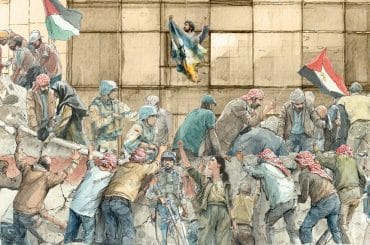
egyptians remember the spirit of those seventeen magical days in tahrir square. how to recapture and sustain that spirit in the day to day as well as the long term without disrupting the economy, that is the dilemma.
Thanks for these reports, James. Most of my direct info about Egypt comes from the Copts in my neighbourhood, who were reluctantly (and soberly) pro-Mubarak and remain extremely pessimistic about the chances for successful reform. They are definitely spooked by the Brothers and the Salafis and see little chance of recovery for the already devastated tourist industry (which has sent huge numbers of unemployed men home to be supported by the families they used to support).
Not a word here about the really disenfranchised 5 million people (about 1/3 of Cairo’s total) that are living in Cairo’s “City of the Dead” among the tombstones of the giant cemetery, most of them with no running water, electricity or schooling for the children.
As to the Brothers and the Salafists, just about the only conflict between them is about the timing for implementing changes for the same desired end result: the Salafists wants to introduce Sharia law and all it entails about dress, alcohol and so on in the next 20 minutes and the Brothers want to do gradually it with vaseline over a period of several years, but still want to do it nonetheless. Egypt’s 10 million Christians and other non-Sunni minorities don’t really figure in the long term plans of either group.
Yesterday, the squeeky-clean Mohammed el-Baradei announced that he won’t run in the presidential elections because the military has no intention of relinquishing real control of the country and today Amr Moussa declared his candidacy and that Egypt’s democracy is alive and well thanks to Egypt’s military. Looks like Moussa will be the next President of Egypt.
Sheikh and Imam MuthHar Shaheen from Egypt recently spoke at a Christian church in Cairo. Preceding the speech, a symbolic march took place from a mosque in the city to this church.
http://www.youtube.com/watch?v=IW2MPkWETQU
In his speech he talked about the chasm between the Christian and Moslem communities that which Mubarak incited and fomented.
The speech was aimed at building bridges between the two communities, a sort of an outreach to overcome the divisions created by Mubarak’s regime.
The Imam spoke about the religious oppression that Mubarak used to control people. He also mentioned how during times of turmoil and political persecution the church in which he stands acted as a refuge for Moslems persecuted by the secret police and the so-called security forces.
Note the (Christian) women in the background, teary eyed, clearly moved by the Imam’s words. The audience chants, One Hand…..We are all Egyptians.