

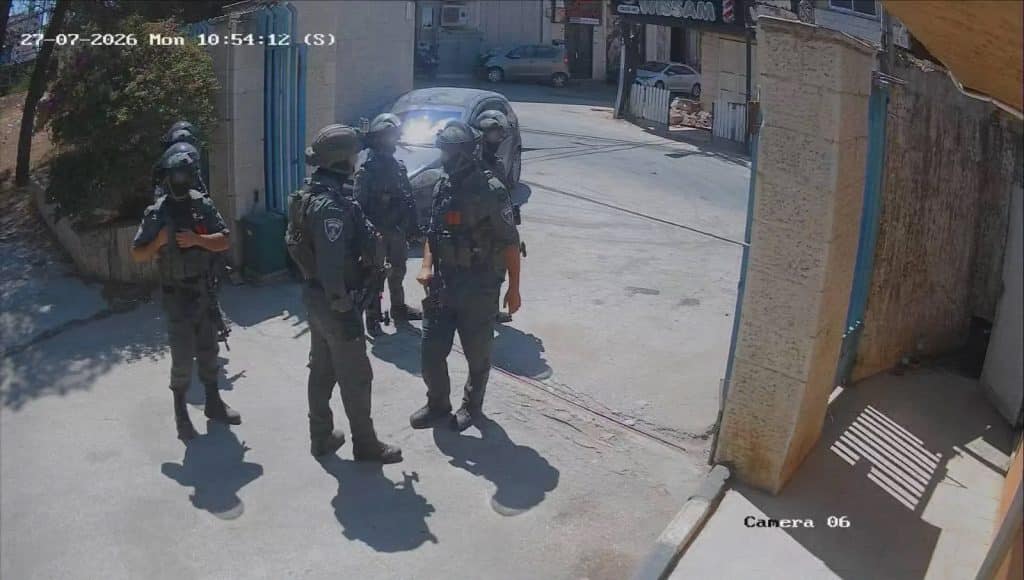
The UN Relief and Works Agency (UNRWA), which is in charge of Palestinian refugee camps in Palestine and the region, is bracing for an “imminent” Israeli takeover of its premises in Jerusalem, according to a statement by the agency’s West Bank affairs director, Roland Friedrich, on August 14.
In the days prior to the statement, Israeli municipal authorities in Jerusalem entered the agency’s premises in the Shufaat refugee camp north of Jerusalem, which includes UNRWA’s schools complex, health center, and the camp’s community services office, the statement said. Private contractors began work in the buildings as well.
Israeli media quoted Israel’s Jerusalem municipality as saying that the properties do not belong to UNRWA but are privately owned, with which the municipality has signed use agreements. UNRWA, however, says the Israeli push to take over its premises in Shufaat is running simultaneously to similar moves on the agency’s vocational training center in the Qalandia refugee camp, also north of Jerusalem.
The moves in Shufaat and Qalandia are the latest phase of a long Israeli campaign to remove UNRWA’s presence from the city, and with it, the legal recognition of a refugee population Israel does not want acknowledged within the city’s limits.
Why the north of Jerusalem?
Both Qalandia and Shufaat were established after the Nakba of 1948 to house Palestinians displaced from their homes in what became Israel proper. They are located in the northern periphery of Jerusalem, under the jurisdiction of Jerusalem’s municipality, and under Israel’s control since its occupation of eastern Jerusalem in 1967.
However, Israel has physically isolated Qalandia and Shufaat from the city with the separation wall, which it began building in the early 2000s, marginalizing residents by diminishing municipal services to the two areas, while at the same time preventing the Palestinian Authority from exercising any presence within them. This has effectively turned Qalandia and Shufaat into administrative grey zones and no-man’s-lands — sitting between the Israeli annexation wall and Ramallah, and plagued by overcrowding, poverty, and crime.
In these conditions, UNRWA is one of the few institutions providing services to the Palestinian refugee population, particularly education through its schools and vocational centers.
“The schools and the vocational center are very important to the population, because they provide free education to families who have limited income, and limited access to the Palestinian economy in Ramallah,” a resident of Qalandia who asked not to be named told Mondoweiss. “Without UNRWA schools, most young people in Qalandia and Shufaat and other refugee camps wouldn’t have a chance at an education, and without the vocational center in Qalandia, many of them wouldn’t have a chance to learn a profession, because most families can’t afford college fees.”
For Jamal Jumaa from the Palestinian grassroots Stop The Wall campaign (STW), the isolation of the Palestinian population in the north Jerusalem camps is one part of Israel’s strategy to eliminate the refugee question. “Shufaat, Qalandia, and the surrounding areas that are part of Jerusalem’s municipal limits are home to more than 120,000 Palestinians, whom Israel has effectively isolated from the city’s interior,” Jumaa told Mondoweiss. “Many Palestinians whose homes are demolished in Jerusalem, or those who are Jerusalem residents and marry West Bank Palestinians, end up living in this grey zone.”
In this sense, Shufaat and Qalandia are similar to other neighboring grey areas, serving as effective dumping grounds for Israel’s “unwanted” Palestinian Jerusalem residents. But where Qalandia and Shufaat are unique, Jumaa says, is in their status as refugee camps, and Israel doesn’t want to have a refugee population residing in Jerusalem’s outer limits.
“This is why Israel is targeting UNRWA’s institutions in these camps,” Jumaa explained. “UNRWA’s presence is the physical representation of the refugee status of the population.”
Removing the agency from the area, therefore, would erase the refugee status of Palestinians in those areas.
Why UNRWA?
The UN agency was created by a UN resolution in December 1949, seven months after Israel was admitted to the UN as a member state. Israel’s admission into the international organization was conditioned by its implementation of UN Resolution 194, which stipulates Palestinian refugees’ right to return and compensation — a condition which Israel accepted by signature, but never implemented. UNRWA received the mandate to provide humanitarian services to Palestinian refugees, establish refugee camps, and maintain the registry of Palestinian refugees and their descendants as holders of the right of return.
Israel has been pushing to abolish UNRWA for years, arguing that the agency perpetuates the Palestinian refugee problem. For Palestinians, UNRWA is the representation of the international recognition of the Palestinian refugees’ plight and an institutional witness to the Nakba. More crucially, it is the international entity responsible for providing education, health, employment, and legal status to Palestinian refugees deprived of these rights as a result of the absence of a Palestinian state. From both perspectives, UNRWA is central to the Palestinian cause.
In October 2024, Israel passed a law banning UNRWA’s work in Israel. Then in December 2025, Israeli forces took over the agency’s headquarters in the Sheikh Jarrah neighborhood in east Jerusalem, after a series of attacks by Israeli individuals on the surroundings of the headquarters.
Israel’s crackdown on UNRWA followed months of financial strangulation of the agency led by the U.S., which halted its share of funding for it in January 2024 following Israeli allegations that 12 UNRWA employees in Gaza had taken part in the October 7 attacks.
The UN Office of Internal Oversight Services (OIOS) investigated 19 staff members and, in August 2024, concluded that nine employees “may have been involved” in the attacks, resulting in their termination.
The investigation found insufficient evidence to support allegations against nine other staff members, while no evidence was obtained for one additional case, which was closed. UN officials noted that the OIOS could not independently authenticate most of the information provided by Israeli authorities.
What comes next?
The current escalation in Qalandia and Shufaat follows a pattern of intensifying Israeli pressure on the two camps.
In February, Israel raided Qalandia and demolished multiple businesses and structures adjacent to the main street; in May, Israeli forces raided Qalandia again and threatened residents with displacement; and earlier this month, Israeli forces announced a “large-scale operation” in the camp that lasted several days, during which they arrested dozens of Palestinians, interrogated them in the field, and released all but one. In all these raids, residents feared that the UNRWA premises would be targeted, which the Qalandia resident affirmed.
“Every time, residents brace for the takeover of the vocational center for the municipality,” the resident said. “Every time, Israeli forces threaten residents with arrest if they oppose their actions in the future, which confirms that they might be planning something to come, possibly against UNRWA.”
For residents, the stakes would go beyond buildings. “It would be more than the loss of a center that formed countless skilled workers, or the schools, or the health center,” the resident said. “It would be the beginning of imposing Israel’s direct control inside the camp, erasing its identity. If Israel succeeds in that, it could be the beginning of doing the same in other refugee camps.”

Re: Israel has been pushing to abolish UNRWA for years, arguing that the agency perpetuates the Palestinian refugee problem. For Palestinians, UNRWA is the representation of the international recognition of the Palestinian refugees’ plight and an institutional witness to the Nakba. More crucially, it is the international entity responsible for providing education, health, employment, and legal status to Palestinian refugees deprived of these rights as a result of the absence of a Palestinian state. From both perspectives, UNRWA is central to the Palestinian cause.
UNRWA helps sustain the existence of the Palestinian group in the face of the continuing genocidal process that Zionist settler-colonial forces put into full operation in December 1947. The Zionist movement’s longstanding effort to undermine or abolish UNRWA should therefore be understood as part of an effort physically to destroy the Palestinian group as such. In that context, the campaign against UNRWA is also evidence relevant to establishing the dolus specialis—the specific intent to destroy, in whole or in part, the protected Palestinian group—required for the crime of genocide.
The point of Israel’s actions is to commit politicide, a term used by the late Israeli historian Baruch Kimmerling. Politicide is the “attempt to cause Palestinians’ annihilation as an independent social, political and economic entity”. Here’s Kimmerling’s obituary in the Guardian:
Baruch Kimmerling, who has died aged 67, was probably the first Israeli academic to analyse Zionism in settler- immigrant, colonialist terms. He described his homeland as being “built on the ruins of another society”. …Yet he called himself a patriot, and while decrying the “monstrous practices of Zionism” he valued Israel’s “islands of marvellous humanism and creativity”. He feared that a one-state solution to the Israel-Palestine dilemma would just cause further Balkanisation and bloodshed in the Middle East, and he opposed boycotts of Israeli universities.
Baruch Kimmerling | Education | The Guardian
Israel has expelled many humanitarian organizations. At least 37. Many believe with the horrendous crimes Israel continues to commit in Gaza, the yellow line being squeezed, the increased horrific crimes being committed by illegal land thieves in West Bank that the right wing war criminals in charge of Israel are going to escalate their war crimes over next several months.
https://www.timesofisrael.com/liveblog_entry/idf-warning-west-bank-on-brink-of-escalation-due-to-settler-violence-report/
Israel has killed at least 73,000 Palestinians. Thousands more…humanitarian workers etc etc
https://msf.org.au/remembering-our-colleagues-killed-gaza. So ruthless!
https://www.ohchr.org/en/press-releases/2026/01/israel-ban-37-aid-groups-makes-life-unbearable-genocide-survivors-palestine
““Since October 2023, Israeli forces have killed over 500 humanitarian workers and at least 1,500 health workers and intimidated, harassed and conducted smear campaigns targeting humanitarians. UNRWA has been the most visible target, but it is far from the only one,” the experts said.”
International journalist banned from documenting the genocide. Thank goodness there were heads of humanitarian organizations there to witness and document.
https://www.npr.org/2025/11/25/nx-s1-5620604/barred-from-gaza-for-2-years-international-journalists-are-still-fighting-for-access
Palestinian journalist killed by Israel
259 media workers killed by Israel
https://news.un.org/en/story/2026/04/1167267
https://msf.org.au/remembering-our-colleagues-killed-gaza
Judge Napolatino at “Judging Freedom” ask Allistair Crooke /is a former British diplomat, and is the founder and director of the Beirut-based Conflicts Forum, an organisation that advocates for engagement between political Islam and the West.[2] Previously he was a ranking figure in both British intelligence (MI6) and European Union diplomacy.[1][3] what he thinks the Israeli’s will do next. Crooke’s response to that question starts at 23:09.
They discuss what is going on in West Bank and Gaza indicates Israel is about to escalate the violence even more so.
Illegal “settler” army is big. At least “5000.” “Palestinian core issue underlies so much in the region”…..”war between the “Kingdom of Judea and the government of Israel”
Fascinating listen.
https://www.youtube.com/watch?v=VZVoAV9S0jM