

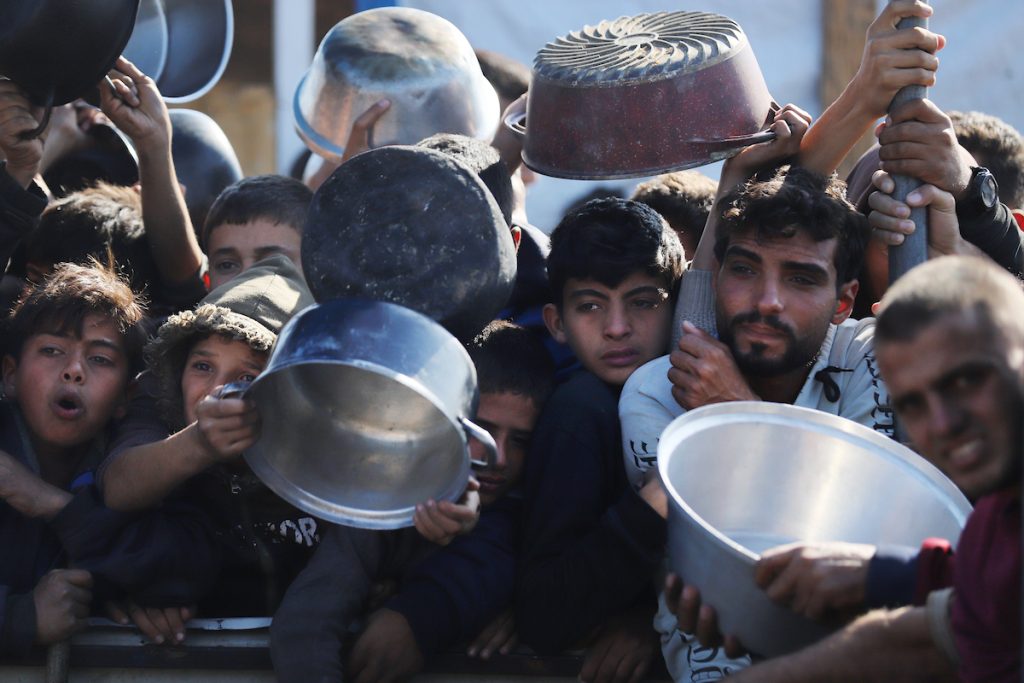
Tahrir Zidan, 41, repeatedly brings his five-year-old daughter, Tala, to the malnutrition clinic at Nasser Hospital in Khan Younis, hoping to receive nutritional supplements or treatment that might help his children grow.
According to Zidan, Tala is 94 centimeters tall. The average height for a child her age is 109-110 centimeters. He says that her height and weight have barely changed over the past two years, and that at times she has actually lost weight.
“She was diagnosed with malnutrition and short stature,” he explained.
Zidan, who is now displaced in the Mawasi area of Khan Younis after being forced from his home in Khuza’a, east of Khan Younis, says he cannot afford to provide his three children with a balanced diet. Two of them, including Tala, suffer from malnutrition.
Since the beginning of the war, he says, he has been unable to buy fruit or provide his family with a complete protein-rich meal. Instead, they depend heavily on food distributed by charitable kitchens to displaced people.
“I have not been able to buy even one kilogram of meat, a chicken, or a kilogram of fruit. We are living through conditions harsher than words can describe. The result is that my children are now suffering from problems that are difficult to treat,” Zidan told Mondoweiss.
Zidan says that his family sometimes obtains only one meal, and it’s not enough for the whole family. “The meal I obtain from the charity kitchen usually finishes while most of us are still hungry,” he said.
Zidan’s children are not alone. For children growing up in Gaza after October 7, hunger is beginning to leave a mark that may extend far beyond the immediate effects of starvation.
At the malnutrition clinic at Nasser Medical Complex in Khan Younis, doctors are increasingly seeing children who are not simply underweight but failing to grow in height. Some were born to mothers who endured pregnancy during periods of severe food deprivation; others have themselves spent years without adequate access to protein, healthy fats, carbohydrates, vitamins, and other nutrients essential for growth.
Doctors at Nasser Hospital say they are beginning to see what they fear could become one of the most lasting consequences of Gaza’s hunger crisis: a generation whose physical growth and development have been permanently altered or stunted by prolonged malnutrition.
A generation affected by stunted growth
Dr. Ahmad al-Farra, head of the Nasser Hospital’s pediatric department, sees dozens of cases a day at the hospital. Beyond the immediate problem of kids who are going hungry, he paints a worrying picture of an entire future generation that could possibly face chronic health issues due to the Israeli-engineered famine and food shortages in Gaza. The primary issue he sees emerging in Gaza presently, is children with stunted growth.
“We are facing a phenomenon that has begun to appear recently: cases of short stature,” al-Farra said. “We are now beginning to see the catastrophic consequences of malnutrition.”
According to the World Health Organization (WHO), “stunting is the result of long-term nutritional deprivation, and often results in delayed mental development, poor school performance, and reduced intellectual capacity.”
Al-Farra says the effects of the prolonged nutritional crisis have begun to become visible after the period of severe hunger that intensified in March 2025 and continued into September 2025.
Isra al-Najjar, head of the Clinical Nutrition Department at Nasser Medical Complex, says the facility has recently recorded an increase in cases of stunted growth. Stunting is assessed by measuring a child’s height and comparing it with their chronological age against international growth standards and standard deviations.
“A height-for-age measurement between two and three standard deviations below the expected level is classified as stunting, while a measurement reaching three standard deviations below the norm is considered severe stunting,” she said.
In Gaza, Najjar says, “many cases of stunting are nutritional in origin, resulting from deficiencies in essential nutrients during critical periods of growth.” The problem became particularly pronounced during the famine of 2025, when many children were unable to obtain adequate amounts of protein, healthy fats, and complex carbohydrates. These deficiencies, she says, have affected their weight, overall growth, and height.
“The number of cases has been increasing month by month,” Najjar said. “Between three and 10 cases of stunted growth are now identified during each daily visit to the nutrition clinic at Nasser Medical Complex,” a rate she describes as significantly higher than before the war.
On August 26, 66 cases of malnutrition were seen at the clinic, including one child with short stature, according to al-Farra. On August 15, 82 malnutrition cases were recorded, including two cases of short stature. On August 22, 73 malnutrition cases were seen, including one case of short stature. On August 24, 79 cases were recorded, including four children with short stature.
The figures, al-Farra says, illustrate a recurring pattern: dozens of children arrive daily at the clinic with malnutrition, and an increasing number are also showing impaired linear growth.
In Tal al-Hawa, West of Gaza City, Jana Hajjaj, 10, is one of six siblings and has been diagnosed with malnutrition. Her father, Osama Hajjaj, 44, noticed that she was not growing as expected for her age. When he took her to a malnutrition clinic at al-Shifa hospital, doctors found that her skeletal development corresponded to that of a seven-year-old, indicating significant growth delays.
Jana was prescribed growth hormones for one month, her father says, but she needs to continue the treatment for six consecutive months. Gaza’sMinistry of Health, despite its limited resources, was able to provide the first month’s doses but could not secure the remaining supply. Hajjaj says he has also been unable to afford or obtain the medication himself.
“I have six children,” Hajjaj said. During the famine, we went hungry for several days at a time. Sometimes, we had only one meal every day or two. At times, I would go without food so that my children could eat.” Despite the deprivation, Hajjaj developed diabetes during the period of famine. Jana, meanwhile, became malnourished, and her growth was stunted.
“I don’t know whether this is something to be grateful for or something to fear,” Hajjaj said. “Out of my six children, only one developed malnutrition severe enough to affect her growth.
Thankfully, the others did not experience the same growth problems, although some of them also suffered from malnutrition. The effects may show up later, and we do not know what the future holds for us in Gaza.”
Effects from the womb into childhood
Dr. al-Farra says that in Gaza, the crisis starts from conception. He describes a scenario that he sees often: a pregnant woman who lived through famine in Gaza while repeatedly being displaced, exposed to fear, attacks, spoiled water, and inadequate medical care, with little or no access to prenatal follow-up or nutritional supplements such as folic acid.
Such conditions, he says, can lead to several possible outcomes, including congenital abnormalities, pregnancy loss, or fetal death. But another outcome worries him: a child born with low birth weight, premature birth, or impaired growth.
“If the child is born with low weight or is premature, and that child is a girl, the effects can extend into puberty,” he said. “There can be hormonal problems, delayed puberty, and ultimately short stature” Al-Farra said.
Al-Farra describes this as an “intergenerational cycle,” arguing that nutritional deprivation during pregnancy can influence the biological development of the fetus and potentially affect the next generation.
Scientific research supports part of this broader concern. A 2024 medical review found consistent evidence linking maternal undernutrition with fetal growth restriction, preterm birth, low birth weight and being small for gestational age. A large systematic review involving more than one million women similarly found that maternal underweight was associated with increased risks of preterm birth and low birth weight.
Researchers studying the developmental origins of health and disease have also found evidence that maternal undernutrition can influence fetal development through changes involving the placenta, gene expression and metabolic programming.
That does not mean that every child exposed to maternal malnutrition will develop stunting or chronic disease. But it does mean that deprivation during pregnancy can alter the conditions under which fetal growth takes place.
Lifelong consequence
Al-Farra says that when a child experiences prolonged malnutrition, particularly for more than four weeks, the consequences extend beyond stunted growth, and can potentially affect children into adulthood.
The body’s hormonal systems can be affected, he says, including sex hormones and thyroid hormones. Growth can slow or stop, while developmental and cognitive problems may emerge.
“If the situation is corrected and the child receives adequate nutrition and care, height can recover, and hormonal function can recover,” he says. “But neurological and cognitive effects may not necessarily be fully reversible.”
Research on childhood malnutrition supports the broader concern about developmental consequences. A systematic review of 30 studies found strong evidence linking childhood malnutrition with impaired neurodevelopment and academic achievement, and moderate evidence of associations with impaired cognition and behavioral problems.
The WHO likewise notes that the effects of stunting are not limited to physical size. It can affect language, learning, psychosocial development, and later work capacity.
Al-Farra also points to what researchers call the “thrifty phenotype”: a theory describing how exposure to nutritional deprivation during fetal development can produce metabolic adaptations that help the body survive in a food-scarce environment but may become harmful if food becomes more abundant later.
Research has linked fetal undernutrition and this form of developmental programming to an increased risk of obesity, insulin resistance, type 2 diabetes, and metabolic syndrome later in life.
Al-Farra argues that this may help explain some of the nutritional changes he is seeing among children in Gaza.
He points to children who receive foods high in sugar and calories but lacking adequate protein and other nutrients. During the war, he says, products such as Nutella, instant noodles, chips, and Coca-Cola entered Gaza at various stages, creating a diet that provided calories without the nutrients children require for healthy development.
The result, he says, is a combination of excess body fat and protein deficiency that could increase the risk of chronic disease later in life.
“What we fear is that we are facing the targeting of an entire generation,” al-Farra said. “A generation that will suffer in the future from problems with cognition, understanding, and interaction, as well as chronic neurological problems and stunted growth.”
Editor’s Note: One of the interview subjects of this piece, Osama Hajjaj, is the relative of Mondoweiss’ Gaza Correspondent Tareq Hajjaj, the author of this piece.


I’ve been commenting about the lack of adequate supplies of water ever since the Sharm el-Sheikh Fact-Finding Committee Report, which was published in April 2001. Likewise, I’ve been commenting about the impacts and violations noted by the ICJ in the 2004 Wall case findings of fact. They listed violations of the right to work, healthcare, education, and an adequate standard of living in paragraphs 131–134 detailing how Israel systematically restricts or severs access of Palestinians to vital resources and facilities including agricultural lands, medicine, food, shelter, water, schools, and work. You know, apartheid.
The issues of severe malnutrition, stunting, mental impairments, and premature death due to lack of food and medicine in poorer neighborhoods of Gaza has already been a multi-generational crisis. It has been highlighted by the Lancet, British Medical Journal, and the US National Institute of Health – Pubmed since 2007. If (or when) starvation is used as a weapon of war against children anywhere, armed resistance and resort to open warfare is always certain to follow.
Just for the sake of argument let’s assume that history began on Oct 7 and Israel had to do something to defend itself. What could it have done differently? Again I submit this article written by a marine who served in Fallujah:
“The Operational Case Against Israel’s Gaza Campaign….Gaza did not have to look the way it looks. That is not a moral claim. It is an operational one.…Claims of necessity are invoked to explain the scale of civilian harm, but they founder in the face of operational logic. Supporters of Israeli methods argue that Gaza’s urban battlefield — tunnels, rocket fire, extreme population density, hostages held underground — left no viable alternative to large-scale destruction. That argument rests on a false assumption: that large-scale fires were inevitable rather than chosen, and that the only tradeoff was between more fires and mission failure. That is a false choice, and I’ll explain why….Destroying Hamas Required Separation, not Saturation… A workable approach would have established secured zones distributed along the coastal strip, each absorbing a manageable segment of the population. Consecutive adjacent zones, established as ground operations progressed sector by sector, would mean the Israeli military never had to manage the entire population at once. If one area came under pressure, the others would continue to function….”
The Operational Case Against Israel’s Gaza Campaign
“Andy Milburn is a retired U.S. Marine Corps officer. He fought in Fallujah, led an infantry battalion in Iraq’s Anbar Province, and commanded a special operations task force during the campaign to retake Mosul from the Islamic State.”
In a nutshell, Israel chose genocide when other alternatives were available. Milburn’s substack is worth reading:
Andrew’s Substack | Substack
“Hamas rehearsed the 7 October attack in the open, on camera, for two years. Israeli intelligence watched — and concluded it meant nothing.”
Blowing off Steam – by Andrew Milburn – Andrew’s Substack
“Zidan’s children are not alone. For children growing up in Gaza after October 7, hunger is beginning to leave a mark that may extend far beyond the immediate effects of starvation.”
After slaughtering at least 75,000 Palestinians, at least 20,000 being children. Injuring tens of thousands, many amputees, starving tens of thousands, killing hundreds of humanitarian workers, killing hundreds of Palestinian reporters, banishing internationally respected humanitarian groups, not allowing international reporters in, holding over 1.5 million Palestinians in shabby tent camps, lack of water, waste facilities, millions suffering within those camps with not enough food, water for drinking, washing…..Israel keeps proving over and over again they are an apartheid, genocidal, sadist nation state who does not give a flying fuck about determinations made by the ICC, ICJ, other international organizations. Israel clearly does not give a flying fuck about what anyone thinks. Clearly they do not care about the Palestinians, Lebanese etc etc. They don’t give a flying fuck! Their only concern is killing anyone who stands in the way of a “Greater Israel” They are ultimately burying themselves
The only thing that is going to force them to even consider the welfare of the Palestinians etc they have yet to slaughter is international boycotts, divestment and sanctions.
And so it begins…..Although sure looks like too little too late….still it is more substantive!
https://apnews.com/article/uk-west-bank-israel-settlement-sanctions-b4d7354221bfe0c48e4bfce7a3b7624b
https://www.reuters.com/world/uk/uk-announce-trade-ban-israeli-west-bank-goods-2026-09-08/