

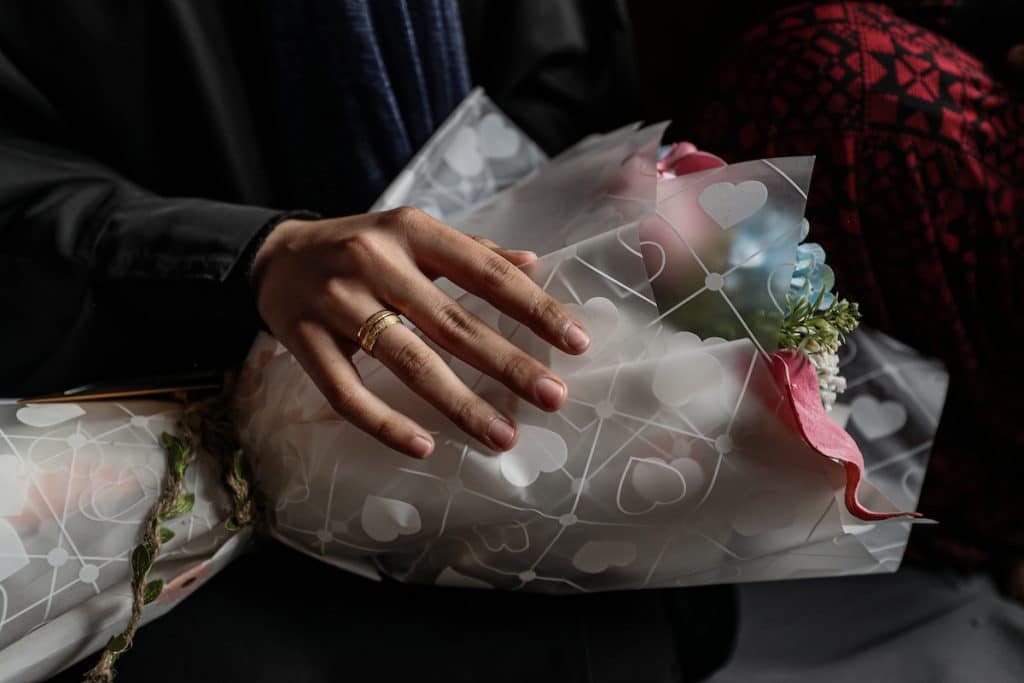
Safaa’s face bears marks of fatigue and exhaustion far beyond her 19 years. Squeezed into a torn nylon tent on the sandy coast of Deir al-Balah in central Gaza, months into a supposed ceasefire that has done little to ease the hardships of her people, she sits at the entrance with hollow eyes and brittle nails — the visible signs of malnutrition and vitamin deficiency. She is also pregnant, waiting to give birth while gripped by unrelenting fear.
In 2024, her parents married her off with the promise that she would live in better conditions. “There was no house, no walls, no celebration,” she tells Mondoweiss quietly, asking to be referred to by her first name only.
Instead of finding reprieve in her marriage, she found herself responsible for gathering firewood, cooking over an open fire, and washing clothes by hand amid a water shortage — burdens her frail body was not built to bear.
Her pre-war life in Shuja’iyya was the picture of an ordinary childhood. Then their home was struck and leveled in 2023, leaving her family of eight with no roof and no income. Her pregnant mother grew weaker by the day. Safaa herself suffered constant dizziness from malnutrition. When a young man proposed, promising food and stability, she agreed at 15 and was married at 17.
But the illusion collapsed on the first day.
Before October 2023, child marriage in Gaza had been declining. According to the Palestinian Central Bureau of Statistics, the rate of girls married under 18 had fallen from 22.2 percent in 2015 to 17.9 percent in 2022. The war reversed that progress entirely. A 2024 UNFPA survey found that 71 percent of respondents reported growing pressure to marry girls under 18, driven by displacement, poverty, and the collapse of protective systems.
“Girls in Gaza are not choosing marriage. They are being driven into it by hunger, fear, and displacement,” UNFPA Country Representative Nestor Owomuhangi said in April 2025. As such, childhood marriage can put young girls in precarious conditions where they are unable to make educated decisions about their future.
“Under continuous bombardment and repeated displacement, I see parents pushed toward excruciating, zero-option scenarios,” Walaa al-Othmani, a field specialist with the al-Shafi Association for Family Development, told Mondoweiss. “Through my direct work with these families, I witness how extreme deprivation drives them to make the most painful decision: marrying off their young daughters.”
Losing everything
In a narrow, dark corner of a school run by UNRWA in Nuseirat refugee camp sits Manal, 17, wedged between piles of discarded school furniture. Before the war, she was a top student planning to study at an arts college. Today she lives in a chaotic, overcrowded environment where hundreds of displaced families share classrooms and hallways with no privacy, and diseases spread from overflowing sewage and a chronic water shortage.
In 2024, her father convinced her that marriage would protect her and ease the family’s burden. Two of her older sisters had already been married off. She had no say. Within days, she was transformed from a student carrying a school bag into a wife responsible for running a household inside a displacement corridor.
“I never once imagined that I would become a wife living in a classroom crowded with displaced people,” she said, asking to be identified by her first name only. “No protection, no stability, not even a private space to cry. I lost my school and my childhood at the same time.”
The collapse of education was a direct driver. According to UNICEF, more than 97 percent of Gaza’s schools have been damaged or destroyed since October 2023, leaving around 658,000 school-age children without access to formal education. The UN has described this destruction as deliberate and systematic. What was once a protective space for young girls has ceased to exist.
“Child and early marriage is witnessing a marked rise; amidst wartime conditions, some families have come to view it as a safe way to secure their daughters’ futures,” Maryam Zaqout, Director of the Aisha Association for the Protection of Women and Children in Gaza, told Mondoweiss. “Yet, at a time when these girls ought to be in school, we see them carrying their own children and sometimes coming to the association seeking protection from the harsh reality in which they live.”
Al-Othmani describes how the concept of protection has been distorted beyond recognition: girls are being promised security and safety in marriages in exchange for their childhood. “Fathers escape this fear by passing responsibility for the girl to a husband, believing a male presence will shield her,” Zaqout says. “But what we witness on the ground is that this protection is an illusion. The young girl moves to a new tent only to find herself completely unprotected and far more vulnerable to abuse, without her own family there to back her up.”
This is what happened with Amal, the 15-year-old wife whose frail body was subjected to sexual abuse and violence from the first day of her marriage. She lives in the southern edge of Khan Younis, in a sand-battered tent with her family, surviving on a single free meal each day from a communal charity kitchen. At 15, she was married off in a hasty agreement between her father and her aunt, despite her own mother’s objections. Amal found no room to maneuvere. “It felt as though my father simply wanted to get rid of a heavy burden in the tent and cut expenses,” she said.
Since October 2023, Israel has tightened its siege over Gaza, imposing a famine that starved its population and killed dozens. Months into a ceasefire, Gaza’s families remain trapped between hunger and soaring living costs: food prices are still about 235 percent above pre-October 2023 levels, while shortages of cash, jobs, cooking fuel, and clean water make even basic meals difficult to afford. In July, the World Food Program found that 45 percent of households surveyed reported going to bed hungry at least once in the 30 days preceding the survey, with 6 percent experiencing this more than ten times.
On her wedding night, and as a result of sexual violence, Amal’s weak body endured severe bleeding and serious health complications which were exacerbated by a complete lack of medical care or nearby hospitals capable of handling her case. “I thought moving to my husband’s tent might mean better food,” she recalled. “Instead I found myself sinking into something even harsher.”
Soon after, she got pregnant with a baby she quickly lost as a result of malnutrition and overall physicall unwellness. Grappling to navigate the emotional, mental, and physical tool the marriage has had on her, Amal feels numb. “I just wanted to go to school, finish my education, graduate, and not have to constantly worry about having enough food or calculating every bite just to make it last. I didn’t want much from this world — just to breathe freely and see the sea, not something that would choke the life out of me,” she said.
The legislative vacuum
Israel’s assault on Gaza has wiped out the judicial system’s infrastructure entirely — demolishing court buildings, destroying decades of records preserving marriage contracts, paternity records, and custody rulings, and killing or displacing judges and licensed marriage officiants. The result is the total paralysis of the official legislative system.
“Under normal circumstances, Palestinian law and sharia courts enforced strict procedures prohibiting the documentation of any marriage for those under 18, except through stringent judicial exceptions requiring a judge’s approval, medical examination, and social assessment,” al-Othmani explained. “Today, amid the absence of the court, the judge, and the registrar, marriage decisions are made individually inside camp tents — without legal oversight or statutory deterrents.”
Data from the Supreme Sharia Court, cited by the Associated Press, shows that 20.6 percent of the 35,474 marriages recorded in 2024 and 2025 involved a girl under 18, including 627 marriages of girls under 15. Rights advocates warn that even these figures undercount the reality: most child marriages now take place verbally, entirely outside any statistical record.
The collapsed healthcare system also adds to the physical toll these young wives face.
In Zeitoun, east of Gaza City, 16-year-old Fatima suffered three consecutive miscarriages within six months of her forced marriage, a direct result of grueling physical labor, including hauling water and gathering firewood while walking for long distances over rubble, severe malnutrition, and the complete collapse of healthcare in northern Gaza. Before the war, she had opened her own small food stand and had great ambitions. Air strikes destroyed it along with her family’s home in Beit Hanoun. “The war took my home, my work, my dream, my health, and my unborn children,” she told Mondoweiss, explaining that destitution and her family’s struggle to find food drove her into this marriage. “I was completely deprived of medicine or care throughout my miscarriages,” she added, lamenting the circumstances that crushed her dreams and independence.
Only 50 percent of Gaza’s hospitals are functioning even partially, according to the World Health Organization. Pregnant minors face a complete absence of prenatal care, ultrasound checkups, and essential supplements, producing a sharp rise in premature births, uterine rupture, severe hemorrhaging, and recurrent miscarriage. According to UNFPA, approximately 10 percent of all newly registered pregnancies in Gaza now involve adolescent girls.
A last line of defense
Faced with this crisis and the absence of official protection, grassroots initiatives have emerged as the only available response.
The al-Shafi Association for Family Development, working in partnership with UNFPA, operates through three strategies inside the displacement camps: expanding safe spaces and dedicated tents exclusively for adolescent girls; running direct awareness campaigns for parents using medical evidence on the dangers of early pregnancy; and offering legal guidance to families who proceed with a marriage, encouraging them to draft temporary contracts signed by the camp’s mukhtar (a respected elder tasked with mediating disputes) and recognised community figures, preserving dowry rights and proof of paternity until sharia courts reopen.
Al-Othmani describes how eagerly the girls turn up. “They are fully aware of the rights they have lost,” she says, “and are in urgent need of self-care and an outlet for their emotions.”
But the scale of what has been lost cannot be offset by tents and awareness sessions. As the genocide continues and all traces of normalcy are erased, girls continue to be forced into marriage in hopes of better living conditions, purpose, or an escape.
Field estimates place the rate of marriage among girls under 18 at above 35 percent.
Manal still carries her school notebook. Its pages are worn from being leafed through in the displacement corridor where she now lives as a wife. “Every time I remember what my life was supposed to be,” she says, “I feel like I can’t breathe.”

We see exposed here the mechanistic logic of fascism. Israel creates such appalling poverty and other pressures on the Palestinian people that they have little choice but to resort to measures such as early marriages in order to survive. This provides the racist Israeli media and state with ‘evidence’ of the primitive misogyny supposedly inherent to Palestinian people… and therefore a very good reason to erase them. No doubt that was the logic within the ghettos and camps in WWII.
I am not sure what purpose a story like this serves? Palestine is a mess because of the savagery and terrorism of the colonial rulers in Tel Aviv and Gaza is the worst part of it. They would love this story to bring in simple-minded people who hate Muslims.
Why on earth, given the horror would anyone who cared about Palestine and Gaza concentration camp in particular write such a trite, negative story? The Palestinians have suffered 78 years of the worst genocidal holocaust in history. Not six years or so as some European Jews suffered along with tens of millions of non-Jews, but nearly a century of torment, torture, terrorism at the hands of a barbaric occupation regime intent on exterminating them all.
Shame on you Mondoweiss. This is a negative little story – girls are being forced into marriage code- for Muslims are primitive and backward and sexually abuse children – which serves Tel Aviv and not Palestine and helps those suffering under the zio military boot not at all.
If there is still a journalist in Gaza not yet murdered, why on earth is she wasting time writing stuff like this? It is a total betrayal and worse, irrelevant to the suffering.
This story has all the marks of zio propaganda over it and your editors fell for it.
Despite overlooking the weakness of comparing numbers from the Palestinian Central Bureau of Statistics to a survey, and then again to the Supreme Sharia Court – the fact remains that child marriage in Gaza remains less than it was just 10 years ago.