The bar for hospitals to lose protected status under international law is set very high. Those conditions were not met for any of the 36 hospitals in Gaza that Israel destroyed.
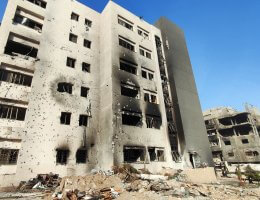

The bar for hospitals to lose protected status under international law is set very high. Those conditions were not met for any of the 36 hospitals in Gaza that Israel destroyed.
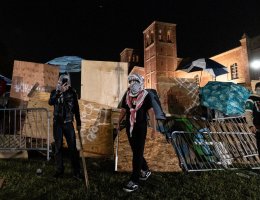
The aftermath of the violence at UCLA illustrates that we live in an upside-down world where we decry property damage on college campuses as we fund the genocide in Gaza, and where we advocate for free speech until it says “stop the genocide.”

Ceasefire talks are “paused” as delegations leave Cairo. Sources say Israel wants a full invasion of Rafah despite U.S. opposition, while Hamas reiterates its acceptance of the latest deal. Meanwhile, a new mass grave has been unearthed at al-Shifa.
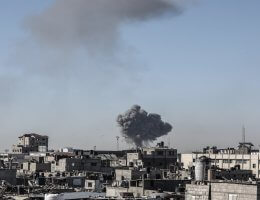
With 1.5 million people trapped in Rafah, Israel is moving forward with its invasion with no clear goals. So far Israel has been unable to wipe out the resistance in Gaza, so its only option is to massacre more Palestinians.
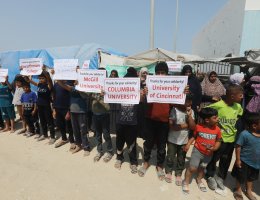
As Israel’s invasion of Rafah begins, people in Gaza are holding out hope that international pressure will force Israel to stand down. Part of that hope is tied to the heroic actions of students across the U.S. rising up for Palestine.
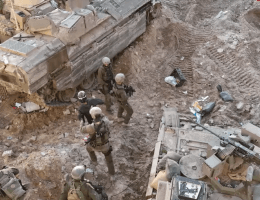
Israeli soldiers rounded up Ahmad Safi and his male family members in Khan Younis and made them stand atop a sand dune for 12 hours as the soldiers took cover behind them during a firefight with Palestinian resistance fighters. This is their story.
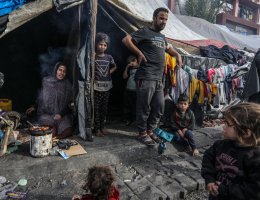
Those who survived Israel’s deadly bombardment now have to contend with the rising environmental disaster in Gaza’s displacement camps, including insect infestations, dangerous amounts of garbage and human waste, and the spread of infectious disease.

Israel is deliberately destroying the entire health sector in Gaza as only four hospitals remain operational. “If these hospitals stop working, they will turn into mass graves, like Nasser and al-Shifa,” Muhammad Zaqout, General Director of Hospitals in Gaza, told Mondoweiss.

Blinken says Hamas “must” respond to Israel’s proposal as the U.S. begins building a sea pier. Meanwhile, the UN says that 5% of Gaza’s population has been killed or wounded since the beginning of Israel’s assault in October.

The more resistance that the colonized shows, the more brutal the colonizer becomes. Genocidal Israel is now walking in the footsteps of all other settler colonies on their deathbed.