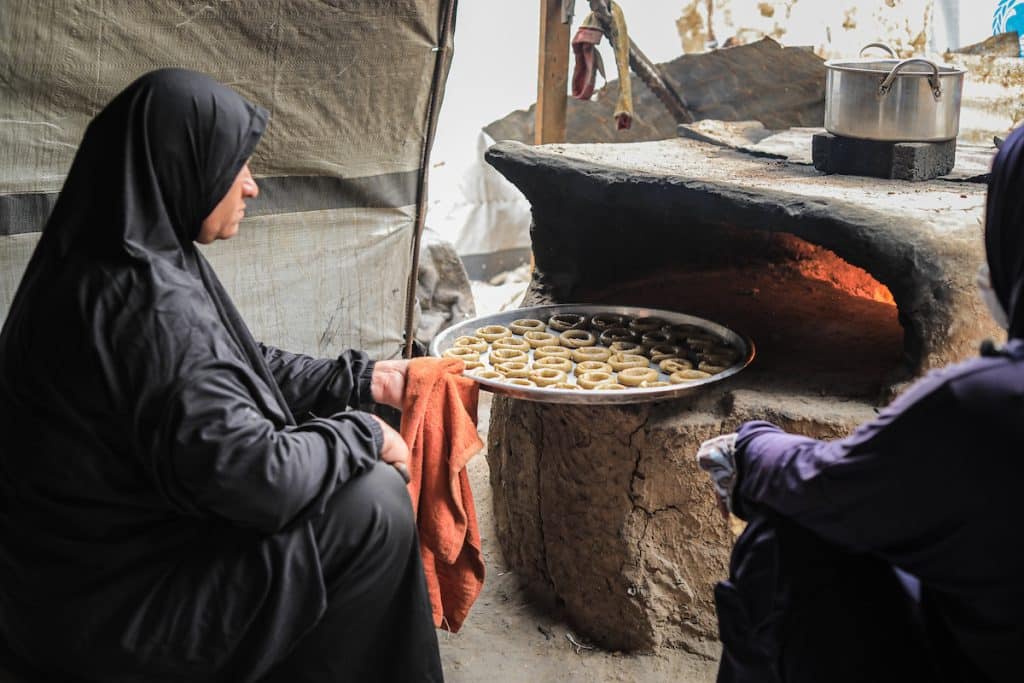
At al-Baraka displacement camp in Khan Younis, 42-year-old Amani al-Hamaida sits alongside 30 other women learning how to embroider by hand. The initiative was set up inside the camp to teach women a skill they could turn into a source of income, however small.
What brings the women together is not only embroidery. Each of the women has lost the man who once helped support her family, a husband killed during the war, detained, or missing with no known fate. They have been left to raise their children and find ways to feed them amid the devastation of Gaza.
Al-Hamaida is raising six children on her own. Some are in their final years of secondary school and need private lessons, she says — an increasingly significant expense given the collapse of Gaza’s educational system during the genocide.
Her husband was killed in 2024 in an Israeli attack in al-Mawasi, Khan Younis. Since then, responsibility for the six children has fallen entirely on her.
She receives some assistance through the camp, but says the aid is not enough. As a mother responsible for six children, she needs an income of her own, money she can use when her children need something rather than waiting for assistance.
Al-Hamaida is one of a rapidly growing number of women in Gaza who have become their families’ sole breadwinners during the genocide.
A recent brief by UN Women found that women now head nearly one in four households in Gaza, representing some 86,290 households, or 23% of all households in the Strip. The figure includes women whose husbands are missing, detained, separated from them, or whose whereabouts remain unknown, as well as women caring for husbands who have been severely injured or disabled and can no longer perform the roles they previously held within their families.
The consequences extend far beyond a change in who is considered the head of the household. Women-led families, the UN Women report found, face overlapping obstacles in securing necessities, finding shelter, reaching humanitarian assistance, staying safe, and maintaining their basic needs. The analysis also confirmed that women-headed households were more likely to report facing both unmet cash needs and movement restrictions, which make it difficult for them to access aid distributions or registration systems intended to support them.
For al-Hamaida, embroidery has provided a modest income alongside the limited assistance she receives from charitable organizations. But the women began with little more than basic instruction.
“We started by learning hand embroidery,” al-Hamada said. “Then we worked on developing our skills and learned more through whatever resources we could find on YouTube and the internet. After that, we started putting what we learned into practice.”
They began making wool hats for children and accessories, including covers for Qurans. Now the women are preparing products for Eid al-Adha, including handmade sheep dolls inspired by the animals traditionally sacrificed during the holiday.
For al-Hamaida, the money matters, but her work has another, more intangible purpose. She says that for women carrying the burdens of grief, displacement, and their responsibility towards their children, simply sitting together with other women and working with their hands provides a temporary outlet of relief. As they work, she says, some of the pressure that has accumulated throughout the genocide begins to ease.
‘I never had to think about finding food’
For Maisa al-Sulaibi, 41, the transformation from mother to sole provider came suddenly.
Al-Sulaibi has three children, ranging in age from three to nine. They live in a displacement camp west of Gaza City that residents have come to call the “widows’ camp” because it houses around 80 families headed by women whose husbands were killed during the war.
Al-Sulaibi holds a master’s degree in counseling and now volunteers with humanitarian organizations conducting psychological awareness sessions roughly two days a week. Her work sometimes takes her through displacement camps, where she speaks with families about personal hygiene, coping with their circumstances, and helping children deal with the psychological pressures of life during the war.
But the counseling she offers others takes place against the backdrop of her own struggle to keep her family together.
Before her husband was killed, al-Sulaibi says, the division of responsibility between them was clear. Her attention was centered on the things that occupy mothers across Gaza: caring for the children, feeding them, reassuring them when they were frightened, and trying to protect their mental well-being. Her husband assumed the responsibility of finding food, water, and shelter for the family, even during the worst periods of hunger.
“I never had to think about how we were going to find food,” she said. “I would stay at home, or in the tent, and take care of the things every mother in Gaza worries about: my children, preparing food, and reassuring them when they were afraid. My husband was the one who worried about bringing us food and water and securing a place for us to live.”
That arrangement ended on May 30, 2025.
Her husband had gone to Beit Lahia, where the family had lived before being displaced, hoping to retrieve food they had left behind. Al-Sulaibi says he was targeted by an Israeli quadcopter and killed. Rescue crews were unable to reach his body for a long period afterward.
From that moment on, the responsibilities he had carried became hers.
“Now I am the first and last person responsible for this family,” she said. “If I don’t go out every day and try to find food, money, and the things my children need, my children could die of hunger.”
It is a level of physical and psychological strain, she says, that she never experienced while her husband was alive.
She now works every other day, usually for about two hours at a time. Two hours may sound brief, but for al-Sulaibi, every minute away from the tent is filled with anxiety about the children she has left behind.
“During those two hours, my mind stays with the tent and with my children inside it,” she said.
Even when she worked while her husband was alive, leaving home felt entirely different.
“I could leave knowing that their father was with them,” she said. “Now, when I leave the tent, I never stop thinking about them.”
The choice she faces each time she steps outside is one in which neither option feels safe: remain beside her children and have no reliable way to provide for them, or leave them alone to earn enough to meet their needs.
For her, going to work can feel like choosing between two forms of danger.
The responsibility pushes her forward, she says, but it also produces moments of despair, particularly because the war, and the possibility of sudden death, continues to shape every decision.
She leaves the tent to find food or earn money for her children, all while carrying another thought she cannot suppress: that one day she might return to find that the tent was bombed and that the children she had gone out to provide for were no longer alive.
The thought follows her throughout the hours she spends away from them. Sometimes, she says, she considers giving up work altogether. She imagines staying beside her children, depending on humanitarian assistance and collecting meals from the takiyas, the charitable kitchens that distribute free food across Gaza.
Then one of her children asks her for something small.
“Sometimes one of my children comes to me and asks for one shekel [$0.33] to buy a piece of candy,” al-Sulaibi said. “My heart breaks because I can’t give it to them.”
And so she goes back out to work.