

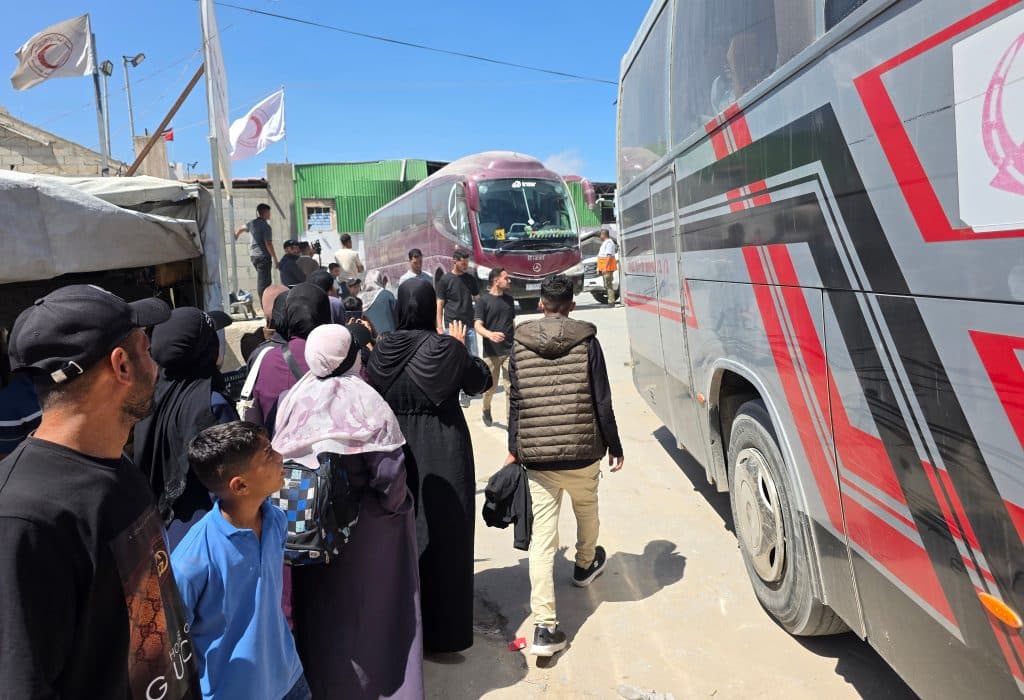
On November 25, 2025, Wissam Yassin, 50, left the Gaza Strip with her two daughters through the Kerem Shalom crossing, as part of an evacuation organized by the French Embassy. It came after several attempts by Yassin, who works for the U.S.-funded Alhurra television channel, and her ex-husband, who works for Radio France, to secure a way out for their two daughters.
Yassin and her family were instructed to go to a UNICEF facility, after which the French Embassy took responsibility for their departure. They left via the Rafah Crossing, traveled through Kerem Shalom, reached Jordan, and were flown directly to France.
“I felt as though I had been uprooted from my place and taken somewhere else,” Yassin, who cared for her children on her own throughout at least five displacements, said. “I wished I could stay in Gaza, but at the same time, I wanted a future and a dignified life for my children.”
Yassin’s family is one of thousands of families forced to leave Gaza since October 2023 – through embassy evacuations, academic fellowships, and World Health Organization (WHO) medical corridors. These are the only channels through which departure is currently possible, and they move slowly and selectively. The people who leave do so while fully aware that they may not be able to return, but they’re also aware that Israeli officials have openly stated, at the highest levels of government, that emptying Gaza of its Palestinian population is an explicit policy and ultimate goal.
The displacement plan
Israeli statements calling for the removal of Gaza’s population have not been hidden. Since the beginning of the war, Israeli officials have repeatedly and publicly made them.
The first major step toward displacement came in October 2023, when more than 1.1 million Palestinians were pushed from northern Gaza toward the south, a move widely described as a possible prelude to forcibly removing the population through the Rafah crossing. Egyptian opposition to Israeli and U.S. pressures to take in the displaced population prevented it and kept the population inside Gaza.
On September 2, 2026, Israeli Defense Minister Israel Katz said there was “no real solution for Gaza” without such forced migration, and that “Israel would facilitate Palestinian migration from Gaza to other places by sea, air, and every possible means.”
The following day, National Security Minister Itamar Ben-Gvir revealed a national action plan for what he called the “voluntary migration” of Palestinians of Gaza, targeting 1.8 million residents over seven years, with around 250,000 people to be removed in the first year.
On September 16, Katz said it’s only a matter of time before Israel resumes war on Gaza and encourages its people to evacuate the Strip.
In March 2025, Israeli media reported the establishment of the Voluntary Emigration Administration, within its Ministry of Defense, dedicated to working out destinations to send the people of Gaza to, in collaboration with its allies.
It is against this backdrop that Palestinians weighing whether to leave must make their decisions.
‘They kill the idea of steadfastness itself’
Palestinian writer and academic Yousri Al-Ghoul, 46, spent the entire duration of the war in northern Gaza – a region that has been deliberately cut off from the rest of the Strip, subjected to prolonged siege and starvation, and endured some of the most relentless bombardment of the entire genocide, with entire neighborhoods razed and its population reduced to a fraction of what it was before October 2023. Through it all, the father of six was active on social media, calling on people to remain steadfast and stay in the Strip.
On December 15, 2025, he and his family were evacuated to Switzerland through an academic fellowship with a university in Lausanne. While in northern Gaza, Al-Ghoul had lived with the fear of being assassinated, as Israeli forces have persistently targeted writers, intellectuals, and prominent figures in Gaza throughout the war.
After avenues for survival in Gaza had been exhausted, Al-Ghoul contacted friends in European countries and asked for help evacuating his family of six to ensure their safety.
According to Al-Ghoul, there are three main channels through which people can currently leave Gaza: family reunification for Palestinians with European citizenship or residency who can apply to bring family members stranded in the Strip; WHO medical evacuations for patients and their families; and academic fellowships for students or academics.
Beyond these options, al-Ghoul says, there are no other ways to leave Gaza.
Al-Ghoul is candid about what his own departure, as an influencer with significant followship, means in the context of Israel’s broader objectives. “Israel was also interested in removing people it considered wanted; its objective was not limited to killing people but was part of a deeper strategic goal of emptying Gaza of its Palestinian population.”
He frames his own case with particular clarity. “When Yousri Al-Ghoul leaves Gaza — the man who had called for steadfastness since the beginning of the war and urged the people of northern Gaza to remain in the north and not leave — the objective achieved by the occupation through his departure is greater than killing him,” he explained. “By forcing me to leave, they kill the idea of steadfastness itself.”
In announcing the Voluntary Emigration Administration, Katz reportedly said the directorate will operate in coordination with international organizations and other governing bodies, in accordance with government instructions, and will coordinate the activities of relevant ministries.
Al-Ghoul doesn’t assume that European organizations and institutions evacuating Palestinians are necessarily acting to help Israel implement its displacement plans. “They are motivated by humanitarian concerns and believe they are helping Palestinians by removing them from Gaza instead of leaving them to face death and killing alone,” he noted.
That does not, however, change the reality that it is proceeding according to Israel’s plan: create the conditions that make it impossible for people to subsist, and they will “voluntarily” seek an escape from the intolerable.
‘Soft migration’
Ahmad Mahmoud — a pseudonym used to protect his identity — left Gaza in May 2026 through the World Health Organization. One of his children required treatment abroad. He applied to the WHO, and after months of pursuing it, he was told the entire family could be evacuated to a European country.
The WHO instructed him to go to a camp operated by the organization in Mawasi, Khan Younis, where the family spent the night. The following morning, they boarded a bus to the Kerem Shalom crossing, then to Jordan, and from there to Spain.
Mahmoud says that if any organization were capable of helping Israel empty the Strip, it would be the WHO, because it holds the most comprehensive data and records on Gaza’s population and families.
While stressing that he does not accuse the WHO of complicity, he describes what happened after his family left as evidence of something more than medical evacuation.
“As soon as we reached Jordan, the WHO’s role ended completely,” Mahmoud said. “We were taken over by delegations from the Spanish Foreign Ministry, which began talking to us about asylum and about providing accommodation and a safe place in Spain.”
He described the dynamic as a form of “soft migration,” whereby families leaving through humanitarian channels with the intention of returning once the option becomes available are being steered immediately toward asylum applications and permanent settlement abroad.
‘Here, nobody knows me’
For Wissam Yassin, the physical distance from Gaza has not resolved the international conflict her departure created.
“Although leaving was an opportunity to survive,” she said, “I did not want to leave Gaza. I never wanted to leave the Strip this way. I always loved traveling and then coming back, but I never imagined that I would leave in a way that meant I could not return.”
“It was a shock to be in a tent, a woman alone without a family, without anyone to support me or help me through the difficult life of displacement, and then, overnight, find myself in Paris. It was a shock by every measure.”
Although friends and colleagues in Gaza envied her for being able to leave Gaza, she says she felt like “a plant that had been uprooted and thrown away.” Despite being in a safe place with the long-lost possibility of planning and enjoying normalcy, she still feels like a stranger.
“Here, nobody knows me,” Yassin said. “Nobody knows who I am or what I am. I left all my history in Gaza, among my family and loved ones who know who I am, what I have done in my life. Here in France, I am completely a stranger.”
Yassin says it sometimes occurs to her that European countries working to evacuate Palestinians from Gaza may be helping Israel implement its displacement plans. “But at the same time, people in Gaza deserve a real chance at life,” she said. “I am grateful to France for receiving me and giving me enough safety and stability – a home, a safe environment, and a school for her children.”

The New Yorker just posted “What Life Is Actually Like in Gaza Today”:
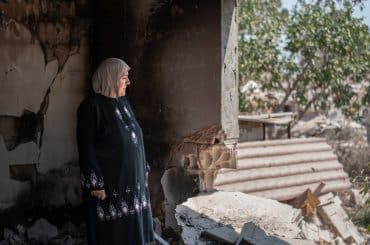
At least twenty-one people, many of them children, were killed earlier this week after a building collapsed in Gaza City, highlighting the dangerous conditions that still exist in the Gaza Strip. The building, like much of the remaining infrastructure in Gaza, had been damaged by Israeli strikes in the war that began after the massacre of October 7, 2023, and which has now killed seventy-four thousand Palestinians. More than thirteen hundred of those deaths have occurred since last October, when a ceasefire between Israel and Hamas went into effect…We know that eighty-one per cent of the Gaza Strip is damaged or destroyed, and more than three hundred thousand housing units were completely destroyed during the war, in addition to schools and other infrastructure, like clinics, hospitals, and mosques….I was surprised to hear this directly from U.N. personnel, about peanut butter not being allowed into Gaza**. So the people are striving to restore some sort of normal life, but they cannot do this because, first of all, hundreds of thousands of children are not going to school for the third year in a row, and the universities are destroyed, and there is unprecedented internal violence among the people in Gaza….they are allowing chocolates and they are allowing sugar into Gaza, but they do not allow something like peanut butter, which is nutritious. …There is no single sewage network that is still working. …the areas that Israel took control of after the ceasefire were the food basket of the Gaza Strip. And now the agricultural production level is, like, three per cent to five per cent of the level that it was before. So in some areas, Gaza was once self-sufficient, in terms of producing olive oil, olives, zucchini, eggplants, cucumbers, and peppers, and of course tomatoes. And at some points in recent years they were exporting tomatoes to Israel. So all of this is gone, and Gazans are not able to produce any kind of food for themselves. So they have to import it, and then that has to be under Israeli control….
What Life Is Actually Like in Gaza Today | The New Yorker
**
Israeli authorities have also classified some food items, like peanut butter, as “luxuries” that are not being allowed in.
[UN: Sept.19] Waltz O.K.’d for UN Post, Isr
I consider it not only a form of Nakba denial to characterize the ethnic cleansing of Palestinians as “voluntary migration,” but also an argument that risks indirectly distorting the historical reality of the Holocaust.
But as Herzl put it: “The antisemites will become our most dependable friends, the antisemitic countries our allies.” Just look at the neo-Nazis within Germany’s AfD. Their support for Israel is not rooted in a love of Jews. They admire Israel as a model for the kind of Germany they would have wanted beyond 1945, and who portrayed its genocide as “self-defense”, as they AFD does in Israel’s case nowadays.
I’ve often remarked here about the breathtaking irony of how Hamas’ vicious strike of October 7, 2023, brought far greater horror, tragedy and devastation to Gaza than it did even to Israel, but it would be supremely poetic if it were to lead to the eventual depopulation of the Strip. I don’t think that’s a very likely outcome, however, because Egypt will not permit it.
There is a need for additional political allies and a discussion on strategies to get to a better future.