

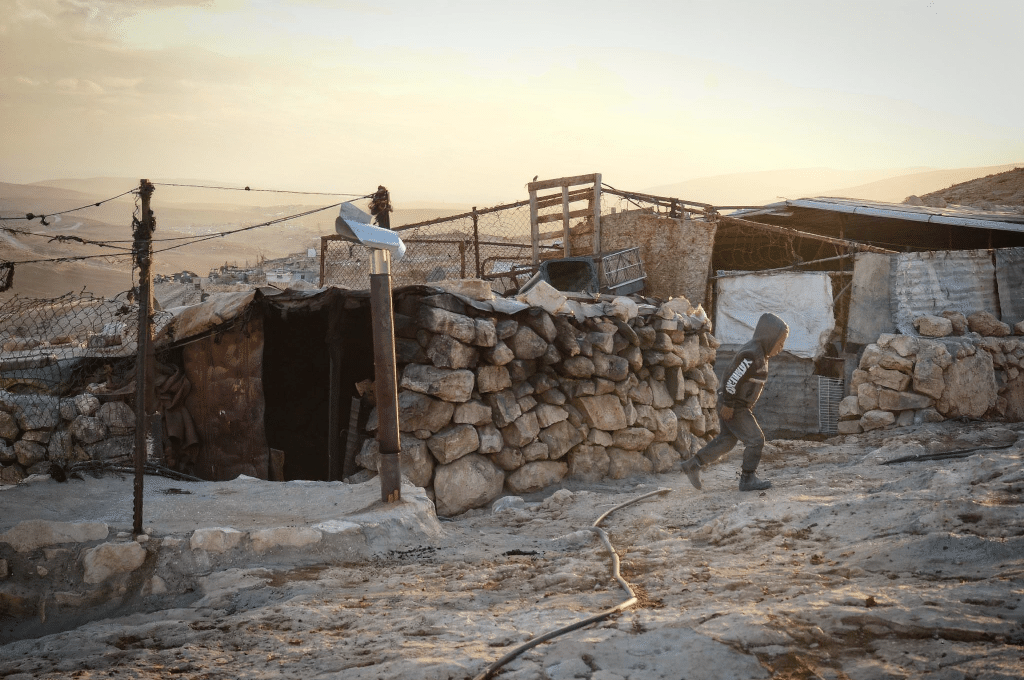
Palestinians in Masafer Yatta, in the south Hebron hills, are facing repeated water cuts after Israeli settlers damaged infrastructure supplying water to families in the area. According to Hebron’s governor Khaled Dudin, this attack follows a persistent pattern of settlers directly targeting the water supply, now for the fifth time.
Masafer Yatta is a 36-square-kilometer semi-desertic hilly area in the South Hebron region of the occupied West Bank. It directly overlooks the Naqab desert and extends west to the edge of the Dead Sea Valley. The hills are adjacent to the 1949 Armistice line, known today as the Green Line and viewed internationally as the borders of Israel proper. This strategic location makes it crucial for urban and agricultural growth south of the West Bank. For Israel, Masafer Yatta is treated as a buffer zone separating Israel proper from the deeper Palestinian demographic presence — a zone that needs to be emptied of Palestinians.
Last Saturday, during a field visit to Masafer Yatta, governor Dudin told the media that 1,600 Palestinian families within these 14 Palestinian hamlets are facing difficult living conditions due to damaged water lines, with families forced to rely on water tanks. Dudin also pointed out that water lines had been previously rehabilitated with the support of international organizations.
The Israeli settlers’ attacks on Palestinians’ means of life in Masafer Yatta has been ongoing since before October 2023, but has escalated in the past three years, and particularly in the past weeks. Sami Hureini, local activist and resident, told Mondoweiss that “the villages of Masafer Yatta have come under a relentless wave of attacks by settler groups, but also of demolitions by the Israeli army itself.”
Hureini said that there is no real infrastructure for services in Masafer Yatta, because the Israeli army doesn’t allow it. “In the past years, the communities were able to extend one water line from the edge of the zone where the Israeli army imposes strict control, and reached all 14 villages,” Hureini said. “But Israeli settlers kept damaging it, and sometimes the Israeli army bulldozed it.”
The main water line in the area was extended in 2018. It was first cut by the Israeli army’s civil administration in 2019, but was fixed by the joint municipality of Masafer Yatta. It was then partially damaged by Israeli settlers and fixed again multiple times.
In January, the Israeli army cut it again, and since then, it was damaged five times by Israeli settlers or the army.
The demolition of Palestinian property in Masafer Yatta has intensified since 2023, but more particularly since the beginning of 2026.
The area under strict Israeli military control was designated as a “firing zone” (areas in the West Bank that are off-limits to civilians and controlled by the Israeli army) in 1980, and Palestinians are not allowed to build or develop infrastructure around their homes. Palestinian families have been engaged in a legal battle with the Israeli army in Israeli courts for over 20 years for their right to live in their villages. In May 2022, the Israeli court gave its definitive ruling on the case — against the Palestinian residents, hence green-lighting their expulsion. This expulsion, Hureini affirmed, has been happening in a gradual, but accelerating manner since before the ruling.
Two weeks ago, Israeli forces demolished multiple built structures in Fakhit, a hamlet that is home to 70 residents and 12 farming families, leaving 30 people without housing. According to testimonies published by the Arabic news site Alaraby Al-Jadeed, Israeli forces gave residents only 20 minutes to evacuate. In the past two days alone, Israeli forces conducted 24 demolitions in three villages: Fakhit, Tabban, and Jinba, leaving 300 people without homes.
“People did not leave,” Hureini explained.“They stay in tents and caves that they have cleaned and made into living spaces, but living conditions are very dire, and are getting worse every day.”
Hureini also pointed out that Israeli settler groups have been stealing the water from Palestinians’ water wells, and that many of the people in the area have been forced to sell part of their livestock. Palestinian families in Masafer Yatta are mostly livestock herders who depend on sheep to make a living. Nidal Younis, the mayor of Masafer Yatta, told Mondoweiss that “in addition to the human consumption of water in Masafer Yatta, there are over 4,000 livestock that need water supply.”
This is not the first time that Palestinians in Masafer Yatta have faced water shortages because of Israeli damage to water lines. In December 2023, Israeli settlers damaged a waterline that serviced the hamlets of Isfaya, Maghayer al-Abid, and Tuba. In May 2025, Israeli army forces demolished seven water wells and 10 water tanks in the hamlet of Khalet Al-Dabe’.
‘The aim is to make people leave‘
According to local mayor Nidal Younis, the joint municipality for Masafer Yatta was able to connect the main water line for all of the 14 villages in 2018 with the help of European funding, providing high-quality water at an affordable price. “In early 2019, the Israeli army’s civil administration cut the line for the first time, and later Israeli settler groups damaged it again in the same year, but we were able to fix it every time,” he said.
“This time it is more difficult, as the escalating demolitions and restrictions by the Israeli army in Masafer Yatta make new attempts to fix the water line almost futile, and people are left relying on old wells, which settlers repeatedly damage or steal water from, and on overpriced water tanks that are very difficult to get to the remote areas in Masafer Yatta.”
Masafer Yatta is not the only place where Palestinians face water restrictions by Israeli forces or settlers. Since 2025, Israeli settler groups have repeatedly damaged water pumps at the Ain Samia spring east of Ramallah, which provides running water for 20 villages. Last May, Israeli settlers took over the Ain Al-Auja spring, northeast of Jericho, depriving Palestinian farmers of a vital irrigation source. Currently, 47 Palestinian families are left without access to water as a result of Israeli military infrastructure projects in the east of Tubas, in the northern Jordan Valley.
These patterns have been denounced by Amnesty International, and by Israel’s main human rights group B’Tselem who called it a “systemic, cruel campaign to deprive the most vulnerable Palestinian communities in the hottest, most arid parts of the West Bank of their water sources.”
In September 2011, the Emergency Water, Sanitation and Hygiene group (EWASH), a coordination body consisting of 28 international and local NGOs as well as UN agencies published a joint report with the Palestinian human rights group Al-Haq, stating that Israel’s water restrictions on Palestinians were a means to displace Palestinians from their lands.
For Nidal Younis, it is a clear policy with a clear aim. “People in Masafer Yatta are holding on to their land against all odds,” he said. “But steadfastness in these conditions becomes more difficult every day. The aim is to make people leave, the Israeli occupation doesn’t want anything to do with Palestinians in this area.”
Younis explained that the water line and the water wells had been rehabilitated with funding from the European Union, and that they have been damaged repeatedly since January, either by Israeli settlers or the Israeli army. “These wells and the water line provided water to the population for six shekels [about $2] for the cubic meter, which is affordable, and in good quality, but now, access to water has become a real challenge for every family in Masafer Yatta, especially the most remote places.”
“The village of Jinba, for example, is located deep in the so-called firing zone, at 24 kilometers from the nearest town with services,” the mayor explained. “This makes it difficult even for water tanks to reach it, since the Israeli army has blocked most roads from reaching the area.”
The mayor added that the roads in question are little more than rugged dirt paths that cut through the hills, and that Israeli settlers have established 13 settler outposts throughout Masafer Yatta.
Masafer Yatta’s ‘firing zone’ is 35 square kilometers wide. Located in the southernmost tip of the West Bank, its herding communities in the 14 villages are the only Palestinian presence in the area. Israel claims that Palestinians haven’t had a “permanent presence” in Masafer Yatta prior to 1980, ignoring the fact that the seasonal relocation of families is their ancestral way of life, and that they are the owners of grazing and farming lands there, most of which have been occupied by Israeli settlers since 2023.
The ‘firing zones’ play a central role in Israel’s plans to expand settlements in the West Bank. As was revealed in the declassified minutes of a 1979 meeting between the World Zionist Organization then-Israeli agriculture minister Ariel Sharon, where he said that ‘firing zones’ in the West Bank would be used as “land reserves for settlements.” Israel declared Masafer Yatta a ‘firing zone’ the following year.
Freedom and Despair: Notes from the West Bankby David Shulman
Interweaving powerful stories and deep meditations, Freedom and Despair offers vivid first-hand reports from the occupied West Bank in Palestine as seen through the eyes of David Shulman-an experienced Israeli peace activist who has seen the Israeli occupation close up as it impacts on the lives of all Palestinian civilians….Alongside a handful of beautifully written and often shocking tales from the field, Shulman meditates deeply on how to understand the evils around him, what it means to persevere as an activist decade after decade, and what it truly means to be free. The violent realities of the occupation are on full display. We get to know and understand the Palestinian shepherds and farmers and Israeli volunteers who face this situation head-on with nonviolent resistance.
Buy Freedom and Despair: Notes from the West Bank Book Online at Low Prices in India | Freedom and Despair: Notes from the West Bank Reviews & Ratings – Amazon.in
“The aim is to make people leave.”
Since 1948 they call it “voluntary emmigration”.
Juan Cole’s invaluable Informed Comment blog has an excellent article today by Dutch Holocaust survivor Anne-Ruth Wertheim:
https://www.juancole.com/2026/09/holocaust-forbidden-comparison.html