

Before 2023, Mahmoud Dweima, 75, would look forward to September and October more than any other time of year.
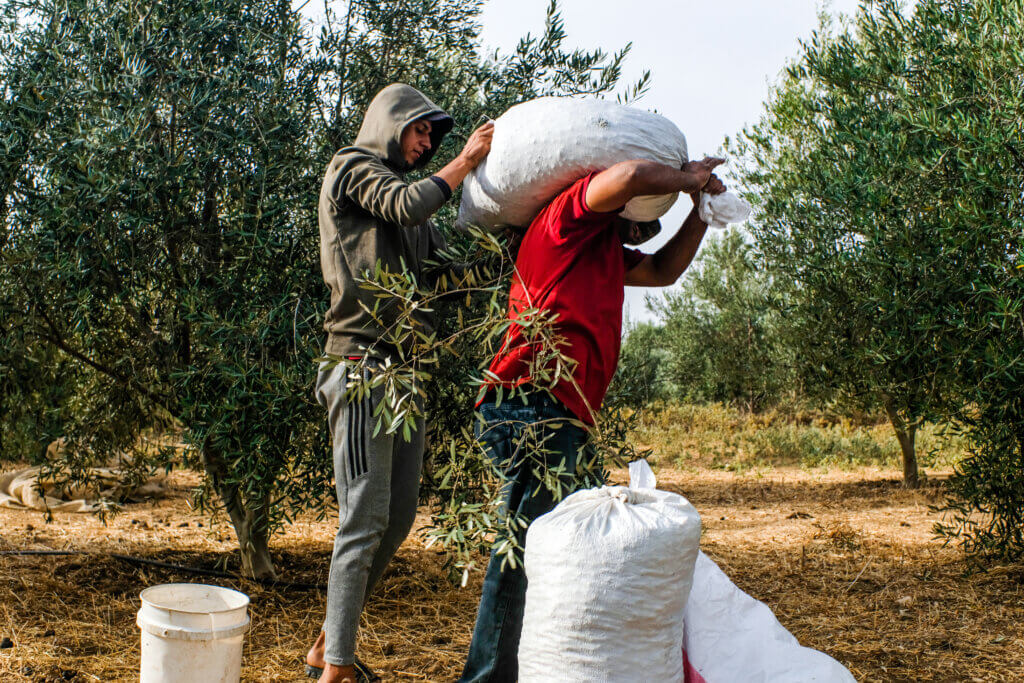
When the olive harvest arrived, he would gather his sprawling family, all 14 sons and daughters, and their children, and prepare for a day of agricultural work that resembled a family picnic.
They packed tall ladders, plastic sheets and tarps to spread beneath the olive trees, buckets for collecting the olives, and enough food to last the day. They brought a small portable gas stove, tomatoes, potatoes, olive oil, za’atar, and bread. Then, early in the morning, they would leave their home in Gaza City’s Shuja’iyya neighborhood and head east toward Juhr al-Dik, where Dweima owned a plot of land planted with over 200 olive trees.
The journey was barely seven kilometers, but Dweima remembers the anticipation around the harvest felt as if theywere traveling from one country to another. The family waited for it all year.
Like thousands of Palestinian families who own olive trees, the harvest was not simply about collecting a crop. It was a season unto itself, a time when families gathered outdoors from dawn to dusk, eating together, working, and returning home with buckets and sacks full of olives.
Today, when October rolls around, Dweima’s family has no olive trees to harvest.
For the third consecutive year, that season has all but disappeared from Gaza. Israel’s war has devastated Gaza’s olive sector, destroying groves, uprooting trees, damaging olive presses, and cutting farmers off from large areas of agricultural land. Much of Gaza’s most productive olive-growing land lies in the eastern parts of the enclave, including areas now behind what has become known as the ‘yellow line’, which demarcates over 64% of Gaza that is now under Israeli military control, and where Palestinian landowners are prohibited from reaching their property.
For farmers like Dweima, the destruction has meant far more than the loss of a crop. A vital source of income cultivated over decades and making up an entire seasonal way of life has been erased, severing families from land passed down and cared for across generations and interrupting one of the most deeply-rooted social rituals in Palestinian life.
According to Gaza’s Ministry of Agriculture, the Strip has lost roughly 90% of the land that was once planted with olive trees. The ministry says the number of olive trees has fallen from around 2 million to approximately 150,000, while annual olive production has plunged from about 40,000 tons to roughly 5,000 tons. Olive oil production, meanwhile, has fallen from approximately 5,000 tons annually to around 700 tons.
In July 2026, Palestinian Agriculture Minister Rizq Salimiya said that more than 1.6 million olive trees had been destroyed in Gaza during the genocide.
For Dweima, those numbers can be measured in the disappearance of every tree he once owned. “Not a single branch is left,” he said. His land was completely bulldozed.
Dweima had spent decades tending his trees, watching them mature and eventually bear fruit. He speaks of them in almost familial terms: he raised and cared for them as his own sons until they began producing fruit like children growing into adulthood.
Before the war, his grove yielded between 70 and 80 containers of olive oil per year, each holding about 16 liters. The family also harvested large quantities of olives for pickling, some of which they kept and others they distributed among neighbors. Giving away part of the harvest was itself part of the tradition.
“Every year, the oil we produced was enough for me to cover living expenses until the next season,” Dweima said. “I would give dozens of pounds of olives to the neighbors, the people who would see us leaving for the harvest and then returning with sacks full of olives.”
For Dweima, this was not simply generosity. It was part of the culture surrounding the harvest. Olive growers, he said, believed that sharing the crop with neighbors and loved ones brought blessings to the remaining groves.
The olive tree, for Dweima and his family, was never merely an agricultural crop. “It represented heritage and identity,” he said.
An uprooted economy
The destruction of the harvest has also affected Dweima’s economic security.
For much of his life, he depended on the olives he harvested, the olive oil he sold, and the olives he preserved. Selling olive oil alone could bring him between $13,000 and $15,000 a year, in addition to income from selling the fruit itself. That annual income is now gone.
Since the war began, Dweima said, his financial situation has deteriorated year after year. Today, even when olive oil is available in Gaza, he says he cannot afford to buy a single 16-liter container. And even if he could, he says, it would not be the same. He cannot find the pure oil he once pressed from his own trees.
Shaher al-Rifi, director general of rural development at Gaza’s Ministry of Agriculture, describes the transformation of the olive sector in similarly stark terms.
“All the lands that were rich with olive trees are gone,” al-Rifi told Mondoweiss. “Inside the yellow line, what remains are small plots here and there with some olive trees.”
According to al-Rifi, Gaza had approximately 44,000 dunams (4,400 hectares) of land planted with olive trees in 2022. The sector produced around 31,000 tons of olives destined for oil, which was pressed in 41 olive presses across the Strip.
Today, he said, only about 5,000 dunams of olive groves remain across Gaza, producing approximately 4,000 to 5,000 tons of olives. Some of the fruit goes to presses for oil production, while the rest is preserved for eating.
Only nine olive presses are currently operating, al-Rifi said, concentrated in Gaza City and the central Gaza Strip.
Keeping those presses running has become difficult. The Ministry of Agriculture is working with other organizations to reduce operating costs, al-Rifi said, as the presses contend with Gaza’s energy crisis and severe fuel shortages. A working olive press can require roughly 20 liters of diesel an hour, fuel that is both scarce and extraordinarily expensive in Gaza.
The ministry, therefore, treats the surviving presses as strategic facilities, al-Rifi said, because they form an essential link in what remains of Gaza’s agricultural production chain.
But the economic importance of the olive season extends far beyond farmers and press owners.
Before the war, the season generated more than 22,000 daily work opportunities across Gaza, according to al-Rifi. Workers were needed to pick olives, transport the harvest, operate presses, package the oil, and market and sell the final products. The residue left after olives were pressed was then used for heating, fertilizer, and soap production, creating additional use from the crop.
For a territory with few natural resources, al-Rifi said, agriculture had long been one of Gaza’s most important productive sectors. He described the olive tree as a witness to the Palestinian experience itself, a tree endowed with a cultural and symbolic memory that extends far beyond its economic value.
“Now, all of that is gone,” he said.
A community built around the harvest
The olive harvest in Gaza was never confined to the trees themselves.
For two weeks, sometimes a month, the groves became gathering places. Families carried everything they needed to remain on their land from sunrise until sunset. Children played between the trees. Women sorted the harvested olives. Relatives and neighbors joined in. Meals were prepared and eaten outdoors.
The work was exhausting, but it was also a celebration.
For many families, the season embodied a connection to land and heritage, reproduced every year through small rituals: separating green olives from black ones, picking out the leaves, cooking lunch over a fire, taking the first harvest to the press, and tasting the season’s first oil.
In Beit Lahia in northern Gaza, 59-year-old Mazouna Abu Riyash once owned land planted with more than 40 olive trees and dozens of lemon trees.
Beit Lahia was renowned for its fertile soil and the diversity of its crops. Abu Riyash’s family cultivated several kinds of fruit, but the olive harvest remained special in its own way. Everyone wanted to participate.
Today, Abu Riyash is displaced in Deir al-Balah, in central Gaza. “The most beautiful time of the entire year was when we began harvesting the olive trees,” she said.
By harvest season, Gaza’s intense summer heat would have begun to fade. As the family worked, the air sometimes became cool enough that they would light small fires to sit around. Then they would cook.
One of the meals Abu Riyash most closely associates with the harvest is “galayet bandora,” a traditional Palestinian stew of tomatoes cooked in olive oil from last year’s season.
But another meal had to wait for the first oil of the season. Once the family had taken their olives to the press and brought back the fresh oil, they would prepare “musakhan,” a Palestinian dish made with bread, onions, chicken, sumac, and generous amounts of olive oil.
The meal would then be served at lunch for everyone working in the grove.
“We would prepare it there in the field, in front of everyone, and they would all eat together,” Abu Riyash said.
These memories, Abu Riyash said, “reveal what has been lost beyond the agricultural devastation itself. The rituals of the harvest were fundamentally social. They connected relatives, neighbors to families, and families to the land they cultivated.”
There have been a lot of events and programs this week on the 3rd anniversary of Oct7.
This documentary is worth watching. It’s about Soroka Hospital here in Beersheva (I can see it from my porch).
It includes footage from surveillance cameras on that day, other material and interviews. Doctors, nurses, Jews, Arabs, civilians, soldiers.
In Hebrew, with English subtitles.
https://www.kan.org.il/content/dig/digital/p-11412/s7/1106347/