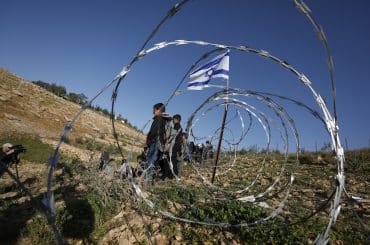
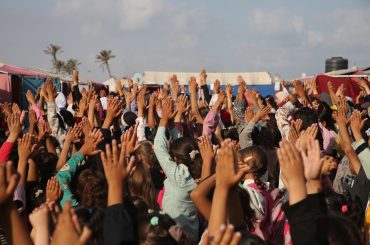
Ali Abu al-Ezz, 38, lives with his six children near the “Yellow Line” in Gaza City’s eastern Tuffah neighborhood. His children range in age from 13 to two years old. After they were displaced from their land following the demarcation of the Yellow Line, Abu al-Ezz pitched a tent for his family as close to their home in Tuffah as he could, hoping that one day they would be able to return.
The tent they live in is far from their daily needs and necessities. Food is difficult to reach, humanitarian organizations distributing water and meals are scarce, and medical facilities and schools are far away. When the new school year began last December, Abu al-Ezz did not send any of his children to attend. In fact, he rarely ever leaves the area, preferring to stay close to his wife and children.
Before the war, Abu al-Ezz’s children attended nearby schools regularly, while he worked as a taxi driver, heading out in the morning and driving until sunset to support his family. Today, the war has imposed an entirely different reality.
“The road to the schools is long and difficult, the streets are not fit for walking, and transportation is also hard to find,” Abu al-Ezz said. “I am afraid that if I send my children to school, a quadcopter will shoot and kill them, or their school will be bombed, and they will die. I decided to postpone all of their education until the war ends, when we can feel safe in our own country again.”
The war has affected families beyond their homes and how they obtain food and water. It has altered the very meaning of family life and the roles that parents and children are expected to play within it.
Despite the blockade and hardships that had long shaped life in Gaza before the war, families could still maintain a semblance of an ordinary social order. Children went to school and played outside together. Even if they made playgrounds and football pitches out of busy streets and lots, they still had space to live their childhood.
That balance has been shattered.
For many fathers, parenthood has become an unending attempt to keep their children alive. Mothers cook over open fires and devise ways to keep rodents out of tents while trying to maintain some measure of cleanliness in conditions that make it nearly impossible. And children, among those most profoundly affected by the war, have been forced into roles that once belonged to adults.
“Some days, I leave in the morning to try to make some money or find some work for the day,” Abu al-Ezz said. “By the time I return with whatever I have earned and some food for my children, my eldest sons will have taken care of other things.”
His sons – Ibrahim, 13, and Hassan, 11 – are responsible for finding drinking water for the family.
“These were never my children’s responsibilities,” Abu al-Ezz said. “But the war has forced these children to carry responsibilities far beyond their age, responsibility for the family itself and for finding the things we need to survive.”
The boys fetch water and search the streets and rubble for pieces of wood to burn for cooking. They return during the hottest hours of the day, walking under the sun while carrying jerrycans of water that, their father says, seem to weigh as much as they do after months of hunger.
Before the war, this time of year sounded very different inside Abu al-Ezz’s home. His children would return from school, filling the house with stories about their classmates and teachers. A new school year meant excitement over new books, school bags, and stationery.
“We lived under siege, and our circumstances were difficult, but our lives were beautiful,” he said. “We lived in our homes. We visited our relatives, and they visited us. We went to the sea to relax. Every month, we would have barbecues on the beach or on our roof. We were happy with the little we had, and we thanked God for what He gave us.”
For Abu al-Ezz, deprivation has penetrated almost every aspect of his family’s life. The infants cry from hunger while their parents search for formula, the children suffer as their daily needs cannot be met, and even his wife’s personal necessities have become difficult to obtain.
“We live as if we have been cut off from the world,” he said. “As if we do not belong to this modern age. It feels as though we are living in the Stone Age, not 2026.”
“And the strangest thing of all is that the world watches us and sees this, yet nothing changes in the miserable life we are living,” he continued.
When children dream of food and shelter
The war has changed not only what children do, but also what they dream about.
For Ibrahim, Abu al-Ezz’s 13-year-old son, aspirations have narrowed to the most basic elements of a livable life.
He dreams of leaving behind the makeshift tent his family assembled from scraps of fabric and wood. Every winter, when heavy rain floods the area, the family risks losing their only shelter. On some nights, they sleep sitting upright on plastic chairs to keep themselves above the water flooding the tent from all sides.
Ibrahim dreams of a Qatari tent, the name Gazans commonly use for the dome-shaped tents that are considered better able to withstand winter rain because of their sturdier fabric and construction.
But his dreams extend beyond shelter, for the simplest things. “I dream that one day we will eat three good meals,” Ibrahim said.
He also dreams of going to his grandfather’s house and playing with his cousins, and of having just one more of the evenings his father once organized on Gaza’s Mediterranean shore: the entire family gathered together for a barbecue by the sea.
Now Abu al-Ezz’s extended family has been scattered. Relatives live far from one another, each in a different tent, each confronting their own conditions of displacement and survival.
A family scattered across Gaza
The transformation of family life in Gaza is not limited to children or their parents. The rituals that once held extended families together, from visiting relatives’ homes to evening gatherings to sharing meals and stories, have all been disrupted.
For older women in particular, the contrast between life before and after the war can be stark.
Before the war, many spent their later years surrounded by children and grandchildren, living in established family homes and enjoying the companionship of nearby relatives of their generation.
Hanan Abu Arab, 63, was one of them.
Displaced from eastern Khan Younis and now living in Deir al-Balah, Abu Arab once had a five-story house where her children and grandchildren gathered. In front of it was a garden where she sometimes received close friends and relatives. They would sit beside rose bushes she had planted herself, spending hours together in the evening, talking and drinking tea.
Today, she hesitates to even name her new home as a tent. “It is more like a room wrapped in cloth,” she said. “It is not properly enclosed.”
During the winter, rain enters from every direction. Sometimes, she said, she has to leave and stand by the roadside, searching for any roof or overhang that might shelter her from the rain.
“My house was a landmark in Bani Suheila because of how beautiful it was,” Abu Arab said. “My relatives who lived nearby would come almost every day. We stayed up together, ate fruit, and talked for hours. Everyone who entered my house would tell me how beautiful it was.”
“All of those traditions are gone,” she added.
Abu Arab sees this fragmentation as one of the less visible consequences of the war. Everyone, she said, is pushed toward the same calculation: Protect yourself and your children, stay away from danger, leave the tent as little as possible, and hope that, by doing so, death will pass you by.
“This is one of the hidden goals of this genocide,” she said. “For the Israeli army to tear apart everything that connects Palestinians, everything that creates a social fabric and solidarity in Gaza, and replace it with this constant, urgent need for individual survival.”