

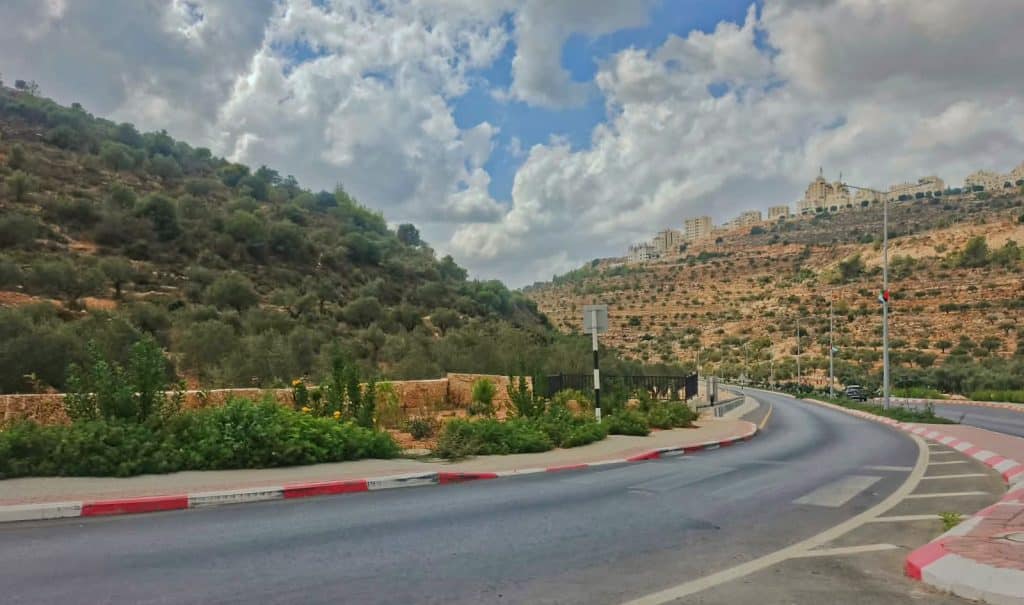
The urban area of Ramallah, the main commercial and economic hub of the occupied West Bank and the seat of the Palestinian Authority (PA), is now in the crosshairs of Israeli settler expansion. According to a report by Haaretz, an Israeli plan is underway to “allow” Israeli settlers to drive on a road in the northern part of Ramallah’s urban area, a main thoroughfare for Palestinians that connects Ramallah’s city center and its northern suburbs.
Haaretz reported that the Israeli army has begun preparations for settler access to the road, which are expected to include military outposts and checkpoints that would fragment the city and disrupt Palestinian movement within and around it. For Palestinians in Ramallah, this move is not a simple case of urban planning or rerouting of traffic, but yet another settler strangulation of Palestinian existence in the West Bank that is making daily life impossible.
The road in question, known in Israel as “Road 463,” is 10 kilometers long, running from the west Ramallah village of Ain Qinia to the Jalazon refugee camp in the east.
The road currently connects the heart of Ramallah to seven towns, a university, a school, a major hospital, and a sewage treatment plant on its northern edge. Today, under the jurisdiction of Ramallah’s municipality, the road is well-served with trees, side drains, new pavement, and roundabouts. The visual absence of Israeli settlers along the tree-lined road gives Palestinians a rare experience of normality, residents say.
“It is the only drive where I feel like I’m in a normal country,” Yousef Masalmeh, a taxi driver from Birzeit, north of Ramallah, tells Mondoweiss. “I use this road every day, and I drive from Birzeit to the Ramallah city center in just 15 minutes, which makes it so easy for people to live in Birzeit, al-Rihan, or Jifna, while working in Ramallah, and that’s a privilege.”
A privilege, because unlike elsewhere in the West Bank, Palestinians in the immediate surrounding metropolitan area of Ramallah, especially the residential areas north of the city, had been able to move between the city center and its suburbs without encountering Israeli checkpoints or settler attacks — that is, as long as they stayed within Ramallah. This freedom of movement does not apply to Palestinians who live a few kilometers outside of the city, including the majority of the governorate’s 80 villages, who have to deal with daily road closures, iron gates, Israeli military checkpoints, or threats of Israeli settler attacks on the road.
Cutting off a rare space for Palestinian urban development
The Palestinian areas served by the “Chinese Road,” as locals call it — due to partial funding of the road infrastructure by the Chinese government — are among the few spaces in the West Bank that have seen urban expansion, not in small part because of the road’s access.
Most major cities and towns in the West Bank are choked off by Israeli settlements, settler roads, military checkpoints, and other movement barriers imposed by the occupation. That reality has led to overcrowding in city hubs like Ramallah, driving up prices and making most cities unaffordable for Palestinians, particularly young professionals. The suburbs surrounding the Chinese Road have offered a small relief from sky-high prices in the city, offering a rare chance for Palestinians with the financial means to purchase property.
Eyad Shoufani, a real estate agent, sells apartments to middle-class Palestinian families in the al-Rihan neighborhood, which sits just north of Ramallah along the road, just ten minutes from the city center by car. Al-Rihan was a pre-planned residential area built between 2009 and 2012 by a private Palestinian investment firm. Shoufani’s customers, he says, are mostly young Palestinian professionals working in Ramallah, many of whom are from other parts of the West Bank and need to live close to the city. Prices for apartments in the neighborhood range from $100,000 to $300,000, with long-term monthly payment plans available. For comparison, an average apartment in Ramallah can cost anywhere from $170,000 to $1 million. For Eyad, the Israeli plans for the road will kill the chances of many Palestinians to own a home there.
“Apartment prices are already high in Ramallah, and businesses like mine are meant to offer some kind of solution for middle-income Palestinians who want to live in Ramallah,” he told Mondoweiss. “If the road becomes closed, entirely or partially, the prices will at least double, because the space for more urban buildings will be drastically limited around the city…and buying an apartment here will become available only for the most wealthy Palestinians.”
“Today, I was speaking to an employee at a bank in Ramallah, who has been looking for an apartment, and he told me that the current prices are just too high for him,” Shoufani said. “He is thinking of leaving the country altogether, because he can’t afford a home here, and if settlers’ plans go ahead in Ramallah, this will be the case for many more people like him.”
‘Taking the road back to Jewish hands’
The push to open the road to Israeli settlers has been driven by settler groups, according to Haaretz, under the slogan of “Taking the road back to Jewish hands.” This is because the road was originally carved out by the Israeli settlement council of Benyamin in 1994, without the approval of Israeli planning authorities. As other roads opened after the signing of the Oslo accords in 1993, this one was meant to not only to shorten the distance for settlers travelling between the settlements of Dolev in the west, adjacent to the Palestinian village of An Qinia, and the settlement of Beit El in the east, adjacent to the Jalazaun refugee camp, but also to limit the size of land to be returned to the Palestinian Authority’s self-administration.
The Israeli army’s chief of staff at the time opposed allowing Israeli settlers to use the road, which was dubbed Road 463, but then-Israeli Prime Minister Shimon Peres approved it. Then, during the Second Intifada between 2000 and 2005, Israeli forces blocked the use of the road to both Israelis and Palestinians, before gradually allowing Palestinians to use it in the years following the Intifada, as urbanization north of Ramallah resumed and later experienced a boom.
As the road became a busy Palestinian thoroughfare, especially with its easternmost part — crossing through what became practically an extension of Ramallah’s urban expanse — Israeli settlers stopped using it, and the Israeli army closed it to Israeli circulation altogether.
In recent months, Israeli settler groups have staged several “visits” to the area along the road, placing Israeli flags on the roundabouts, later to be removed by Palestinians, and performing group dances at a city park near the road. Haaretz quoted an Israeli army source confirming that the army “is working to put in place special security arrangements for future travel on the route.” For Palestinians, opening up a road to Israeli settlers does not mean having to share a road. It means new checkpoints and iron gates will come first, and then settlers will follow.
The Ramallah municipality, which currently maintains the road, has announced steps to counter Israeli plans. These include, according to the municipality’s statement, organizing social and cultural activities in the area and increasing infrastructure and maintenance work there to strengthen the Palestinian presence.
But Palestinians’ limited options to protect their movement on the vital road seem to be an uphill battle against Israeli preparations. Haaretz reported that Israeli media quoted Israel Ganz, the head of the Yesha council, which groups settlement councils across the West Bank, confirming that opening the road to settler traffic had been approved in principle, that a budget had been allocated, and that the army had already begun preparing. The fact that part of the road runs through areas classified as Area C — the 60% of the West Bank that falls under Israeli military control as part of the 1993 Oslo Accords — provides the administrative grounds for the Israeli army to open the road for settlers. But the reality is that the majority of the road used by Palestinians falls within Areas A and B — the 18 percent and 22 percent of the territory falling, respectively, under full PA administrative and security control and joint Israeli-PA control.
A growing pattern
This is not the first time that Israeli control is planned inside a Palestinian city’s urban parts that fall within Area A. In fact, it is already a reality on the ground in other West Bank cities. In Hebron, the Old City has been under direct Israeli military control for decades, alongside the presence of 400 Israeli settlers, in the heart of the largest Palestinian city in the West Bank. Last May, in Jenin, the Israeli army established a military base in the Jabriyat neighborhood, inside Jenin city. In June, Israeli settler groups announced plans to establish 100 settler outposts in areas classified as Area A. These plans were endorsed by Israel’s hardline Finance Minister, Bezalel Smotrich.
But giving Israeli settlers access to this road in Ramallah would have much larger repercussions, as the city represents the center of the PA’s self-government regime, while serving as a work hub for countless humanitarian organizations, cultural institutions, and international diplomatic missions. Ramallah is also the center of finance and commerce in the West Bank, and has a mixed population of Palestinians from across the entire territory, in addition to Palestinian Jerusalemites and Palestinians with Israeli citizenship.
Despite the almost-daily Israeli army raids into Ramallah’s neighborhoods, the city has been considered a prosperous bubble of Palestinian stability by many Palestinians, although it has drawn considerable criticism for what some say is a normalization of the Israeli occupation.
The planned settler road would stand to shatter that normalcy, as any Israeli expansion into this major urban area would have significant symbolic and political implications for Palestinians and the perception of the PA’s efficacy.
Since October 2023, Israeli settlers have taken over 1 million dunums (1,000 square kilometers) of Palestinian land across the West Bank and established between 100 and 150 outposts, many of which have been recognized by the Israeli government. This takeover has displaced at least 107 Palestinian communities. In May, the Israeli anti-occupation group Peace Now reported that the Israeli government had allocated $270 million to build more roads to connect Israeli settlements and settlement outposts across the West Bank.

The threat of pariah status just seems to embolden Israelis. However, another small advance reported in today’s Guardian:
https://www.theguardian.com/society/2026/oct/02/royal-college-of-nursing-cuts-ties-with-israeli-drug-company