Israel regards any kite flown in Gaza as an “act of war” and has ordered the army to treat them like drones. “I don’t know what we can do that won’t anger Israel,” says Muhammad Owais, 13, who struggles to understand the rules of this new reality.
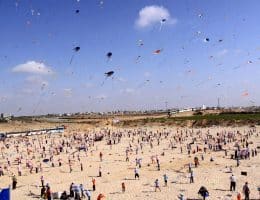

Israel regards any kite flown in Gaza as an “act of war” and has ordered the army to treat them like drones. “I don’t know what we can do that won’t anger Israel,” says Muhammad Owais, 13, who struggles to understand the rules of this new reality.
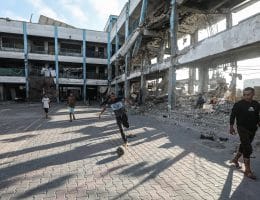
Children in Gaza used to aspire to become doctors or teachers, but today their dreams revolve around running a community kitchen, handing out aid, or leading a shelter. Yet even though the genocide rewrote their ambitions, it couldn’t erase them.
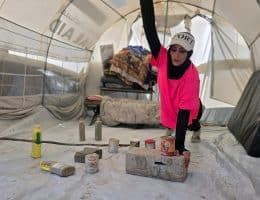
In Gaza’s displacement camps, survival has bred a new economy: a gym owner forges weights from empty cans, a supermarket owner turns baker, a housewife becomes a street vendor — each person rebuilding a livelihood from the wreckage of genocide.
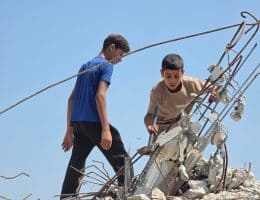
With reconstruction stalled in Gaza, boys as young as 14 are clearing the wreckage of destroyed homes by hand for as little as $10 a day. Often they are the breadwinners for their families and are forced to abandon their studies to work for survival.
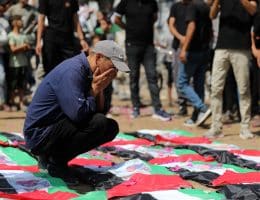
Nearly three years after a November 2023 Israeli airstrike buried them in the rubble, Gaza families recovered 112 of their dead and laid them to rest, including a mother still embracing her three children.
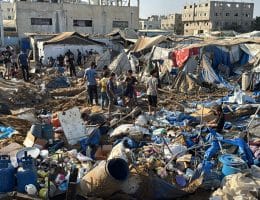
An Israeli strike destroyed two major medicine warehouses in Deir al-Balah, the latest Israeli attack on Gaza’s failing health system. Gaza’s Health Ministry says medicine shortages are now killing three cancer patients a day.

Hours after Donald Trump announced a “historic” agreement for disarming Hamas and Israel’s withdrawal from Gaza, Israel attacked Gaza, killing 19. Palestinians weren’t surprised. “We don’t trust Israel, and we don’t trust America,” said one resident.

Despite displacement, hunger, and the loss of their homes, Gaza’s students sat for their national high school exams and still came out on top.
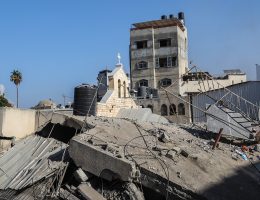
The church’s action follows resolutions by two other religious bodies at their summer meetings — the Presbyterian Church (USA) and the American Academy of Religion — both of which named Israel’s war on Gaza a genocide.
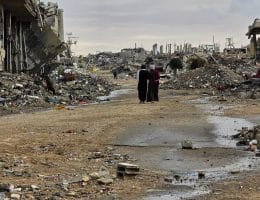
For nine days, Fatima Abu Khammash searched for her missing son across Gaza’s Israeli-controlled zone. When they refused to hand over his body, she crossed the line herself, finding a mother’s uneasy peace in what she carried back.