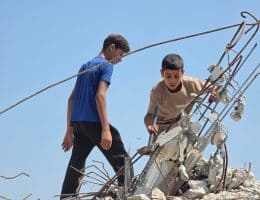
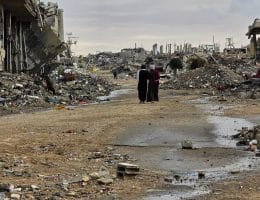
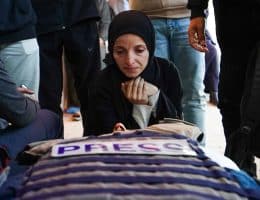
For decades, the General Secondary Education Examination, or “Tawjihi,” was one of Gaza’s most significant milestones. But now, for the third year, students are taking their exams with no classrooms, no reliable electricity, and barely enough food.
Every day that I report on Gaza, Gaza reports back to me. Its people, its streets, its memories, and its wounds — they all remind me that while I may be far from the land, the land has never been far from me.
Before the genocide, Gaza’s residents carried their TVs into the streets to watch the World Cup with their neighbors. Today, following a match requires electricity that many don’t have, and money that most people can’t afford.
Former detainees who spent time with the prominent Gaza doctor before his transfer to solitary confinement describe systematic beatings, dog attacks, and deliberate medical neglect, warning he may not survive.
Israeli soldiers shot three-year-old Rayyan Abu al-Ajeen in his father’s arms and mocked his father’s pleas as he cried for his dying son. The father says they were in the part of Gaza designated as “safe” for civilians during the “ceasefire.”
In Gaza, a ‘ceasefire’ means Israel can kill more than a dozen people in under 24 hours — and over 1,000 people since the ceasefire took effect in October 2025 — while the world remains silent.
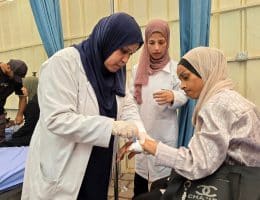
Health officials in Gaza say Israel is waging an aggressive campaign against Gaza’s healthcare system by deliberately calibrating restrictions on fuel and supplies to keep hospitals on the brink of collapse.
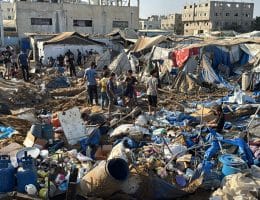
The Israeli army is targeting Gaza’s remaining residential blocks that were left standing after the ceasefire, leaving even more Palestinians homeless. “Fear has become a permanent guest in our homes,” one resident told Mondoweiss.
“He went for a walk and never returned.” Palestinians in Gaza describe the disappearance of their loved ones during the genocide and the open-ended agony of not knowing when they might see them again.